

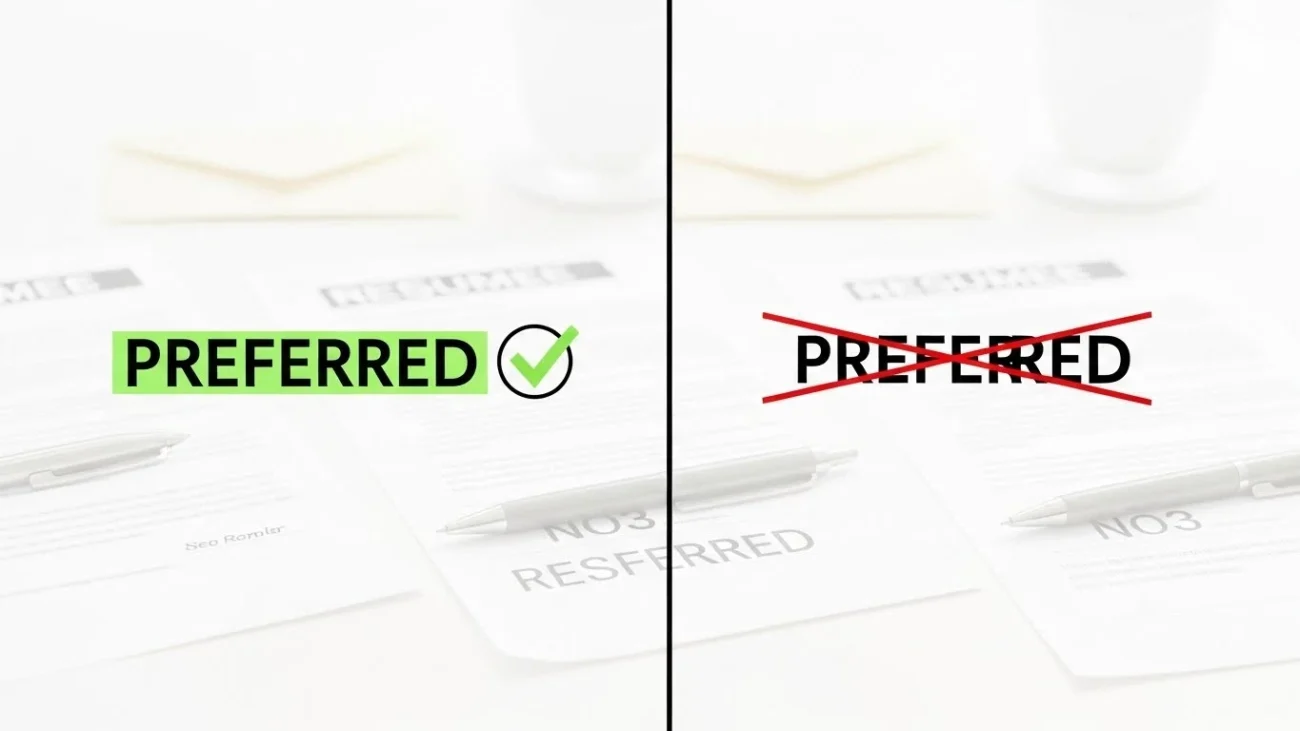
Many people search for preferred or prefered because this spelling mistake appears everywhere emails, resumes, academic writing, and social media.
At first glance, both spellings look acceptable. After all, English often drops or keeps letters in confusing ways. But here’s the problem: only one spelling is correct.
I’ve seen job applications rejected and professional emails lose credibility because of this single error. People usually make this mistake when adding -ed to verbs ending in -r, and English spelling rules don’t always feel logical.
This article clears the confusion completely. You’ll get a quick answer, a clear explanation of the spelling rule, British vs American usage, common mistakes, real-life examples, and practical tips.
By the end, you’ll never write prefered again and you’ll understand why.
Preferred or Prefered : Quick Answer
✅ Preferred is correct.
❌ Prefered is incorrect.
Examples:
- She preferred tea over coffee.
- This option is preferred by most users.
👉 Always use preferred with double “r”.
Read More : Scepter vs Sceptre: Meaning, Spelling, and Usage Explained
The Origin of Preferred or Prefered
The verb prefer comes from the Latin word praeferre, meaning to choose before. When English forms the past tense or past participle of prefer, it follows a spelling rule:
If a verb ends in a stressed consonant vowel consonant pattern, the final consonant is doubled before adding ed.
In prefer, the stress falls on the second syllable (pre-FER), so the final r is doubled.
That’s why:
- prefer → preferred
- referring → referring
- referral → referral
Prefered breaks this rule, which is why it’s wrong.
British English vs American English Spelling
There is no difference between British and American English for this word.
| Aspect | British English | American English |
| Base verb | prefer | prefer |
| Past tense | preferred | preferred |
| Incorrect form | prefered | prefered |
👉 Both follow the same doubling rule.
Which Spelling Should You Use?
Always use preferred, regardless of:
- Country
- Formal or informal writing
- Academic or casual context
Professional advice:
If you ever feel unsure, remember this rule:
Stressed syllable → double the consonant.
Common Mistakes with Preferred or Prefered
❌ This option is prefered by users.
✅ This option is preferred by users.
❌ She prefered online classes.
✅ She preferred online classes.
❌ My prefered choice is blue.
✅ My preferred choice is blue.
Memory trick:
- Prefer has two r sounds when spoken → two r letters when written.
Spelling accuracy matters even more in professional and academic contexts, where small errors can leave a negative impression. Words like preferred appear frequently in resumes, cover letters, surveys, forms, and official documents, making this mistake highly visible.
Recruiters, teachers, and editors often notice spelling errors immediately and may associate them with carelessness. Many learners wrongly assume English spelling is random, but stress-based rules like this one are consistent and predictable.
Once you recognize that verbs such as prefer, refer, occur, and admit double the final consonant when stressed, similar mistakes become easier to avoid. Using the correct spelling also helps automated grammar checkers, ATS resume systems, and search engines recognize your content accurately. In short, writing preferred instead of prefered is not just about correctness it’s about clarity, professionalism, and confidence in modern written English.
Preferred or Prefered in Everyday Examples
Emails
- Your preferred meeting time is noted.
Resume
- Preferred skills include communication.
Academic Writing
- The preferred method was selected.
Social Media
- Dark mode is my preferred setting.
Preferred or Prefered : Google Trends & Usage Data
Search data shows:
- Preferred dominates search results globally
- Prefered spikes as a spelling check query
- High confusion among ESL learners
Most searches come from:
- Students
- Job seekers
- Office professionals
👉 Users mainly want to confirm the correct spelling.
Comparison Table: Preferred vs Prefered
| Feature | Preferred | Prefered |
| Correct spelling | Yes | No |
| English rule | Follows doubling rule | Breaks rule |
| Accepted in exams | Yes | No |
| Used in dictionaries | Yes | No |
| Safe to use | Always | Never |
FAQs: Preferred or Prefered
1. Is prefered ever correct?
No, it is always incorrect.
2. Why is the “r” doubled in preferred?
Because the stress is on the last syllable.
3. Is this rule British-only?
No, it applies in both UK and US English.
4. Does “preferred” have two meanings?
It means chosen or favored.
5. What about preferring?
It also doubles the r: preferring.
6. Is this a common mistake?
Yes, especially in resumes and emails.
7. How can I avoid this error?
Remember: pre-FER → double r.
Conclusion
The confusion between preferred or prefered comes down to a clear spelling rule. Preferred is the only correct form, and it follows English stress-based doubling rules. Prefered is always wrong and should never be used in formal or informal writing.
There is no British vs American difference here both use preferred. Once you understand why the final r is doubled, this word becomes easy to remember.
Mastering small details like this improves your writing accuracy and helps you appear more confident and professional in English.

I am Michael Swan, an English grammarian known for explaining confusing grammar and word comparisons in a clear way. I focused on real usage, not just rules, helping learners understand why English works the way it does. My work simplifies complex language problems for everyday users.