

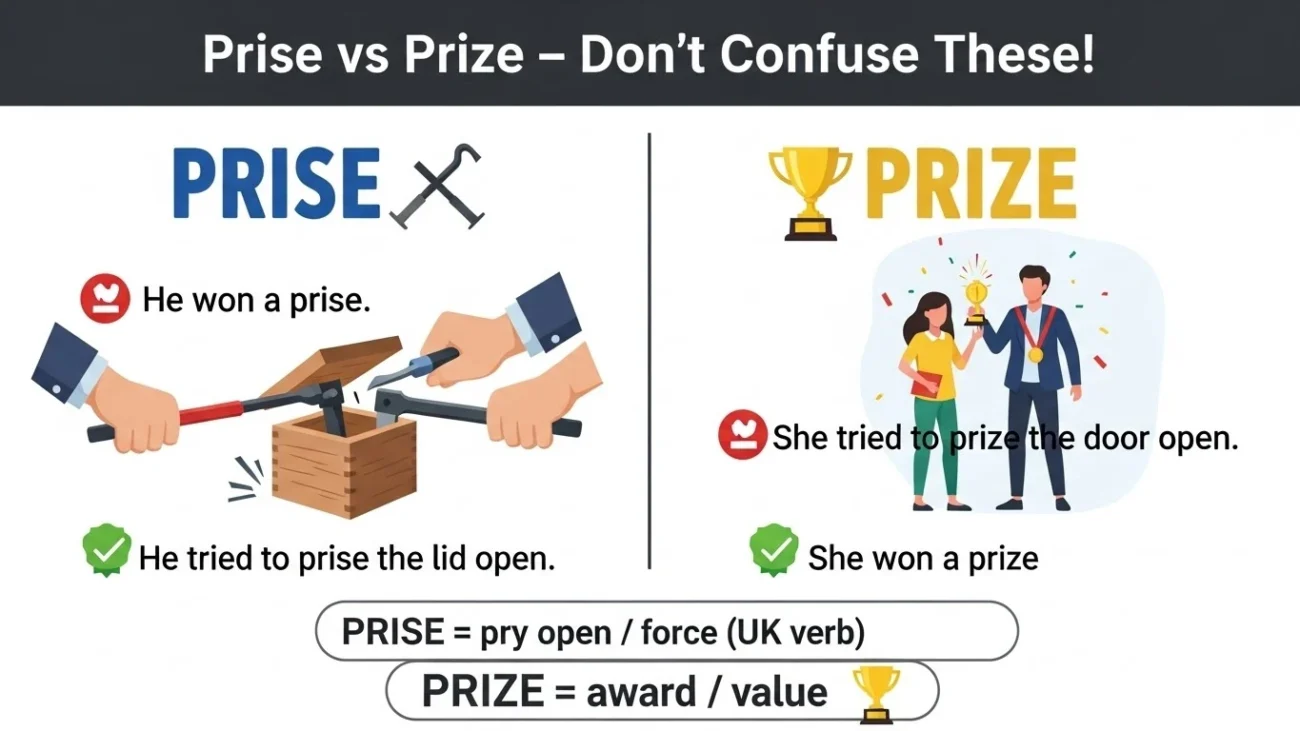
Many people search for prise or prize because these two words sound very similar but have different meanings.
Using the wrong one can make a sentence confusing or incorrect. For example, “He wanted to prise the award” is incorrect, while “He wanted to win the prize” is correct.
This confusion is common among English learners and writers who hear the word but aren’t sure about spelling. This article clears the confusion simply and clearly.
You’ll get a quick answer, learn the origin, see common mistakes, everyday examples, and expert advice.
By the end, you’ll confidently know when to use prise and when prize is correct.
Prise or Prize : Quick Answer
- ✅ Prise → (mainly British English) verb meaning to force open or extract
- ✅ Prize → noun meaning award or verb meaning to value highly
Examples:
- He tried to prise the lid off the box.
- She won a prize in the competition.
- I prize honesty above everything else.
👉 Force open/extract = prise
👉 Award/value = prize
Read MOre: Quite or Quit : Difference and Which One Should You Use?
The Origin of Prise or Prize
- Prise comes from Old French presier, meaning to value, estimate, or take by force.
- Prize also comes from Old French pris, meaning something taken or won.
Both words share a similar origin but evolved differently in English: prise became mostly a verb (UK), while prize became a noun and verb (US and UK).
British English vs American English Spelling
| Word | British English | American English |
| Prise | ✅ Used (verb) | ❌ Rare / uncommon |
| Prize | ✅ Used | ✅ Used |
👉 British English sometimes prefers prise as a verb, while American English almost always uses prize.
Which Word Should You Use?
Use prise when:
- Talking about forcing something open (mainly UK)
- Referring to extracting something physically
Use prize when:
- Talking about an award or competition
- Referring to valuing something highly
Memory tip:
- Prise = pry/open
- Prize = reward/value
Common Mistakes with Prise or Prize
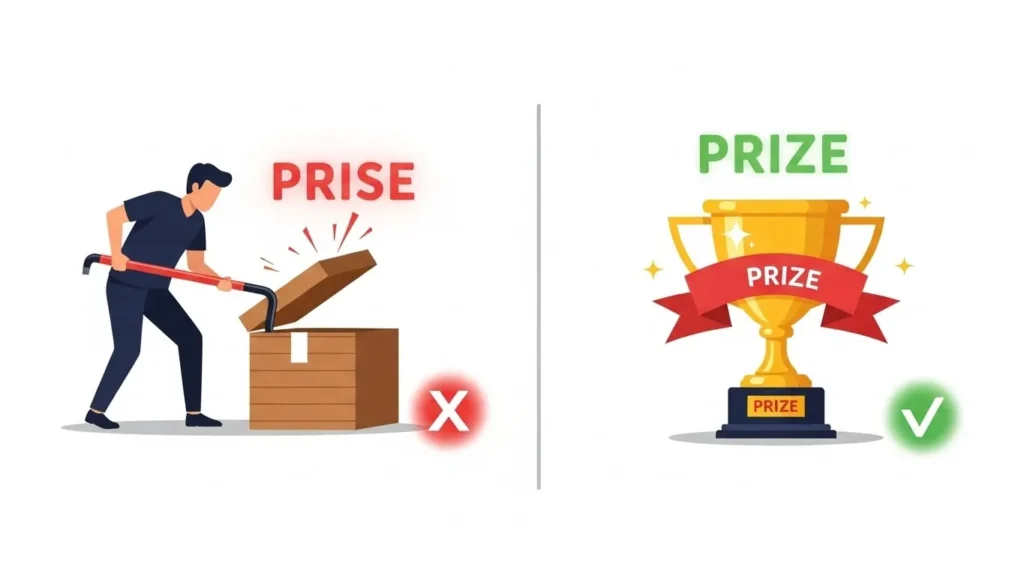
❌ He tried to prize the box open. (if in UK context, still possible but not standard in US)
✅ He tried to prise the box open.
❌ She won a prise.
✅ She won a prize.
❌ Confusing verb and noun forms
✅ Match meaning to context
One of the most common mistakes with prise or prize is using prize when talking about forcing something open. Many writers say, “He tried to prize the door open”, especially in American English.
While this may be understood informally, standard British English prefers prise for the meaning “to force open or lever apart.” Using prize here can sound incorrect or careless in formal writing.
Another frequent error is using prise to refer to an award or competition result. Sentences like “She won first prise” are incorrect and often appear due to pronunciation-based spelling. Prise is never a noun meaning an award.
The correct word for competitions, rewards, and achievements is always prize.
Writers also confuse the verb forms of prize. Some believe prize can only be a noun, but this is not true. Prize as a verb means to value or cherish, as in “I prize honesty above money.” Replacing it with prise in such contexts is wrong and changes the meaning completely.
Regional confusion is another source of mistakes. In American English, prize is sometimes used informally instead of prise for opening something, but in British English, this is considered incorrect or nonstandard.
Academic, technical, and professional writing should always follow the correct regional usage.
Finally, many learners mix these words because they are pronounced exactly the same. This leads to spelling errors in exams, blogs, and emails. The key is to focus on meaning, not sound.
✅ If the sentence involves forcing open or extracting, use prise (mainly UK).
✅ If it involves winning, rewarding, or valuing, always use prize.
Remembering this distinction will help you avoid one of the most common English spelling and meaning errors.
Prise or Prize in Everyday Examples
UK/Physical action
- He used a crowbar to prise the window open.
Awards
- She received a prize for best painting.
- Winning the scholarship was a huge prize.
Valuing something
- I really prize our friendship.
Casual conversation
- “Don’t try to prise my phone out of my hands!”
- “He got the first prize in the competition.”
Comparison Table: Prise vs Prize
| Feature | Prise | Prize |
| Part of speech | Verb | Noun / Verb |
| Meaning | Force open / extract | Award / value |
| Common error | Using for award | Using for forcing open |
| British English | ✅ Used | ✅ Used |
| American English | ❌ Rare | ✅ Used |
FAQs: Prise or Prize
1. Can prise mean award?
No, use prize for awards.
2. Can prize be used as a verb?
Yes, it can mean to value or appreciate.
3. Is prise used in American English?
Rarely; mostly UK English.
4. Are the words pronounced differently?
No, both are pronounced the same: /praɪz/.
5. Can I say “I prize honesty”?
Yes, that’s correct usage of prize as a verb.
6. Is it okay to use prise for opening something?
Yes, mainly in British English.
Conclusion
The difference between prise or prize depends on meaning and region. Prise is a verb meaning to force open or extract (mainly UK), while prize is a noun meaning an award or a verb meaning to value. Using the wrong word can change the meaning of a sentence.
A simple tip: want to open something = prise; want to win or value something = prize. Following this rule ensures your writing is clear, professional, and accurate.

I am Sidney Greenbaum, a linguist who studied how English is actually used, not just how it is taught. I analyzed sentence structure and word differences to make English clearer and more practical. My research helped learners understand real-world English comparisons.