

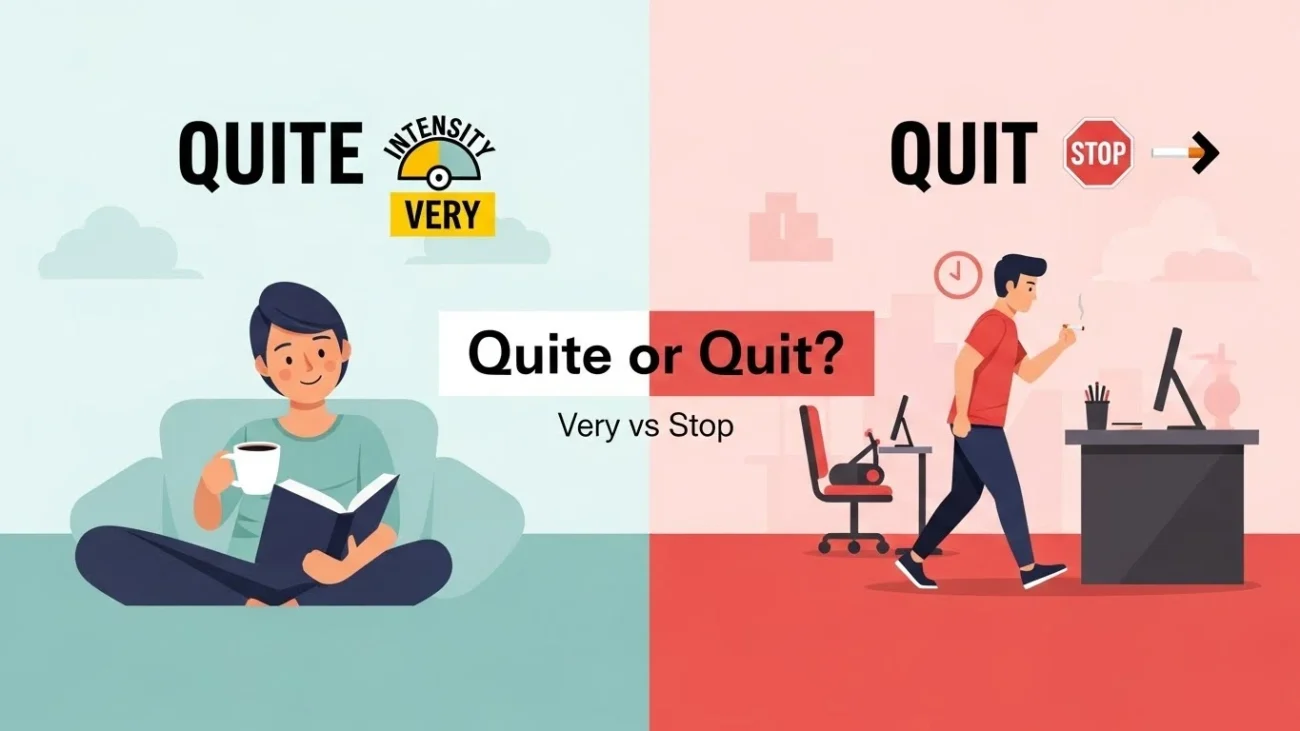
Many people search for quite or quit because these two words look similar but have very different meanings.
Using the wrong one can completely change the meaning of a sentence. For example, “I am quit happy” is incorrect, while “I am quite happy” is correct.
This confusion is common among English learners and even native speakers when writing quickly. This article clears the confusion simply and clearly.
You’ll get a quick answer, learn the origin, see common mistakes, everyday examples, and expert advice. By the end, you’ll confidently know when to use quite and when quit is correct.
Quite or Quit : Quick Answer
- ✅ Quite → adverb meaning completely, entirely, or very
- ✅ Quit → verb meaning to stop or leave
Examples:
- She is quite talented in music.
- He decided to quit his job last week.
👉 Completely/very = quite
👉 Stop/leave = quit
Read More : Liason or Liaison:Difference and Which One Should You Use?
The Origin of Quite or Quit
- Quite comes from Old English cwīt, meaning free or clear, later evolving to mean entirely or very.
- Quit comes from Old French quiter, meaning to release or free, and now means to stop, leave, or give up.
Although they look similar, their meanings and uses are completely different.
British English vs American English Spelling
There is no difference in spelling between British and American English.
| Word | British English | American English |
| Quite | Same | Same |
| Quit | Same | Same |
👉 Only meaning and context matter, not region.
Which Word Should You Use?
Use quite when:
- Describing intensity or degree
- Modifying adjectives or adverbs
Use quit when:
- Talking about stopping an activity
- Leaving a place or a job
Memory tip:
- Quite = “very”
- Quit = “stop”
Common Mistakes with Quite or Quit
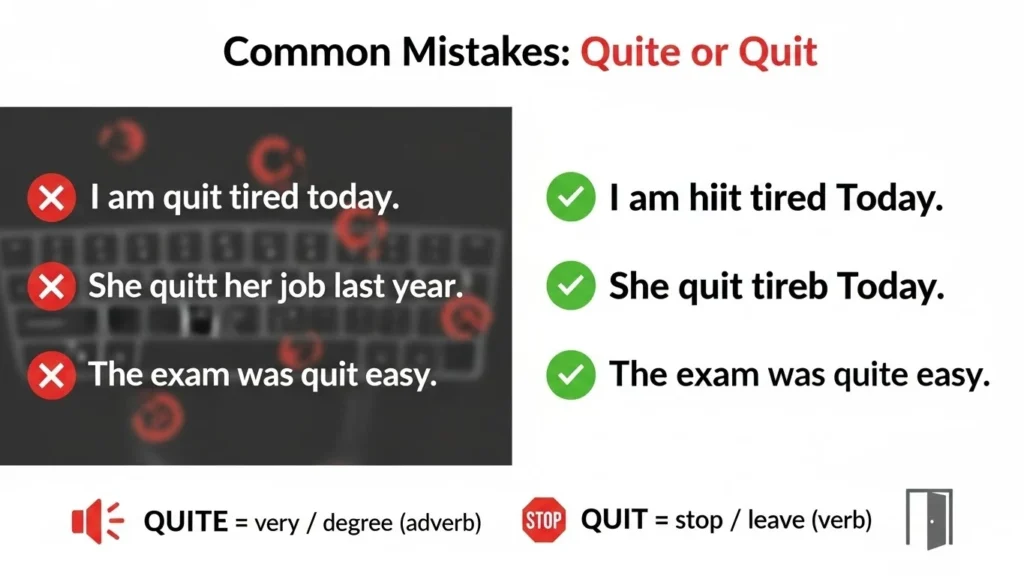
❌ I am quit tired today.
✅ I am quite tired today.
❌ She quite her job last month.
✅ She quit her job last month.
❌ Mixing adverb and verb
✅ Match the word to its function
Because quite and quit look almost identical, writers frequently mix them up, especially when typing quickly or relying on pronunciation. However, these mistakes can seriously change meaning and reduce clarity.
- Using quit instead of quite for emphasis
❌ I am quit confident about the result.
✅ I am quite confident about the result.
Here, the writer wants to express intensity, not stopping. - Using quite instead of quit for actions
❌ She quite her job last year.
✅ She quit her job last year.
Quite cannot describe actions or decisions. - Confusion due to missing “e”
Many learners drop the final e in quite, turning it into quit by accident.
❌ The exam was quit easy.
✅ The exam was quite easy. - Mixing parts of speech
Quite is always an adverb, while quit is always a verb.
❌ He quite smoking last month.
✅ He quit smoking last month. - Mistakes in professional writing
Errors like “I am quit interested” in emails or resumes make writing look careless and unpolished. - Overreliance on pronunciation
Since both words sound similar in fast speech, writers spell what they hear instead of recalling meaning.
How to avoid mistakes:
Ask yourself: Am I describing degree (very)? → use quite
Am I talking about stopping or leaving? → use quit
Mastering this distinction improves accuracy, confidence, and professionalism in everyday English.
Quite or Quit in Everyday Examples
Daily Life
- I am quite happy with the results.
- He decided to quit smoking for health reasons.
Work
- She is quite skilled at Excel.
- Many employees quit during the busy season.
Casual
- The movie was quite interesting.
- Don’t quit halfway through the game.
Education
- He is quite good at mathematics.
- She quit the course after two weeks.
Comparison Table: Quite vs Quit
| Feature | Quite | Quit |
| Part of speech | Adverb | Verb |
| Meaning | Completely / very | Stop / leave |
| Common error | Using as verb | Using as adverb |
| Usage | Adjectives, adverbs | Actions, leaving |
FAQs: Quite or Quit
1. Can quit mean “very”?
No, quit means to stop or leave.
2. Can quite mean to leave?
No, quite is an adverb for emphasis.
3. Do British and American English differ?
No, both use the same forms.
4. Is quite formal?
Yes, but also used in casual conversation.
5. Can quit be used in casual speech?
Yes, e.g., “I quit!” meaning “I stop.”
6. How to remember the difference?
Think: quite = very, quit = stop.
Conclusion
The difference between quite or quit is simple but essential. Quite is an adverb used to emphasize degree or intensity, while quit is a verb meaning to stop or leave. Using the wrong word can confuse readers or change the meaning of your sentence.
A simple trick: if you mean “very,” use quite; if you mean “stop,” use quit. Following this rule ensures your writing is clear, professional, and accurate.

I am Sidney Greenbaum, a linguist who studied how English is actually used, not just how it is taught. I analyzed sentence structure and word differences to make English clearer and more practical. My research helped learners understand real-world English comparisons.