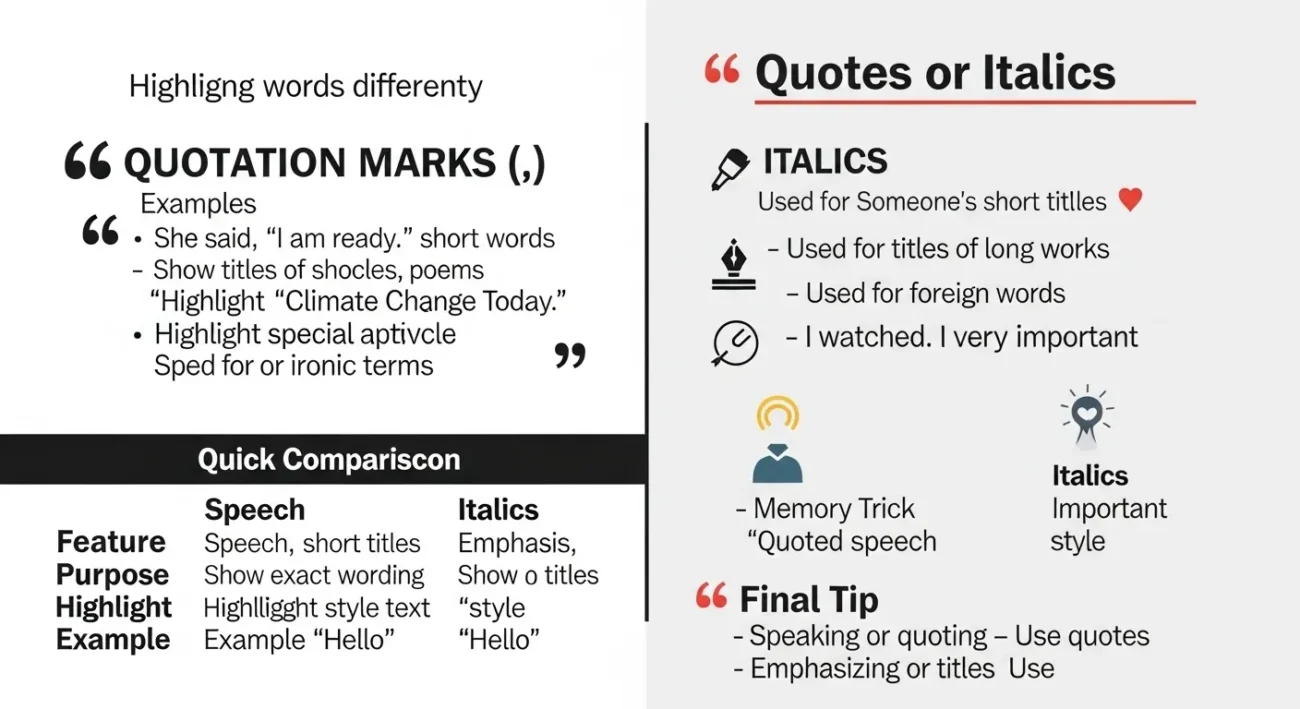
If you are wondering about “quotes or italics,” the quick answer is that quotation marks are used for exact words or speech, while italics are used for titles and emphasis.
I often see writers confused because both are used to highlight text, but they serve different purposes. When I first learned this, I used quotes everywhere, which made my writing look incorrect.
Over time, I realized that quotes show someone’s exact words, while italics help emphasize or format titles properly. Understanding this difference is important for clear and professional writing.
In this guide, I will explain meanings, rules, examples, and how to use them correctly.
Quotes or Italics : Quick Answer
The difference between quotation marks and italics is simple.
- Quotes (“ ”): used for exact words or speech
- Italics: used for titles, emphasis, or special terms
Examples
- He said, “I am ready.”
- I watched Titanic.
Simple idea
- Quotes = speech 🗣️
- Italics = emphasis or titles ✍️
The Origin of Quotes and Italics
Quotes
Quotation marks developed to show exact speech or writing. They help readers know that the words belong to someone else.
Italics
Italics come from Italian printing styles. They were designed to highlight text and make it stand out.
British English vs American English Usage
There is a small difference in style.
| Feature | American English | British English |
| Quotes style | Double quotes “ ” | Often single quotes ‘ ’ |
| Italics | Same | Same |
Which One Should You Use?
Choosing between quotes or italics depends on context.
Use Quotes if:
- You are writing direct speech
- You are quoting someone’s exact words
- You are showing dialogue
Use Italics if:
- You are writing book or movie titles
- You want to emphasize a word
- You are using foreign words
Common Mistakes with Quotes or Italics
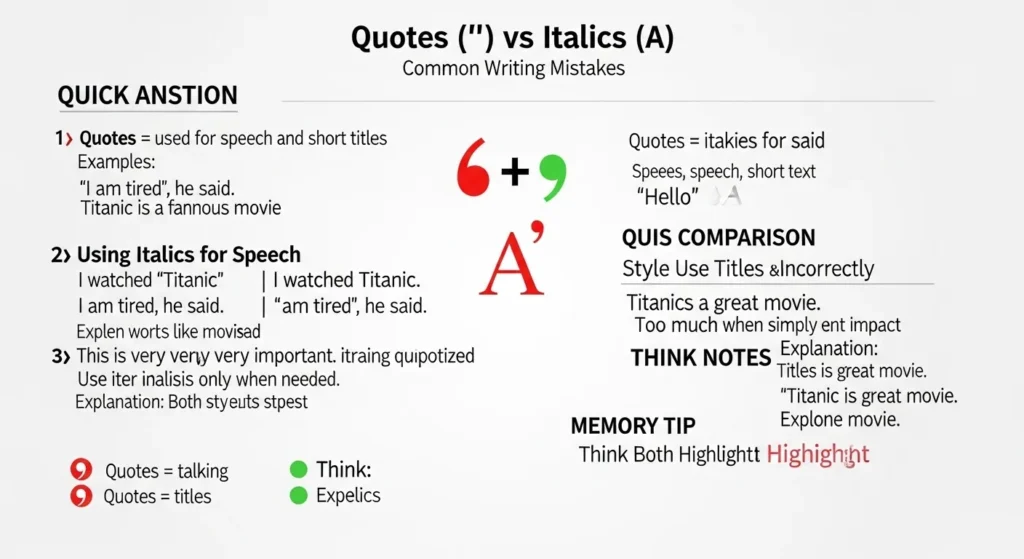
Mistake 1: Using quotes for titles
❌ I watched “Titanic”.
✅ I watched Titanic.
Mistake 2: Using italics for speech
❌ I am tired, he said.
✅ “I am tired,” he said.
3) Mistake: Overusing italics
❌ This is very very very important.
✅ Use italics only when needed.
Mistake 4: Mixing both styles
❌ “Titanic is a great movie.”
✅ Titanic is a great movie.
Italics or Quotes in Everyday Examples
Conversation
- “Please help me,” she said.
Writing titles
- I read Harry Potter.
Emphasis
- This is really important.
Quotes or Italics : Usage & Popularity
- Quotes are used in conversations and writing
- Italics are used in books, articles, and formatting
Both are essential tools for clear writing.
Comparison Table of Quotes vs Italics
| Feature | Quotes | Italics |
| Purpose | Show speech | Show emphasis |
| Usage | Dialogue | Titles |
| Symbol | “ ” | Slanted text |
| Context | Talking | Formatting |
FAQs
1. Which is better, quotes or italics?
It depends on usage. Quotes for speech, italics for titles.
2. Can I use both together?
Usually no, unless required in special cases.
3. Are italics used for book titles?
Yes, book and movie titles usually italicized.
4. Are quotes used for dialogue?
Yes, quotes used for direct speech.
5. Can italics replace quotes?
No, they serve different purposes.
6. Which is more common?
Both are common in writing.
7. How do I avoid mistakes?
Understand the purpose before using them.
Conclusion
When I compare quotes or italics, I clearly see that both are important but used in different ways. Quotation marks mainly used to show exact speech or someone’s words. They are very common in conversations, stories, and dialogue writing. Without quotes, it would be hard to know who is speaking.
On the other hand, italics used for formatting and emphasis. They help highlight important words, titles of books, movies, and sometimes foreign terms. Italics make writing look more professional and organized.
From my experience, the biggest mistake people make is using one in place of the other. This can confuse readers and make writing unclear. The key is to understand the purpose. If you are writing what someone said, use quotes. If you are highlighting or naming something, use italics.
In simple terms, quotes are for speech, and italics are for emphasis and titles. Keeping this difference in mind will help you write correctly and confidently.

I am Mark Twain, a writer who loved the English language for its humor, irony, and everyday comparisons. I used simple words to show deep differences between truth and lies, wisdom and foolishness. My writing proves that clear English is always more powerful than complicated English.