

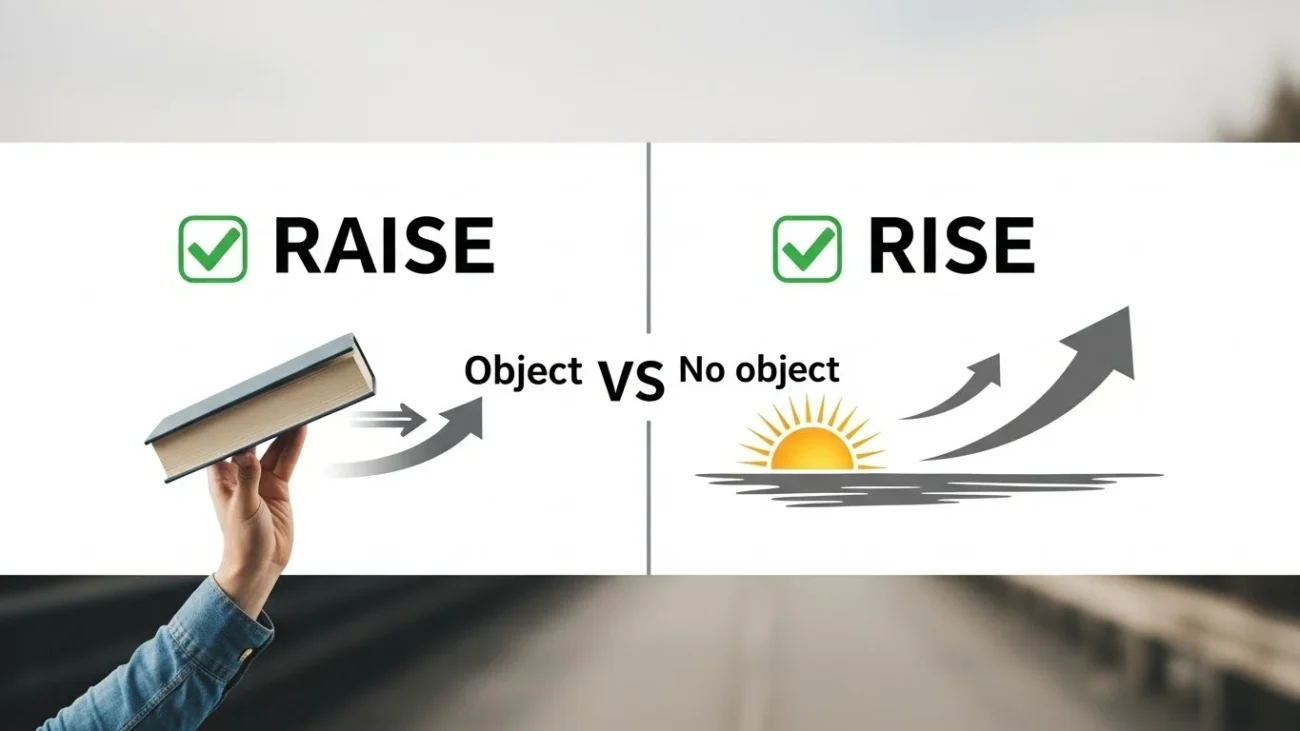
The confusion between raise or rise is one of the most common problems in English grammar. Many people search for this keyword because both words relate to going up, yet they are not interchangeable.
Using the wrong one can make a sentence grammatically incorrect, especially in exams, formal writing, news articles, and professional emails.
I’ve often seen sentences like “Prices are raising” or “He raised early in the morning”. These mistakes happen because learners focus on meaning but miss the grammar rule behind these words.
The real confusion lies in how these verbs work in a sentence, not just what they mean.
This article solves that confusion clearly. You’ll get a quick answer first, then a simple explanation of meaning, origin, British vs American usage, common mistakes, everyday examples, and professional advice.
By the end, you’ll confidently know when to use raise and when to use rise.
Raise or Rise :Quick Answer
Raise means to lift something and always needs an object.
Rise means to go up by itself and does not need an object.
Examples:
- She raised her hand.
- The sun rises in the east.
👉 If someone lifts something → Raise
👉 If something goes up by itself → Rise
Discover More Article:Key or Legend : Difference and Which One Should You Use?
The Origin of Raise or Rise
Raise comes from Old Norse reisa, meaning to lift up or build. This explains why it is used when someone causes something else to go up.
Rise comes from Old English rīsan, meaning to get up or ascend. It has always been linked to movement that happens naturally or on its own.
The confusion exists because:
- Both words relate to upward movement
- Their past forms look similar
- Learners focus on meaning, not grammar
But historically, they have always served different roles.
British English vs American English Spelling
There is no spelling difference between British and American English.
| Aspect | British English | American English |
| Raise | Same spelling, same meaning | Same spelling, same meaning |
| Rise | Same spelling, same meaning | Same spelling, same meaning |
| Difference | Grammar-based | Grammar-based |
👉 This is a grammar issue, not a regional spelling issue.
Which Spelling Should You Use?
Choose based on sentence structure, not audience.
- US audience → Same rule applies
- UK/Commonwealth → Same rule applies
- Global writing → Focus on object vs no object
Easy test:
- Can you ask “raise what?” → use raise
- If there is no “what” → use rise
Common Mistakes with Raise or Rise
❌ Prices are raising.
✅ Prices are rising.
❌ He rose his voice.
✅ He raised his voice.
❌ The teacher asked students to rise their hands.
✅ The teacher asked students to raise their hands.
Memory trick:
- Raise → needs an object
- Rise → no object
Confusion between raise or rise is extremely common in exams, news writing, and professional communication. Raise always requires an object, while rise does not. Using the wrong verb can make sentences grammatically incorrect and unclear. Understanding this difference improves accuracy, confidence, and overall English writing skills.
Raise or Rise in Everyday Examples
Emails
- Please raise your concern with HR.
- Costs may rise next month.
News
- The government raised taxes.
- Temperatures will rise tomorrow.
Social Media
- Time to rise and shine 🌅
- Raising awareness for a good cause.
Formal Writing
- The company raised funds.
- Profits continue to rise.
Raise or Rise : Google Trends & Usage Data
Search trends show:
- Raise is common in business, education, and commands
- Rise is common in news, weather, and daily speech
- High confusion among ESL learners and students
Countries with frequent searches:
- India
- Pakistan
- United States
- United Kingdom
👉 Most users search this keyword to fix grammar errors.
Comparison Table: Raise vs Rise
| Feature | Raise | Rise |
| Needs an object | ✅ Yes | ❌ No |
| Meaning | Lift something | Go up naturally |
| Verb type | Transitive | Intransitive |
| Example | Raise your hand | The sun rises |
| Common error | Used without object | Used with object |
FAQs: Raise or Rise
1. Is “raise” always followed by an object?
Yes, always.
2. Can “rise” take an object?
No, never.
3. Which word is used for prices?
Prices rise.
4. Which word is used for hands or voice?
You raise them.
5. Is this a US vs UK difference?
No, both follow the same rule.
6. What is the past tense of rise?
Rose.
7. What is the past tense of raise?
Raised.
Conclusion
The difference between raise or rise is not about spelling or region it’s about grammar. Raise requires an object and shows that someone is causing something to go up.
Rise does not take an object and shows that something goes up on its own.
If you remember just one rule, remember this: If you can ask “raise what?” and get an answer, use raise. If you can’t, use rise.
This simple test will save you from many common English mistakes.
Mastering word pairs like raise or rise improves clarity, accuracy, and confidence in both spoken and written English.

I am Michael Swan, an English grammarian known for explaining confusing grammar and word comparisons in a clear way. I focused on real usage, not just rules, helping learners understand why English works the way it does. My work simplifies complex language problems for everyday users.