

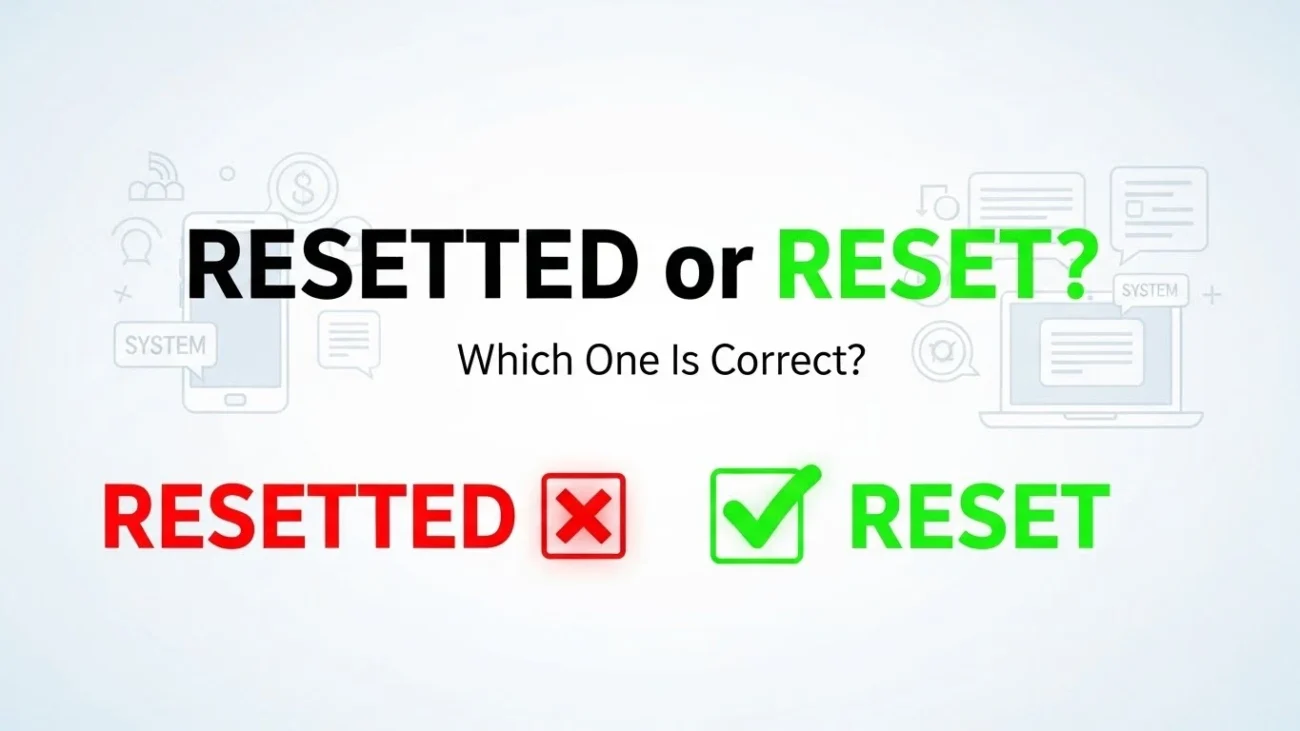
Many English learners and writers search for resetted or reset because both forms appear online, especially in technology blogs, software messages, troubleshooting guides, and casual conversations.
This confusion exists because reset is an irregular verb, and irregular verbs do not follow the standard rules most learners expect. Additionally, the spelling looks deceptive, which leads many people to apply the regular ed ending without checking grammar rules.
Throughout this article, you will get a clear and direct answer first. After that, you’ll explore the word’s origin, grammar rules, common mistakes, real life examples, usage data, and professional advice.
By the end, you will confidently know which word to use and avoid a very common English error in both spoken and written communication.
Resetted or Reset: Quick Answer
✅ Reset is correct
❌ Resetted is incorrect and not standard English
Examples:
- I reset my phone.
- The router was reset yesterday.
- Please reset your password before logging in.
- I have reset the settings.
Important rule:
- Present tense → reset
- Past tense → reset
- Past participle → reset
No matter the tense, the form never changes.
Read more: Has vs Had in English:Difference, Rules, Examples, and Quick Tips
The Origin of Resetted or Reset
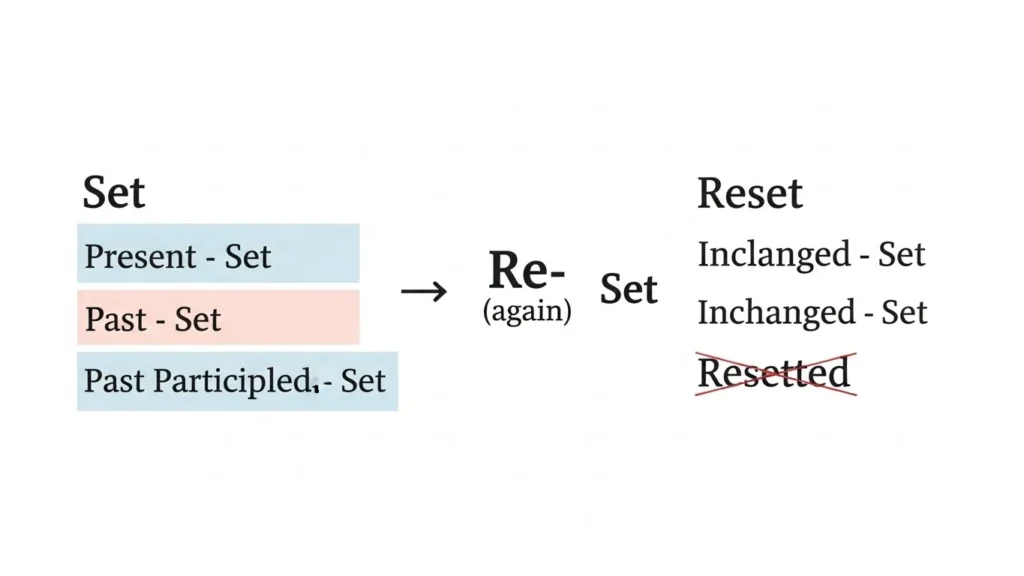
To understand why resetted is incorrect, it helps to look at the origin of the word. The verb reset comes from set, which is one of the most irregular verbs in English. Interestingly, set keeps the same form in the present, past, and past participle.
Here is the pattern:
- set → set → set
- upset → upset → upset
- offset → offset → offset
- reset → reset → reset
Because reset follows this established pattern, it never takes the ed ending. Although you may occasionally see resetted in informal writing or online posts, it does not follow standard English grammar rules.
In professional writing, academic contexts, and exams, resetted is always treated as an error.
British English vs American English Spelling
Some English spelling differences exist between British and American English, which makes learners wonder if resetted belongs to one version. Fortunately, the answer is simple.
There is no difference at all between British and American English for this verb.
| Aspect | British English | American English |
| Present | reset | reset |
| Past | reset | reset |
| Past participle | reset | reset |
👉 Both varieties use reset only.
Which Form Should You Use?
You should always use reset, regardless of tense or context.
Correct usage:
- Present: I reset the system every week.
- Past: I reset the system yesterday.
- Perfect: I have reset the system already.
Professional advice:
In technical documents, software manuals, academic writing, business emails, and exams, using resetted lowers credibility and appears careless. Editors and grammar tools treat it as a mistake.
Common Mistakes with Resetted or Reset
Many learners make predictable errors when using this verb. Fortunately, once you understand the pattern, avoiding these mistakes becomes easy.
Incorrect vs Correct Examples:
❌ I resetted my laptop.
✅ I reset my laptop.
❌ The phone has been resetted.
✅ The phone has been reset.
❌ She resetted the password last night.
✅ She reset the password last night.
Why these mistakes happen:
First, learners often apply the regular ed rule automatically. Since verbs like updated, edited, and downloaded follow this pattern, people assume reset behaves the same way. However, English does not treat all verbs equally.
Second, passive sentences cause additional confusion. For example, people write “The system was resetted” instead of the correct form “The system was reset.” Even grammar checking tools sometimes fail to flag this error, which makes it seem acceptable.
Another frequent issue is inconsistency. Writers may correctly use reset once and then incorrectly use resetted later in the same paragraph. This inconsistency weakens clarity and looks unprofessional, especially in technical or instructional writing.
Memory trick:
If a verb ends in set, it usually never changes.
Resetted or Reset in Everyday Examples
Understanding grammar becomes easier when you see how words are used in real life.
Technology:
- Please reset your router to fix the connection issue.
- I reset my phone after the update failed.
Office and Work:
- The IT team reset the system after maintenance.
- I have reset your login credentials.
Customer Support:
- Your password has been reset successfully.
- We reset your account due to security concerns.
Social Media:
- Phone crashed again, so I reset everything 😩
Resetted or Reset: Usage Trends and Search Behavior
Online search behavior shows strong confusion around this word. Technology related searches dominate queries for resetted or reset, particularly among users troubleshooting devices or software.
Key observations:
- Reset dominates professional and educational content.
- Resetted appears mostly in informal posts and comments.
- Users often search to confirm the correct past tense.
Countries with high search interest include:
- United States
- India
- Pakistan
- United Kingdom
This pattern shows that learners are actively seeking clarity rather than inventing new forms.
Comparison Table: Resetted vs Reset
| Feature | Resetted | Reset |
| Grammatically correct | ❌ No | ✅ Yes |
| Standard English | ❌ No | ✅ Yes |
| Past tense | ❌ No | ✅ Yes |
| Past participle | ❌ No | ✅ Yes |
| Recommended usage | Avoid | Always use |
FAQs: Resetted or Reset
1. Is resetted ever correct?
No, it is not standard English.
2. What is the past tense of reset?
Reset.
3. What is the past participle of reset?
Reset.
4. Is there a difference in British and American English?
No, both use reset.
5. Why do people say resetted?
They mistakenly apply the regular ed rule.
6. Is reset an irregular verb?
Yes, it is irregular.
7. Is reset acceptable in exams and formal writing?
Yes. It is the only accepted form.
Conclusion
The confusion between resetted or reset comes from applying regular verb rules to an irregular verb. Although resetted may look logical, it is grammatically incorrect and should be avoided. The verb reset keeps the same form in the present, past, and perfect tenses.
Remember one simple rule: verbs built from “set” never change. Whether you are writing an email, preparing exam answers, drafting technical instructions, or posting online, always choose reset. This small but important correction can significantly improve your English accuracy and professionalism.

I am Sidney Greenbaum, a linguist who studied how English is actually used, not just how it is taught. I analyzed sentence structure and word differences to make English clearer and more practical. My research helped learners understand real-world English comparisons.