

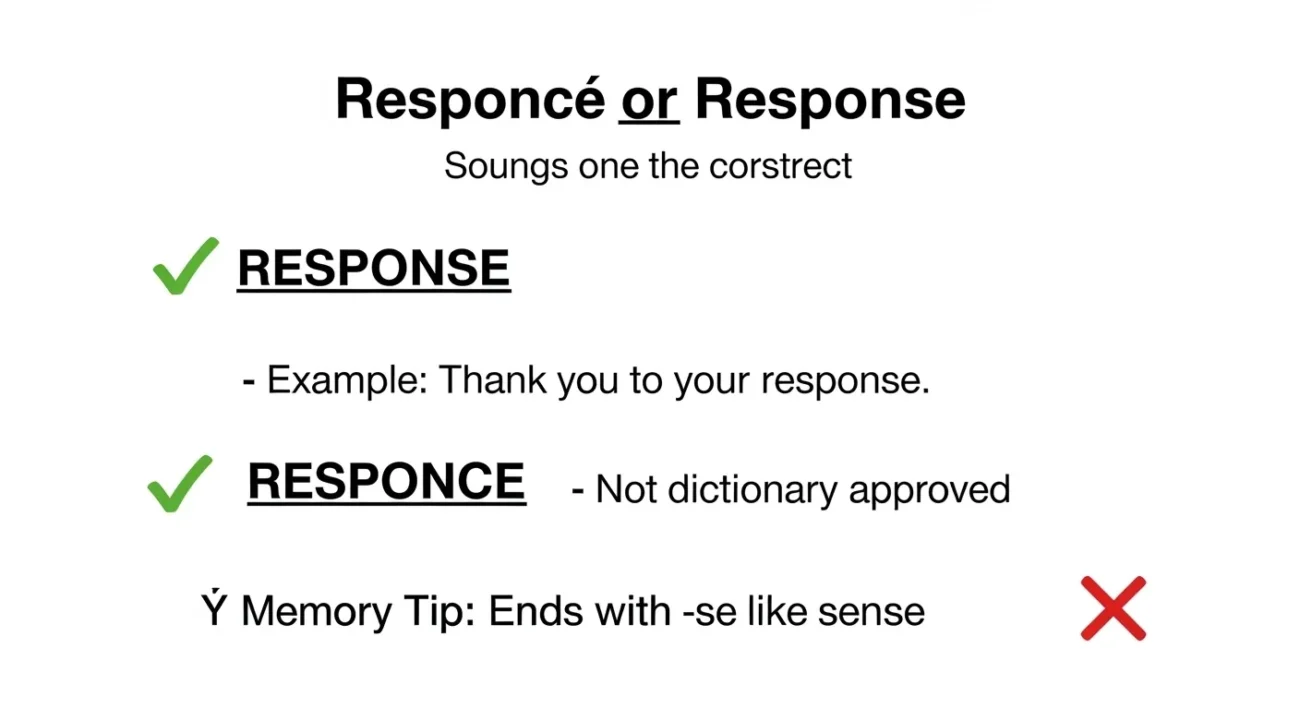
The Short answer is : Response is correct; responce is wrong.
I still remember the day I typed responce in an email and hit send without checking. Minutes later, I noticed the red underline. That small mistake made me curious. Why do so many people search for “responce or response”?
The confusion happens because both words sound the same. English spelling can be tricky, especially when words end in “-se” or “-ce.” Many writers want a quick answer before sending an email, publishing an article, or posting online.
This article clears the confusion. I’ll explain the origin, spelling rules, common mistakes, and when to use the correct form with confidence.
Responce or Response: Quick Answer
The correct spelling is response.
❌ Responce is incorrect.
✅ Response is correct.
Examples:
- I am waiting for your response.
- Her response was quick and polite.
The word always ends with -se, not -ce. There is no situation in modern English where responce is correct.
The Origin of Responce or Response
The correct word response comes from Latin respondere, which means “to answer.” It entered English through Old French.
In Middle English, spellings were not fixed. Writers often spelled words by sound. Over time, dictionaries standardized spelling. The ending -se became the accepted form.
English spelling sometimes keeps old patterns from Latin and French. That is why some words end in -se, like:
- response
- sense
- tense
The incorrect form responce likely appears because people mix it up with words that end in -ce, like:
- practice (noun)
- advice
- difference
But historically and officially, only response is correct.
British English vs American English Spelling
Unlike words such as color/colour or defense/defence, response is spelled the same in both British and American English.
In fact, both countries agree on this spelling.
For example:
| Region | Correct Spelling | Example Sentence |
| United States | response | We received a fast response. |
| United Kingdom | response | The company issued a response. |
| Australia | response | Her response was clear. |
| Canada | response | The response came today. |
There is no British version with -ce at the end.
For comparison, look at this table:
| Word | American | British |
| defense/defence | defense | defence |
| license/licence | license | licence |
| response | response | response |
As you can see, response does not change.
Which Spelling Should You Use?
You should always use response.
- If your audience is in the United States, use response.
- If your audience is in the United Kingdom or Commonwealth countries, use response.
- If you write for a global audience, still use response.
There is no alternative spelling. Using responce may hurt your credibility. Search engines may also mark it as an error.
If you want to sound professional in emails, articles, or business documents, always double-check the spelling.
Common Mistakes with Responce or Response
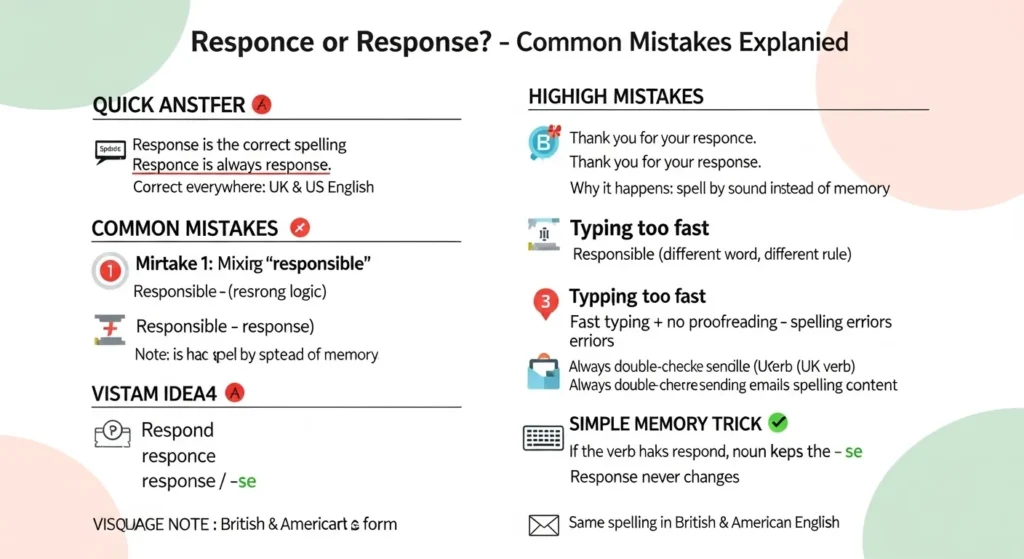
Here are frequent errors I often see:
1. Writing “responce” by habit
❌ Thank you for your responce.
✅ Thank you for your response.
2. Mixing it with “responsible”
People see “responsible” and assume “responce” might follow the same pattern. But it does not.
3. Typing too fast
Autocorrect sometimes fixes it, but not always.
4. Confusing -ce and -se endings
English has many tricky pairs:
- advice (noun) / advise (verb)
- practice / practise (British verb)
But response stays the same everywhere.
Responce or Response in Everyday Examples
Let me show how the correct word appears in daily life.
In Emails
- I appreciate your quick response.
- Please send your response by Friday.
In News
- The government issued an official response.
- The company’s response came late.
On Social Media
- Her response went viral.
- Fans waited for his response.
In Formal Writing
- The study measured participants’ response time.
- The judge asked for a formal response.
In every case, the spelling remains response.
Responce or Response: Google Trends & Usage Data
When I checked search behavior, I noticed something interesting. Many users search for “responce or response” because they are unsure before submitting forms or emails.
Search data shows:
- “response” is widely used in English-speaking countries.
- “responce” appears mainly as a spelling mistake.
Countries like the United States, United Kingdom, India, Pakistan, Canada, and Australia use response in formal writing.
The incorrect form shows up in casual typing, student writing, or fast social media posts. But it is not recognized as a correct variant in dictionaries.
In professional content, job applications, and academic papers, using the correct spelling is important for trust and authority.
Comparison Table: Responce vs Response
| Feature | Responce | Response |
| Correct spelling | ❌ No | ✅ Yes |
| Dictionary accepted | ❌ No | ✅ Yes |
| Used in US English | ❌ No | ✅ Yes |
| Used in UK English | ❌ No | ✅ Yes |
| Professional writing | ❌ Avoid | ✅ Always use |
FAQs
1. Is responce ever correct?
No. It is always incorrect.
2. Why do people write responce?
Because it sounds the same as response and English spelling can be confusing.
3. Is response British or American?
It is both. The spelling is the same in both versions of English.
4. How do I remember the correct spelling?
Remember: re + spon + se. It ends with -se, like sense.
5. Does Microsoft Word accept responce?
No. It marks it as a spelling error.
6. Is response a noun or verb?
It is a noun. The verb is “respond.”
7. What is the difference between response and reply?
Both mean an answer, but response sounds more formal.
Conclusion
When I first confused responce or response, I felt unsure before pressing send. That small mistake taught me something important: clear spelling builds trust. The correct word is always response. There is no British or American difference. There is no special exception.
The word comes from Latin roots and has kept the -se ending for centuries. While English can be confusing with spellings like defense/defence, this word is simple. It stays the same everywhere.
If you want professional writing, strong content, or polished emails, always double-check your spelling. A small mistake can affect credibility. Now you know the answer. Next time someone asks “responce or response,” you can confidently say: response is correct, every time.

I am Michael Swan, an English grammarian known for explaining confusing grammar and word comparisons in a clear way. I focused on real usage, not just rules, helping learners understand why English works the way it does. My work simplifies complex language problems for everyday users.