

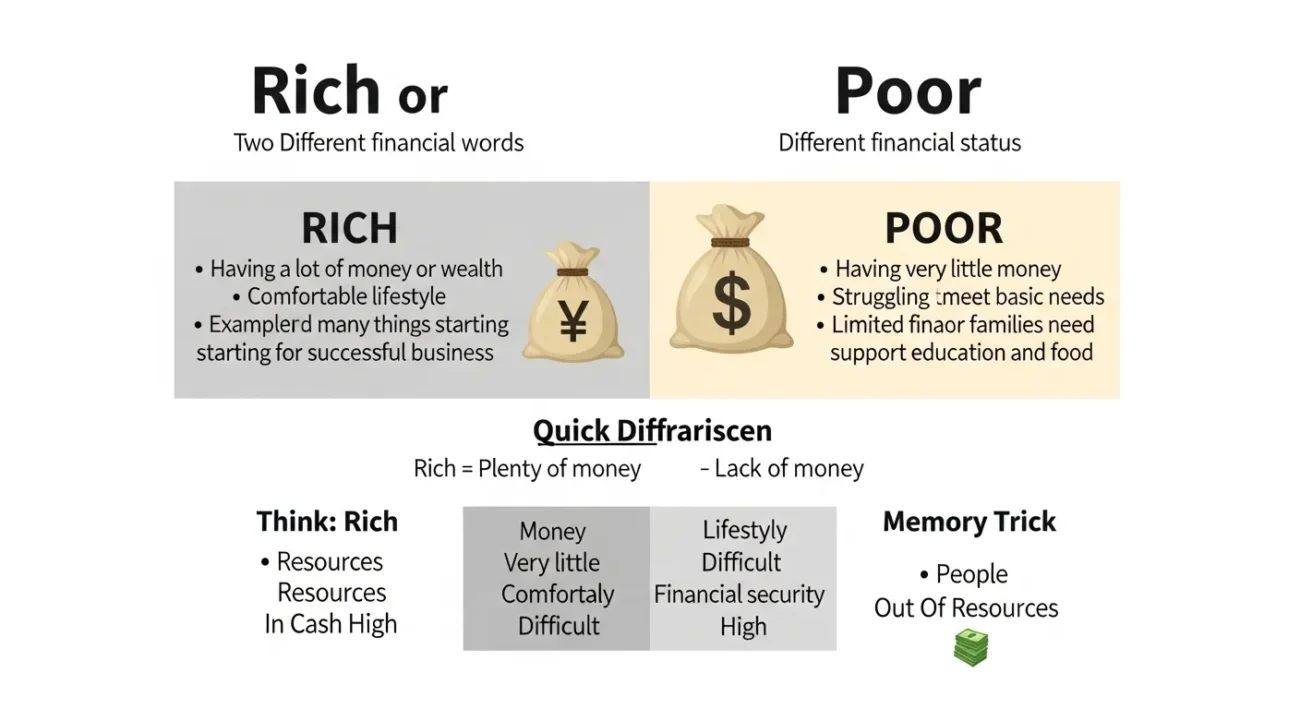
If you are wondering about “rich or poor,” the difference is simple: rich means having a lot of money or resources, while poor means having very little.
I often notice people searching this phrase when they want to understand the meaning of these words or how they are used in everyday language.
When I first explored this topic, I realized that many learners of English get confused because these words are not only about money. Sometimes people use them to describe quality, lifestyle, opportunities, or even flavor. Because of this, the meaning can change depending on context.
In this guide, I will explain the meanings of rich and poor, their origins, common mistakes, real-life examples, and how to use them correctly in different situations.
Rich or Poor : Quick Answer
The difference between rich and poor is mainly about wealth and resources.
- Rich means having a large amount of money, property, or valuable resources.
- Poor means having very little money or lacking basic resources.
Examples
Rich
- He became rich after building a successful company.
- The country is rich in natural resources.
Poor
- Many families struggle because they are poor.
- The soil in that area is poor for farming.
Simple explanation:
- Rich = a lot of wealth or resources
- Poor = very little wealth or resources
The Origin of Rich or Poor
Origin of Rich
The word rich comes from the Old English word “rice,” which meant powerful, wealthy, or influential. Over time, the meaning became strongly connected to financial wealth and prosperity.
Today, the word is used not only for money but also for describing abundance or high quality, such as rich culture or rich flavor.
Example
- The region is rich in history.
Origin of Poor
The word poor comes from the Old French word “povre,” which meant someone lacking wealth or resources. It was originally used to describe people who had very limited financial means.
Over time, the word expanded to describe low quality, weakness, or lack of resources in many situations.
Example
- The team had a poor performance.
British English vs American English Spelling
The words rich and poor have the same spelling in both British and American English.
| Word | American English | British English | Meaning |
| Rich | Rich | Rich | Having a lot of wealth |
| Poor | Poor | Poor | Having little wealth |
There is no spelling difference between these versions of English.
Which Word Should You Use?
The correct word depends on the context you want to describe.
Use Rich when:
- Talking about wealthy people
- Describing abundance or high quality
Examples
- She grew up in a rich family.
- The dessert has a rich chocolate flavor.
Use Poor when:
- Talking about lack of money or resources
- Describing low quality or weak performance
Examples
- Many rural areas remain poor.
- The project failed because of poor planning.
Audience Advice
- Formal writing: Use the words carefully when discussing economic topics.
- Everyday conversations: These words are common and widely understood.
- Academic writing: Sometimes terms like low-income or wealthy are preferred.
Common Mistakes with Rich or Poor
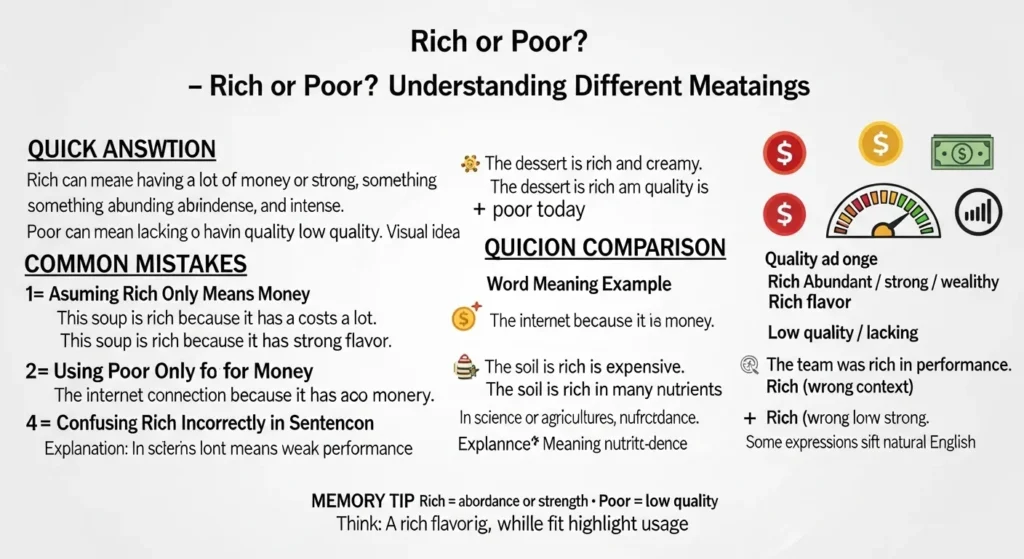
Mistake 1: Assuming rich only means money
❌ This soup is rich because it costs a lot.
✅ This soup is rich because it has a strong flavor.
Mistake 2: Using poor only for money
❌ The internet connection is poor because it has no money.
✅ The internet connection is poor because the quality is bad.
Mistake 3: Using rich incorrectly in context
❌ The soil is rich because it is expensive.
✅ The soil is rich because it has many nutrients.
Mistake 4: Confusing meaning in sentences
❌ The team was rich in performance.
✅ The team had a poor performance.
Rich and Poor in Everyday Examples
These words appear in many real-life situations.
In News
- “The gap between rich and poor continues to grow.”
Social Media
- “Money does not always define whether someone is rich or poor.”
In Conversations
- “Some countries are rich in resources but poor in infrastructure.”
In Formal Writing
- Economic reports often analyze the difference between rich and poor populations.
Poor or Rich : Usage & Popular Context
The phrase rich or poor is often used when discussing economic inequality or social conditions.
Common contexts
- Economics and financial discussions
- Social studies and education
- Political debates about wealth distribution
Popular phrases
- “From rich to poor”
- “Helping poor communities”
This phrase highlights the contrast between wealth and poverty in society.
Comparison Table of Rich vs Poor
| Feature | Rich | Poor |
| Meaning | Having a lot of wealth | Having little wealth |
| Resources | Abundant | Limited |
| Quality usage | Strong or intense | Weak or low quality |
| Example | Rich culture | Poor planning |
FAQs
1. What does rich mean?
Rich means having a large amount of money, resources, or abundance.
2. What does poor mean?
Poor means having very little money or limited resources.
3. Can rich describe something other than money?
Yes. Rich can describe flavor, culture, soil, or resources.
Example
- Rich chocolate cake.
4. Can poor describe quality?
Yes. Poor can describe low quality or weak performance.
Example
- Poor internet connection.
5. Is rich always positive?
Not always. Sometimes rich can describe something too strong or heavy, such as overly rich food.
6. Why do people say “rich and poor”?
The phrase is often used to describe economic inequality or social differences.
7. Are there alternative words?
Yes.
- Rich → wealthy, affluent
- Poor → low-income, impoverished
Conclusion
Understanding the difference between rich or poor is important because these words describe more than just money. At their basic level, rich refers to having a large amount of wealth or resources, while poor describes having very little. These meanings are commonly used when discussing economic conditions, social differences, or personal financial situations.
However, the meanings of these words can expand depending on context. For example, rich can describe something abundant or intense, such as rich soil, rich culture, or rich flavors in food. Similarly, poor can describe low quality or weak performance, such as poor planning or poor internet connection.
Because these words carry strong meanings, they should be used carefully in formal writing or discussions about society. In many professional contexts, people sometimes prefer alternatives like wealthy, affluent, low-income, or underprivileged.
Overall, rich and poor are simple words with powerful meanings. By understanding their origins, usage, and context, you can use them more accurately in conversations, writing, and discussions about economic or social topics.
Discover More Articles:

I am Michael Swan, an English grammarian known for explaining confusing grammar and word comparisons in a clear way. I focused on real usage, not just rules, helping learners understand why English works the way it does. My work simplifies complex language problems for everyday users.