

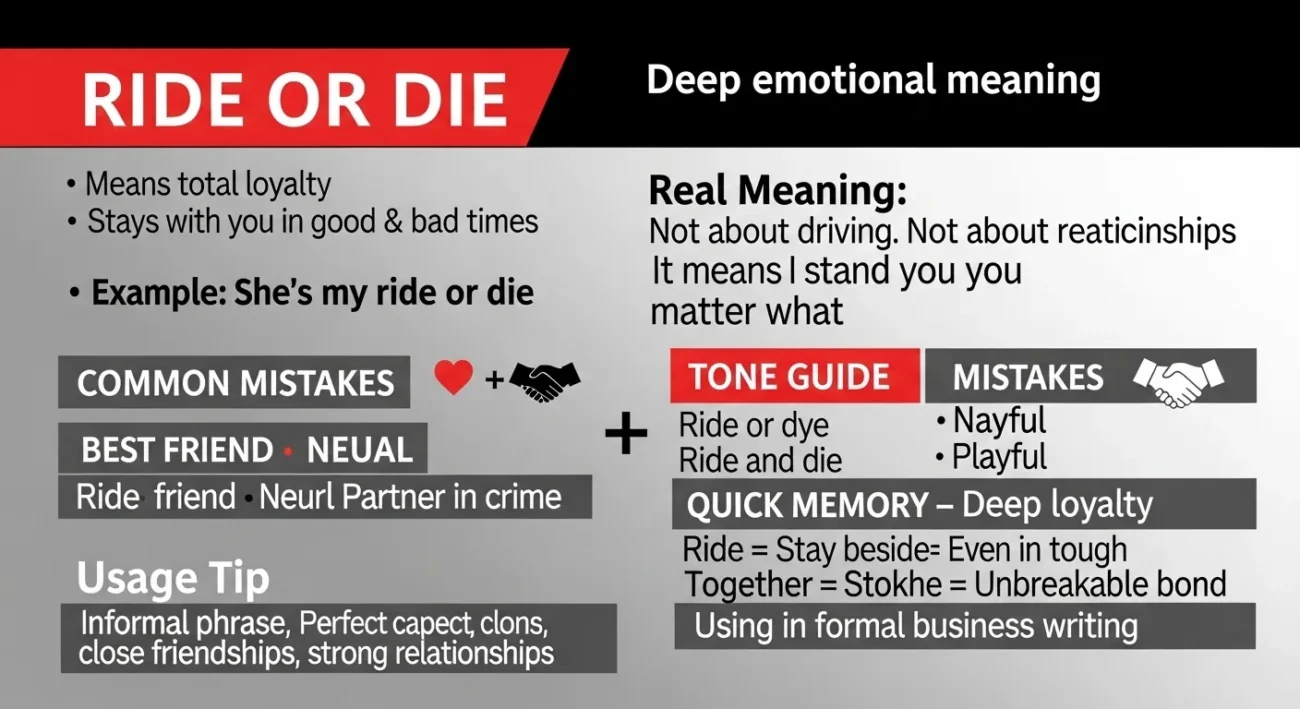
The Short answer is : Ride or die means someone who stays loyal no matter what happens.
I remember the first time I heard it in a song. The singer called someone “my ride or die,” and I paused. Was it about driving? Or something deeper?
Many people search “ride or die” because they see it in music, movies, captions, and relationships. They want to know the real meaning. Is it romantic? it about friendship? Is it serious or casual?
In this complete guide, I will clearly explain the meaning, origin, spelling, examples, common mistakes, cultural impact, and correct usage so you understand it fully.
Ride or Die: Quick Answer
Ride or die means:
👉 A person who stays with you through good and bad times.
It describes strong loyalty.
Simple Examples:
- She is my ride or die.
- A true friend is ride or die.
- We’ve been ride or die since school.
It is not about riding a vehicle. It is about commitment and loyalty.
The Origin of Ride and Die
The phrase became popular in American street culture in the 1990s. It was often used to describe deep loyalty in friendships and relationships.
It became widely known through hip-hop music and movies. Artists used it to describe someone who would “ride” with them in any situation, even dangerous ones.
One major influence was the hip-hop group The LOX, who released a song titled “Ride or Die.” The phrase later became strongly connected with rapper DMX, who often spoke about loyalty and brotherhood.
Over time, the meaning softened. Today, it simply means loyal and supportive.
British English vs American English Spelling
There is no spelling difference between British and American English.
| Phrase | United States | United Kingdom | Canada | Australia |
| Ride or die | Same | Same | Same | Same |
The spelling stays the same worldwide.
Which Spelling Should You Use?
Always write ride or die exactly like this.
Do not write:
- ❌ Ride and die
- ❌ Ride & die
- ❌ Ride or dye
Capitalization:
- Lowercase in normal sentences.
- She is my ride or die.
- Capitalized at the start of a sentence.
- Ride or die friendships are rare.
There are no regional spelling changes.
Common Mistakes with Ride or Die
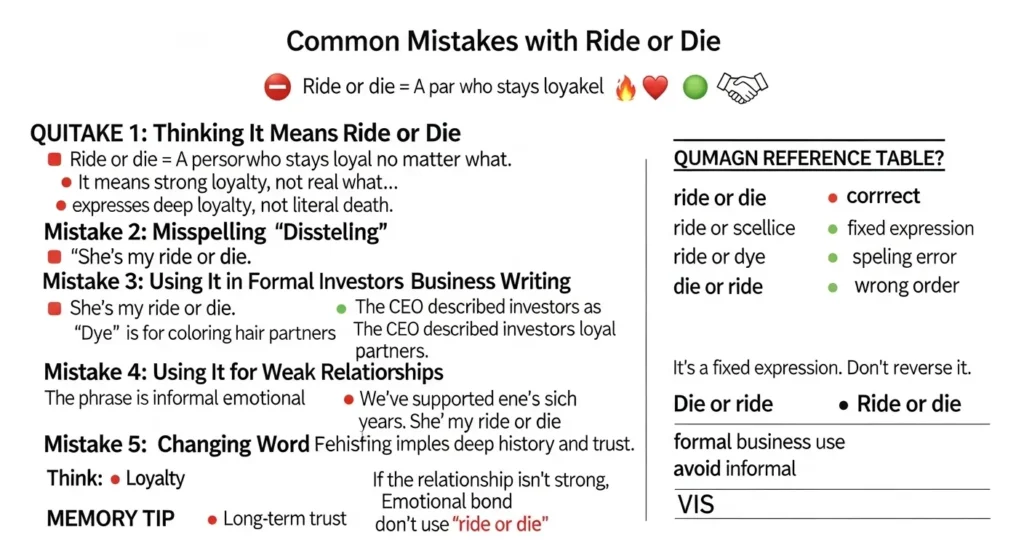
Mistake 1: Thinking it means violence
❌ Ride or die means someone will actually die.
✅ It means strong loyalty, not real death.
2) Mistake: Misspelling die
❌ She’s my ride or dye.
✅ She’s my ride or die.
Mistake 3: Using it in formal business writing
❌ The CEO described investors as ride or die partners.
✅ The CEO described investors as loyal partners.
It is informal and emotional.
Mistake 4: Using it for weak relationships
❌ We met yesterday. He’s my ride or die.
✅ We’ve supported each other for years. She’s my ride or die.
The phrase implies deep history.
Mistake 5: Changing word order
❌ Die or ride
✅ Ride or die
Die or Ride in Everyday Examples
In Friendship:
- She’s been my ride or die since childhood.
- Every person needs a ride or die friend.
Romantic Relationships:
- He calls his wife his ride or die.
- True love feels ride or die.
In Music:
The phrase appears in many hip-hop and R&B songs about loyalty and trust.
On Social Media:
- My sister = forever ride or die ❤️
- Ride or die vibes only.
In Movies:
The phrase often appears in crime or action films where characters trust each other completely.
Ride or Die: Cultural Popularity & Trends
Search interest for “ride or die” is strong in:
- United States
- United Kingdom
- Canada
- Australia
- India
It is most popular among younger audiences.
Common searches include:
- ride or die meaning
- ride or die relationship
- ride or die friend meaning
- ride or die girlfriend meaning
Interest increases around:
- Valentine’s Day
- Friendship Day
- Music releases
- Relationship discussions
The phrase has moved from street slang to mainstream culture.
Comparison Table: Ride or Die vs Similar Phrases
| Phrase | Meaning | Tone |
| Ride or die | Loyal no matter what | Emotional |
| Best friend | Close friend | Neutral |
| Partner in crime | Fun loyalty | Playful |
| Loyal companion | Supportive person | Formal |
“Ride or die” carries strong emotional weight.
Ride vs Die: Literal Meaning Comparison
| Word | Literal Meaning | Figurative Meaning |
| Ride | Travel in a vehicle | Stay with someone |
| Die | Stop living | Face consequences |
| Ride or die | Travel or death | Total loyalty |
The literal meaning is extreme, but the figurative meaning is about commitment.
FAQs
1. What does ride or die mean?
It means someone who stays loyal no matter what.
2. Is ride or die romantic?
It can describe both friendship and romance.
3. Is it formal English?
No. It is informal slang.
4. Does it mean actual death?
No. It expresses loyalty, not violence.
5. Is spelling different in British English?
No. It is the same everywhere.
6. Can it be used in professional writing?
It is better avoided in formal business contexts.
7. Why is it popular in music?
Because music often focuses on loyalty and relationships.
8. Is ride or die positive?
Yes. It usually expresses strong trust and support.
Conclusion
Ride or die is more than just a catchy phrase. I remember hearing it in a song and thinking it sounded intense. Later, I understood its emotional meaning. It describes someone who stands beside you through every challenge.
There is no spelling difference between countries. The phrase remains the same globally. It is informal but powerful. It carries deep meaning in friendships and relationships.
However, it should be used carefully. It fits personal conversations, social media, and music. It does not fit formal reports or academic writing.
In simple words, ride or die means loyalty without limits. It reminds us that true relationships are built on trust, support, and standing together no matter what happens.
Discover More Articles:

I am Michael Swan, an English grammarian known for explaining confusing grammar and word comparisons in a clear way. I focused on real usage, not just rules, helping learners understand why English works the way it does. My work simplifies complex language problems for everyday users.