

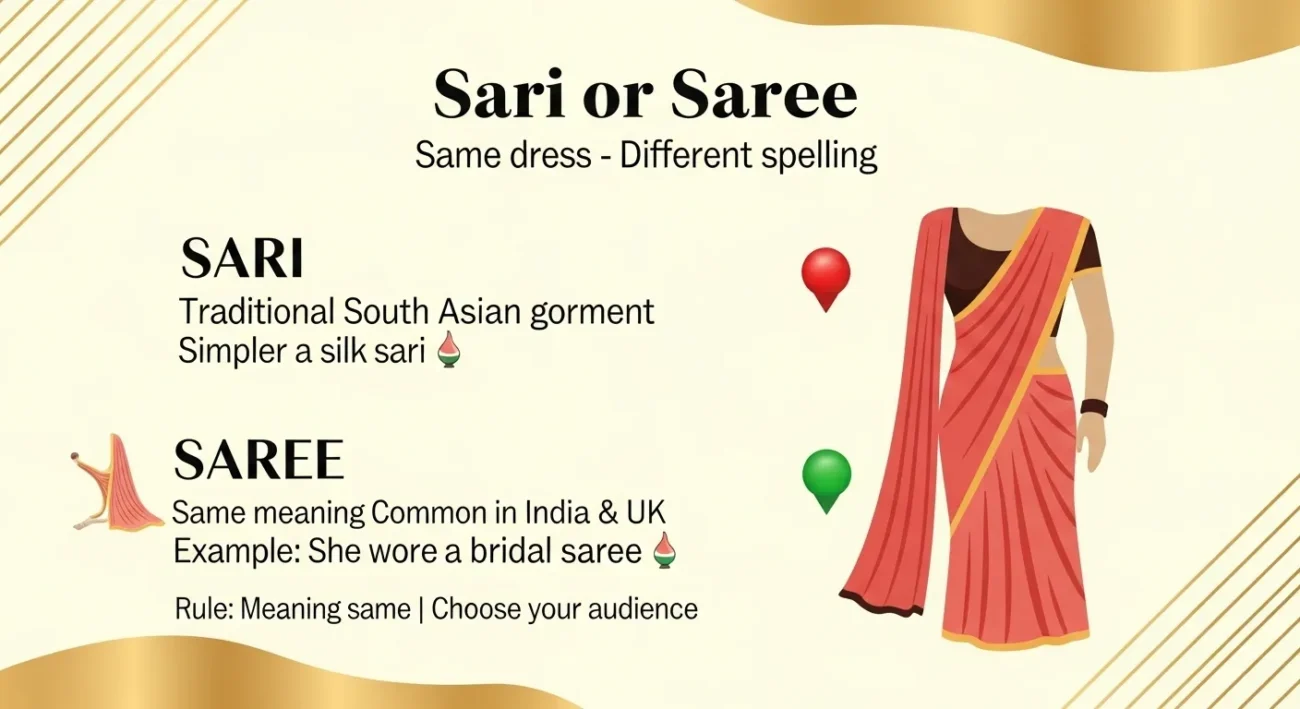
The Short answer is : The correct spelling is “sari” and “saree” both are right.
I once paused while writing a fashion article because I didn’t know which spelling to use. I typed sari, then changed it to saree, then changed it back again. That small doubt made me curious. Many people search “sari or saree” because they feel confused about spelling. Is one British or Is one American? Is one more correct?
This guide solves that confusion. I will explain the difference, origin, usage, and which spelling you should choose. By the end, you will feel confident using either word.
Sari or Saree: Quick Answer
Both sari and saree mean the same thing: a traditional South Asian women’s garment.
Example:
- She wore a red sari to the wedding.
- She wore a red saree to the wedding.
Both sentences are correct.
The difference is only spelling, not meaning or pronunciation. The word sounds like saa-ree. Some writers prefer sari because it is closer to the original word. Others prefer saree because it matches English sound patterns.
The Origin of Sari and Saree
The word comes from the Sanskrit word “śāṭī” (शाटी). Over time, it became “sāṛī” (साड़ी) in Hindi. When English speakers started writing the word, they spelled it in different ways.
During British colonial rule in India, many Indian words entered English. The British wrote the word as saree because it looked more natural in English spelling. Later, scholars and dictionaries simplified it to sari to match transliteration rules.
So the spelling difference exists because:
- Indian languages use a different script.
- English does not have exact sound matches.
- Writers chose different spellings over time.
Both spellings became accepted in English dictionaries.
British English vs American English Spelling
Unlike words like color/colour, “sari or saree” is not strictly a US vs UK difference. Both countries use both spellings. However, trends show small preferences.
| Feature | Sari | Saree |
| Simpler spelling | ✅ Yes | ❌ No |
| Traditional English look | ❌ Less | ✅ More |
| Used in fashion brands | ✅ Common | ✅ Common |
| Found in dictionaries | ✅ Yes | ✅ Yes |
In American English, sari appears slightly more in academic and fashion writing.
In British English, saree appears more in retail and media.
But there is no strict rule.
Which Spelling Should You Use?
I always choose spelling based on my audience.
- For US readers → I prefer sari. It looks cleaner and shorter.
- For UK/Commonwealth readers → I often use saree because it feels familiar.
- For global websites or SEO → I sometimes use both: “sari (also spelled saree).”
If you are writing:
- Academic content → Use sari.
- Fashion retail product pages → Check what competitors use.
- Personal blog → Choose one and stay consistent.
Consistency is more important than which spelling you choose.
Common Mistakes with Sari or Saree
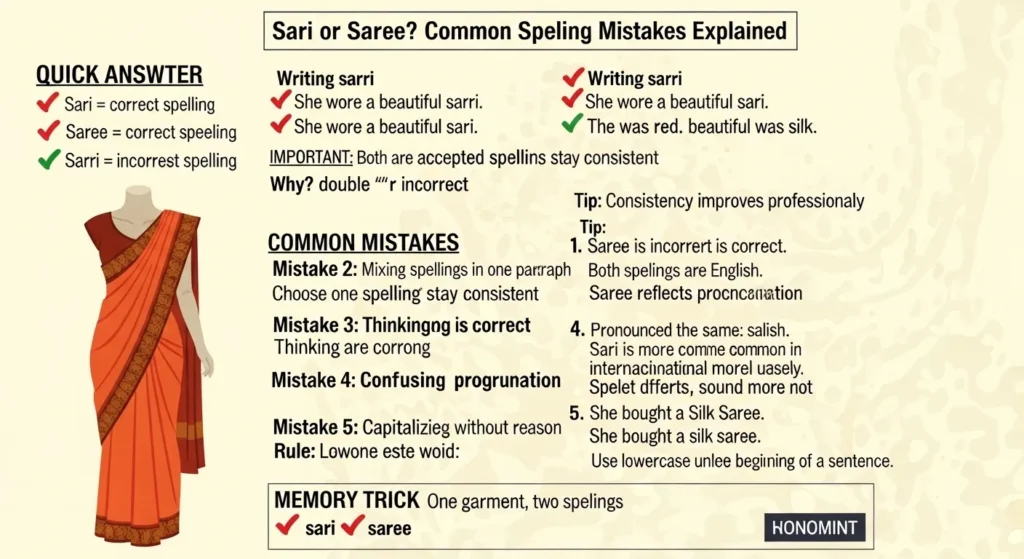
Here are frequent errors I see:
- ❌ Writing sarri
✅ Correct: sari / saree - ❌ Using both spellings randomly in one paragraph
✅ Choose one style and stay consistent - ❌ Thinking one spelling is wrong
✅ Both are correct - ❌ Confusing pronunciation
✅ It is pronounced the same: saa-ree - ❌ Capitalizing without reason
✅ Use lowercase unless at the start of a sentence
Sari or Saree in Everyday Examples
Here’s how I use the word in daily writing:
Email:
“I bought a silk sari for the wedding.”
News Article:
“The actress appeared in a traditional saree.”
Social Media:
“Loving this blue sari look!”
Formal Writing:
“The sari is a symbol of cultural heritage.”
Online Store:
“Shop designer sarees for festive events.”
Both spellings work in all these contexts.
Saree or Sari: Google Trends & Usage Data
When I checked search trends, I noticed something interesting:
- India → “saree” is searched more.
- United States → “sari” is slightly more common.
- United Kingdom → “saree” leads.
- Fashion eCommerce → Both are heavily used.
Search engines treat both words as the same meaning. If someone searches “sari,” they also see results for “saree.”
From an SEO point of view:
- Using both spellings naturally can increase reach.
- Do not stuff the keyword.
- Use variations like silk sari, bridal saree, Indian sari dress.
Comparison Table: Sari vs Saree
| Aspect | Sari | Saree |
| Meaning | Traditional Indian garment | Same |
| Pronunciation | Saa-ree | Saa-ree |
| Origin | From Hindi “sāṛī” | Same origin |
| Popular in India | Less than saree | More common |
| Popular in US | More common | Also used |
| Correct spelling? | ✅ Yes | ✅ Yes |
FAQs About Sari or Saree
1. Is sari or saree correct?
Both are correct spellings of the same garment.
2. Which spelling is more traditional?
“Sari” is closer to the original Indian word.
3. Why do Indians often write saree?
Because it reflects English phonetic style and colonial spelling habits.
4. Is sari American spelling?
Not officially, but it is slightly more common in the US.
5. Do dictionaries accept both?
Yes, major English dictionaries list both spellings.
6. Does Google treat them differently?
No, Google understands both as the same word.
7. Which spelling is better for SEO?
Use the spelling your audience searches most. You can also mention both naturally.
Conclusion
When I first faced the “sari or saree” confusion, I thought one must be wrong. But after researching, I realized both spellings are correct. The difference comes from language history, transliteration, and English spelling habits. There is no strict British vs American rule here. Instead, usage depends on audience and context.
If you write for American readers, “sari” may feel cleaner. If you write for UK or Indian readers, “saree” may feel more natural. For global content, mentioning both can help SEO and clarity. The most important rule is consistency. Pick one spelling and use it throughout your writing.
Now, whenever I write about traditional fashion, I choose my spelling with confidence. You can too.
Discover More Articles:

I am Mark Twain, a writer who loved the English language for its humor, irony, and everyday comparisons. I used simple words to show deep differences between truth and lies, wisdom and foolishness. My writing proves that clear English is always more powerful than complicated English.