

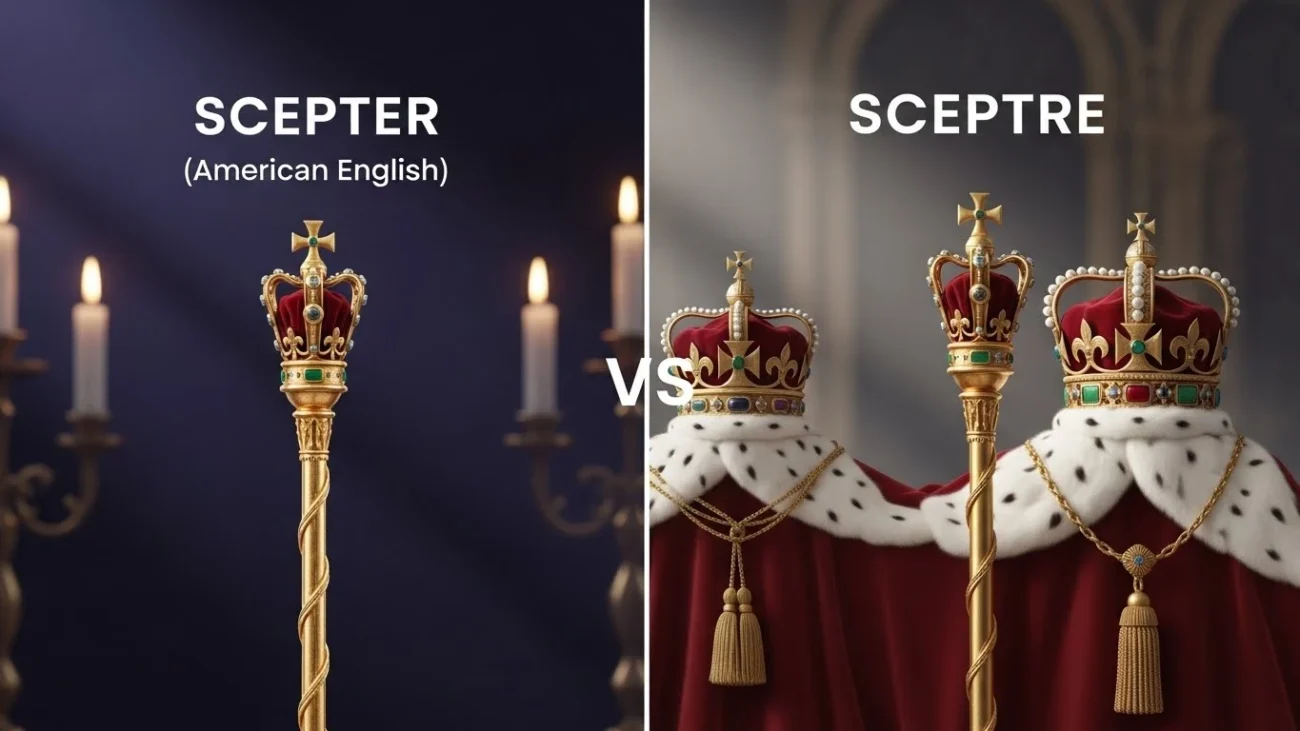
Many people search for scepter or sceptre because both spellings appear correct, yet they look different. You might see scepter in American books and sceptre in British texts, which naturally raises confusion.
Are they different objects? Is one wrong? Or is this another British vs American English issue?
I’ve noticed this confusion often comes up in history lessons, fantasy novels, royal descriptions, and formal writing.
Since a scepter/sceptre is linked to royalty and authority, using the correct spelling matters for accuracy and audience trust.
This article clears everything up in a simple way. You’ll get a quick answer, learn the word’s origin, understand British vs American spelling rules, avoid common mistakes, and see real life examples.
By the end, you’ll know exactly which spelling to use and when.
Scepter or Sceptre : Quick Answer
Both scepter and sceptre are correct.
They mean the same thing: a ceremonial staff held by a king or queen.
- Scepter → American English
- Sceptre → British English
Examples:
- The king held a golden scepter. (US)
- The queen raised her sceptre. (UK)
👉 Meaning is the same; spelling depends on region.
Read more: Preferred or Prefered : Which Spelling Is Correct and Why?
The Origin of Scepter or Sceptre
The word comes from the Greek skeptron, meaning staff or rod of authority. It passed into Latin as sceptrum and then into Old French.
When English adopted the word:
- British English kept the -re ending → sceptre
- American English simplified it to -er → scepter
This spelling split follows a common English pattern seen in other words too.
British English vs American English Spelling
This is a classic spelling difference.
| Aspect | British English | American English |
| Spelling | Sceptre | Scepter |
| Pronunciation | Same | Same |
| Meaning | Same | Same |
| Usage | UK, Commonwealth | United States |
👉 Only spelling changes, not meaning or pronunciation.
Which Spelling Should You Use?
Choose based on your audience.
- US audience → Scepter
- UK/Commonwealth audience → Sceptre
- Global or mixed audience → Pick one style and stay consistent
- Academic or historical writing → Match your style guide
Professional advice:
Never mix both spellings in the same document.
Common Mistakes with Scepter or Sceptre
❌ The king held a royal sceptor.
✅ The king held a royal sceptre.
❌ She lifted her sceptere proudly.
✅ She lifted her scepter proudly.
❌ Mixing spellings in one text
✅ Choose one spelling style and stick to it
Memory trick:
- UK likes -re → sceptre
- US likes -er → scepter
In formal writing, especially history essays, academic papers, and fantasy literature, choosing the correct regional spelling of scepter/sceptre improves credibility. Readers often associate spelling accuracy with subject knowledge, particularly when discussing royalty, monarchy, or symbolism.
Museums, textbooks, and historical records usually follow strict style guides, so consistency matters more than personal preference. Mixing scepter and sceptre in the same document can distract readers and weaken professionalism. This difference also appears in related words like center,centre and theater/theatre, reinforcing the importance of audience awareness.
Writers creating global content should select one spelling system and apply it throughout. Understanding regional spelling patterns not only prevents errors but also helps your writing feel polished, intentional, and trustworthy across different English speaking audiences.
Scepter or Sceptre in Everyday Examples
History
- The monarch’s sceptre symbolized power.
Fantasy Writing
- The wizard carried a magic scepter.
Education
- A sceptre represents royal authority.
Media
- The crown and scepter were displayed together.
Scepter or Sceptre :Google Trends & Usage Data
Search trends show:
- Scepter dominates searches in the US
- Sceptre is more common in the UK and Australia
- Both spike during history, royalty, and fantasy topics
👉 Searches usually aim to confirm correct regional spelling.
Comparison Table: Scepter vs Sceptre
| Feature | Scepter | Sceptre |
| Meaning | Royal staff | Royal staff |
| English type | American | British |
| Pronunciation | Same | Same |
| Correct spelling | Yes | Yes |
| Interchangeable | Region-based | Region-based |
FAQs: Scepter or Sceptre
1. Are scepter and sceptre the same thing?
Yes, they mean the same object.
2. Is one spelling wrong?
No, both are correct.
3. Which spelling should I use in exams?
Follow the English style taught (US or UK).
4. Is pronunciation different?
No, both are pronounced the same.
5. Is sceptre older than scepter?
Yes, the British spelling came first.
6. Can I use both in one article?
No, stay consistent.
7. Which spelling is safer globally?
Either, but consistency matters more.
Conclusion
The difference between scepter or sceptre is purely regional. Both words refer to the same royal symbol of authority and power. Scepter is preferred in American English, while sceptre is standard in British and Commonwealth English.
There is no difference in meaning, pronunciation, or formality only spelling. The key is to know your audience and remain consistent throughout your writing.
Once you understand this simple rule, you’ll never hesitate when choosing between scepter and sceptre again.Understanding regional spelling differences like scepter or sceptre helps you write with clarity, confidence, and professional accuracy for any audience.

I am Mark Twain, a writer who loved the English language for its humor, irony, and everyday comparisons. I used simple words to show deep differences between truth and lies, wisdom and foolishness. My writing proves that clear English is always more powerful than complicated English.