

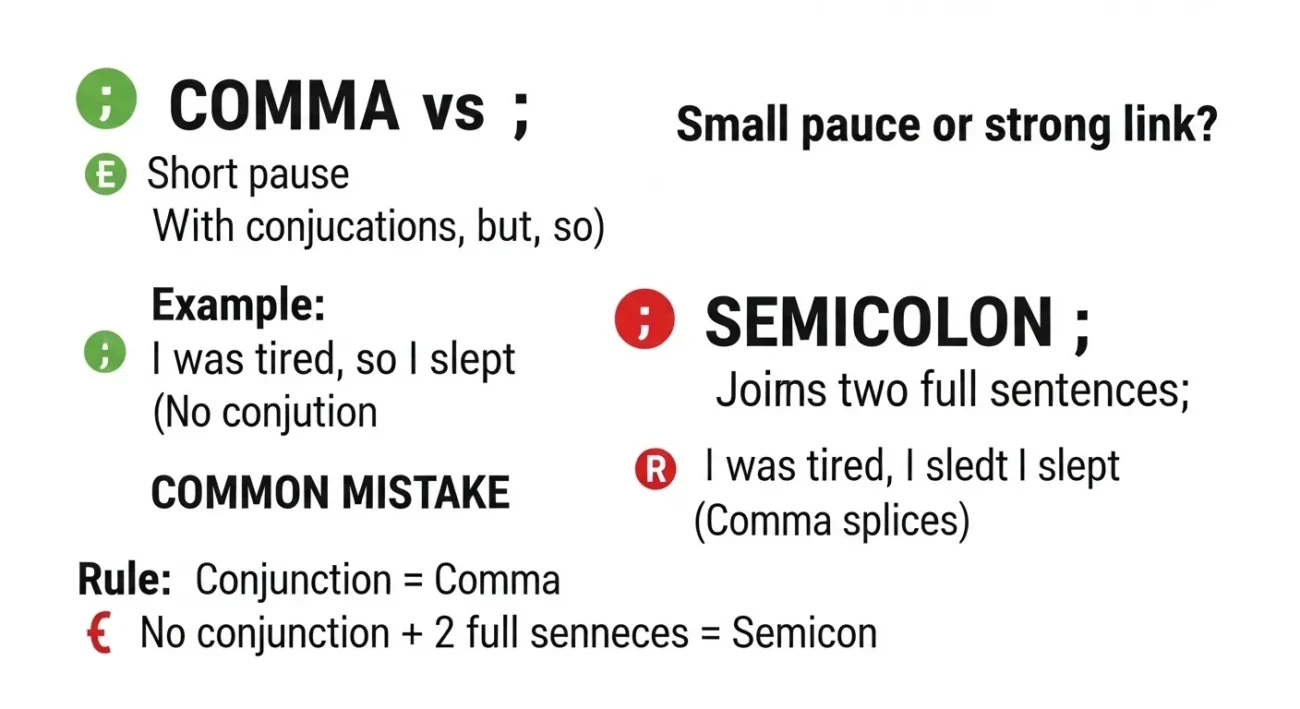
Semicolon or comma? The quick answer: use a comma for short pauses and simple lists, but use a semicolon to join closely related independent sentences.
I remember writing a long sentence once. I used a comma. It looked wrong. The sentence felt broken. Then I replaced it with a semicolon, and suddenly it made sense. Many students and writers search this question because punctuation can feel confusing. When do we use a comma? When do we use a semicolon?
In this guide, I will clearly explain the difference, rules, examples, common mistakes, and how to choose correctly.
Semicolon or Comma: Quick Answer
Here is the basic rule:
- Comma (,) → Short pause, lists, or joining clauses with conjunctions.
- Semicolon (;) → Connects two related complete sentences without a conjunction.
Example:
Comma:
- I went home, and I cooked dinner.
Semicolon:
- I went home; I cooked dinner.
Both sentences are correct, but the structure changes.
The Origin of Semicolon and Comma
The comma is older and more common. It comes from Greek writing and was adopted into Latin and English.
The semicolon was introduced in 1494 by Aldus Manutius, an Italian printer. He created it to show a pause stronger than a comma but weaker than a period.
That is why the semicolon sits between a comma and a full stop in strength.
British English vs American English Usage
There is no major spelling difference between US and UK English here.
Both styles follow the same punctuation rules.
However:
- American English often uses the Oxford comma in lists.
- British English sometimes omits it.
Example with Oxford comma:
- I bought apples, oranges, and bananas.
Without Oxford comma:
- I bought apples, oranges and bananas.
Semicolon rules remain the same in both regions.
Which One Should You Use in Comma and Semicolon?
It depends on your sentence structure.
Use a Comma When:
- Listing items
- I bought milk, bread, and eggs.
- Joining two clauses with a conjunction (and, but, so, because)
- I was tired, so I slept early.
- Adding extra information
- My brother, who lives in London, is visiting.
Use a Semicolon When:
- Joining two related independent clauses
- She loves reading; she visits the library weekly.
- Separating complex list items
- I have visited Paris, France; Rome, Italy; and Berlin, Germany.
When I write long sentences, I check if both parts can stand alone. If yes, I use a semicolon.
Common Mistakes with Semicolon or Comma
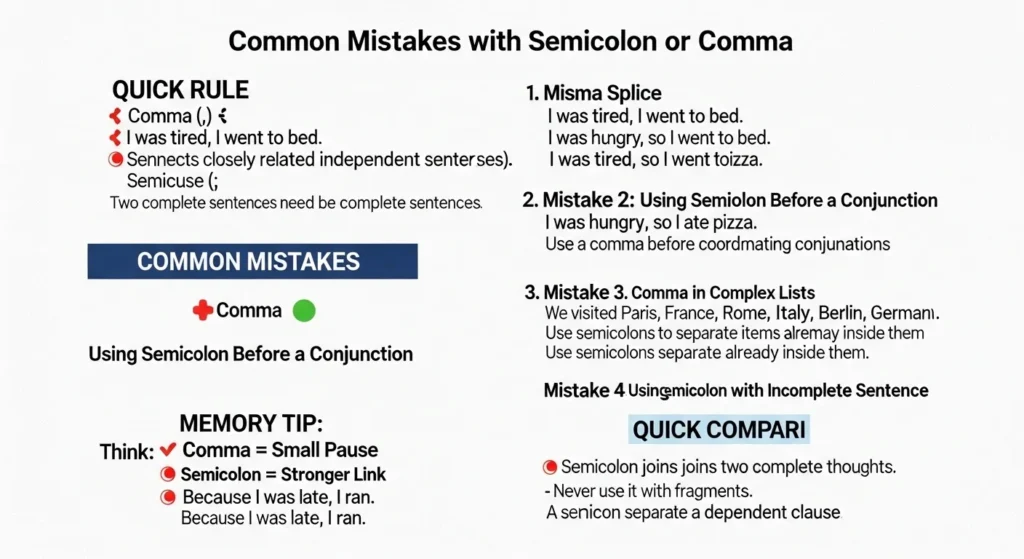
Comma Splice
❌ I was tired, I went to bed.
✅ I was tired; I went to bed.
✅ I was tired, so I went to bed.
Using Semicolon Before a Conjunction
❌ I was hungry; so I ate pizza.
✅ I was hungry, so I ate pizza.
Comma in Complex Lists
❌ We visited Paris, France, Rome, Italy, Berlin, Germany.
✅ We visited Paris, France; Rome, Italy; Berlin, Germany.
Using Semicolon with Incomplete Sentence
❌ Because I was late; I ran.
✅ Because I was late, I ran.
Comma or Semicolon in Everyday Examples
In Emails
“I reviewed the report, and I sent feedback.”
In Academic Writing
“The results were clear; the hypothesis was correct.”
In Social Media
“I tried, I failed, I tried again.”
(Grammatically correct version:)
“I tried; I failed; I tried again.”
In News Writing
“The economy is growing, but inflation remains high.”
Semicolon or Comma: Usage Trends
Usage patterns show:
- Commas are far more common in everyday writing.
- Semicolons appear mostly in academic, formal, or complex writing.
- Many writers avoid semicolons because they feel unsure about the rule.
In modern digital writing, commas dominate. However, semicolons are still important for clarity and style.
Comparison Table: Semicolon vs Comma
| Feature | Comma (,) | Semicolon (;) |
| Pause Strength | Short | Medium |
| Used in Lists | Yes | Yes (complex lists) |
| Joins Independent Clauses | With conjunction | Without conjunction |
| Common in Casual Writing | Very common | Less common |
| Avoids Comma Splice | No | Yes |
Frequently Asked Questions
1. What is the main difference between semicolon and comma?
A comma creates a short pause. A semicolon links related full sentences.
2. Can I replace a semicolon with a comma?
Not always. Doing so may create a comma splice error.
3. When should I avoid a semicolon?
Avoid it before conjunctions like “and” or “but.”
4. Is semicolon formal?
Yes. It appears more in academic and professional writing.
5. Is comma more common?
Yes. Commas are used far more often.
6. Can semicolon replace a period?
Sometimes, if the two sentences are closely related.
7. Why do people fear semicolons?
Because the rule feels strict, but it is simple once understood.
Conclusion
Semicolon or comma confusion is very common, but the rule is simple. Use a comma for short pauses, lists, and when joining clauses with conjunctions. Use a semicolon to connect two complete sentences that are closely related.
I once avoided semicolons because I felt unsure. Then I learned one simple rule: if both parts can stand alone as full sentences and are closely connected, use a semicolon. If you need a conjunction like “and” or “but,” use a comma.
Commas are common and flexible. Semicolons are stronger and more precise. Once you understand their purpose, punctuation becomes much easier.
Now you can confidently choose between a semicolon and a comma in your writing.
Discover More Articles:

I am Michael Swan, an English grammarian known for explaining confusing grammar and word comparisons in a clear way. I focused on real usage, not just rules, helping learners understand why English works the way it does. My work simplifies complex language problems for everyday users.