

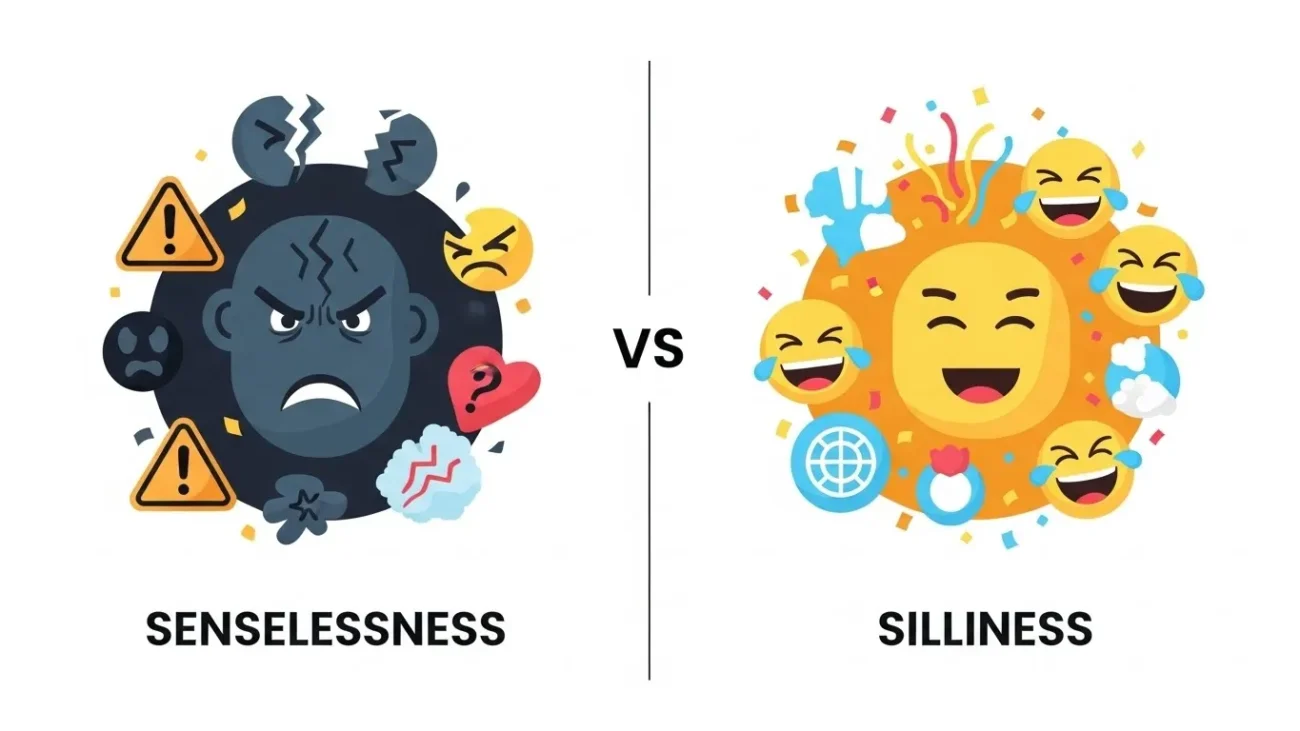
I still remember pausing mid-sentence, unsure whether senselessness or silliness fit better. Both words felt close, almost interchangeable, and that’s exactly why I’ve seen so many people search for “senselessness or silliness.”
Writers, students, even professionals struggle when describing foolish actions, meaningless behavior, or lighthearted fun.
I realized the confusion comes from overlapping tone, not meaning. One points to a lack of sense or reason, while the other suggests playful foolishness.
In this article, I clear that confusion with a quick answer, simple origins, real examples, and guidance on which word works best in everyday, formal, and professional writing.
Senselessness or Silliness: Quick Answer
Senselessness means a lack of meaning, logic, or reason.
Silliness means playful, childish, or lighthearted foolish behavior.
Examples
- The senselessness of the violence shocked everyone.
- The child’s silliness made the whole room laugh.
👉 Key difference:
- Senselessness = serious, negative, often harmful
- Silliness = harmless, playful, often funny
The Origin of Senselessness or Silliness
Senselessness
The word senselessness comes from sense (meaning, reason, understanding) combined with -less (without). It dates back to Middle English and was often used to describe actions without logic, purpose, or moral reasoning.
Over time, it gained strong emotional weight and became common in serious contexts like crime, war, or tragedy.
Silliness
Silliness comes from the Old English word sǣlig, which once meant “happy” or “innocent.” Over centuries, the meaning shifted from innocence to foolishness, and finally to playful or childish behavior.
That history explains why silliness still feels light and friendly today.
British English vs American English Spelling
There is no spelling difference between British and American English for these words.
Both varieties use:
- senselessness
- silliness
However, usage tone can differ slightly in context.
Comparison Table
| Word | British English Usage | American English Usage |
| Senselessness | Serious, formal, moral critique | Same serious tone |
| Silliness | Playful, informal, child-related | Same playful tone |
✔️ Spelling stays the same
✔️ Meaning stays the same
Which Spelling Should You Use?
Since there’s no spelling variation, your choice depends on audience and intent, not region.
- US audience:
Use senselessness for serious topics, silliness for humor or casual tone. - UK/Commonwealth audience:
Same rule applies. Context matters more than location. - Global or professional writing:
Choose senselessness for news, reports, or criticism.
Choose silliness for blogs, parenting content, or informal communication.
👉 Ask yourself: Is the behavior harmful or just playful?
That answer gives you the right word.
Common Mistakes with Senselessness or Silliness
Many writers mix these words and weaken their message.
❌ Common Errors
- Calling a violent act “silliness”
- Using “senselessness” for jokes or children’s play
- Treating both words as synonyms
✅ Correct Usage
- The senselessness of corruption hurts society.
- There was harmless silliness during the office party.
📌 Rule to remember:
If it makes people laugh → silliness
If it makes people angry or sad → senselessness
Senselessness or Silliness in Everyday Examples
Emails
- Please avoid the senselessness of repeating the same mistakes.
- Sorry for the silliness in my last message it was meant as a joke.
News
- The article condemned the senselessness of the attack.
Social Media
- Monday mood: pure silliness 🤪
Formal Writing
- The study highlights the senselessness of ignoring safety rules.
Each context clearly shows how tone decides the word.
Senselessness or Silliness: Google Trends & Usage Data
Search behavior shows that senselessness appears more often in:
- News articles
- Opinion pieces
- Social issues
- Crime and violence reports
Silliness trends higher in:
- Parenting blogs
- Social media
- Entertainment
- Casual conversations
Regional Usage Patterns
- US & UK: Balanced use, context-driven
- Global English learners: Often confuse the two
- Content writers: Search this keyword to avoid tone mistakes
The keyword “senselessness or silliness” is often searched by users wanting clarity, not spelling help, which makes intent-based explanation essential.
Comparison Table: Senselessness vs Silliness
| Feature | Senselessness | Silliness |
| Meaning | Lack of logic or meaning | Playful foolishness |
| Tone | Serious, negative | Light, humorous |
| Context | Violence, errors, criticism | Jokes, children, fun |
| Emotional Weight | Heavy | Light |
| Formal Writing | Common | Rare |
FAQs: Senselessness or Silliness
1. Are senselessness and silliness the same?
No. Senselessness is serious and negative. Silliness is playful and harmless.
2. Can I use silliness in formal writing?
Usually no. It sounds informal and casual.
3. Is senselessness always negative?
Yes. It implies lack of reason or meaning.
4. Which word fits children’s behavior?
Silliness fits best.
5. Which word suits news headlines?
Senselessness is the correct choice.
6. Do these words have spelling variations?
No. Both spell the same in US and UK English.
7. Why do people confuse these words?
Because both relate to foolish behavior but differ in seriousness.
Conclusion
Understanding the difference between senselessness or silliness can completely change the tone of your writing.
They may seem similar at first glance, they serve very different purposes. Senselessness carries weight. It points to actions that lack logic, meaning, or moral sense, often in serious or tragic situations.
Silliness, on the other hand, brings warmth. It describes harmless foolishness, playful moments, and lighthearted behavior.
I’ve learned that choosing the wrong word doesn’t just sound awkward it can misrepresent your message.
Calling a tragedy “silly” feels wrong, just as calling a joke “senseless” sounds too harsh. The key is intent.
The situation is serious or playful. That single question guides you to the correct choice every time.
For professional, academic, or news writing, senselessness is usually the safer option. For casual conversations, parenting content, or social media, silliness fits naturally.
Mastering this distinction improves clarity, tone, and credibility in your writing something every communicator benefits from.

I am Michael Swan, an English grammarian known for explaining confusing grammar and word comparisons in a clear way. I focused on real usage, not just rules, helping learners understand why English works the way it does. My work simplifies complex language problems for everyday users.