

Many people search for signed or sign because these two words look closely related, yet they are used very differently in English.
In everyday writing, you may see emails like “Please signed the document” or “The paper is sign.” Although the intention is understandable, the grammar is incorrect.
This confusion usually occurs because both words come from the same root, sign, while English changes word forms based on tense and function.
As a result, writers often ask one simple question: Which one should I use here?
This article answers that question clearly and quickly. First, you’ll see a direct explanation.
Then, you’ll get an easy breakdown of grammar rules, common mistakes, and real-life examples.
By the end, you’ll confidently know when to use sign and when signed is the correct choice without overthinking it.
Signed or Sign: Quick Answer
Sign is the base verb (present tense or command).
Signed is the past tense or past participle.
Examples:
- Please sign the form.
- I signed the agreement yesterday.
- The contract is signed.
👉 Present or command → sign
👉 Past or completed action → signed
Discover more Artical:Caretaker or Caregiver: Meaning,Difference and Proper Usage
The Origin of Signed or Sign
The word sign comes from the Latin signum, which means a mark or symbol.
Over time, English adopted it as a verb meaning to write your name or approve something.
Meanwhile, the -ed ending in signed follows a standard grammar rule that shows:
- A past action
- A completed state
Because of this rule, sign and signed are not interchangeable they express time and completion.
British English vs American English Spelling
There is no spelling difference between British and American English.
| Aspect | British English | American English |
| Sign | Sign | Sign |
| Signed | Signed | Signed |
| Grammar rule | Same | Same |
👉 In short, the rule is global.
Which Spelling Should You Use?
Use sign when:
- Giving instructions
- Talking about present or future actions
Use signed when:
- Referring to the past
- Describing a completed document
Quick tip:
If the action is finished, choose signed.
Common Mistakes with Signed or Sign
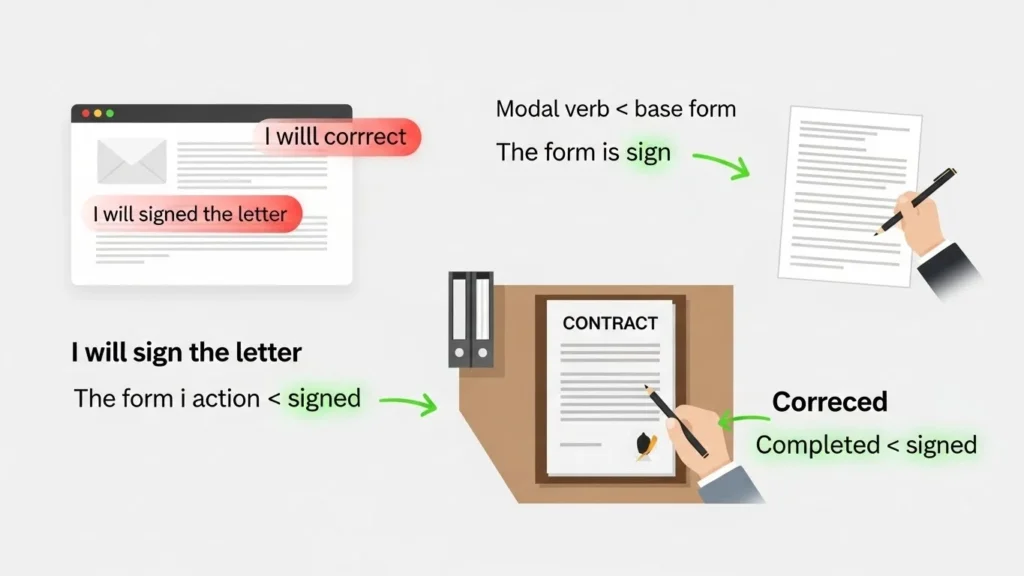
❌ Please signed here.
✅ Please sign here.
❌ I will signed the letter tomorrow.
✅ I will sign the letter tomorrow.
❌ The form is sign.
✅ The form is signed.
Most errors happen because writers translate directly from their first language or overthink English tenses. These mistakes commonly appear in emails, forms, and professional documents.
One frequent problem involves modal verbs such as will, can, should, and must. After these verbs, English always uses the base form. For that reason, “I will sign the document” is correct, while “I will signed the document” is not.
Another issue appears in instructions. Since instructions describe actions that are not completed yet, English uses sign, not signed. Therefore, “Please sign here” is correct.
Writers also mix up active and passive structures. In active sentences, the focus stays on the person doing the action (She signed the form). In contrast, passive sentences focus on the result (The form is signed). Confusing these forms often leads to errors like “The form is sign.”
Finally, some learners assume there is a British–American difference. However, this assumption is incorrect. The rule for sign and signed remains the same worldwide.
By avoiding these mistakes, your English will sound clearer, more professional, and grammatically accurate.
Signed or Sign in Everyday Examples
Emails
- Kindly sign and return the document.
- The agreement has been signed.
Office
- You must sign before submission.
- Management signed the policy.
Legal
- A signed contract is binding.
Social Media
- Finally signed the deal! 🎉
Signed or Sign: Google Trends & Usage Data
Search data highlights:
- Frequent confusion in professional writing
- High usage in legal and business contexts
- Strong interest in fixing tense-related errors
Top regions searching this topic include:
- United States
- United Kingdom
- India
- Pakistan
👉 Clearly, users want simple and reliable grammar guidance.
Comparison Table: Signed vs Sign
| Feature | Sign | Signed |
| Verb tense | Present / base | Past / completed |
| Used for commands | Yes | No |
| Shows completion | No | Yes |
| Common in instructions | Yes | No |
| Common in reports | No | Yes |
FAQs: Signed or Sign
1. Is “please signed” correct?
No. The correct phrase is please sign.
2. Can “signed” be an adjective?
Yes, for example: a signed document.
3. Which form should I use in emails?
It depends on the tense you need.
4. Is there a US vs UK difference?
No, both follow the same rule.
5. Can “sign” be a noun?
Yes, although this article focuses on verb usage.
6. Is “has sign” correct?
No. The correct form is has signed.
7. Which form sounds more professional?
Using the correct tense always sounds professional.
Conclusion
The difference between signed and sign becomes easy once you focus on time.
Use sign for present actions and instructions, while signed shows a completed or past action.
Importantly, British and American English follow the same grammar rules.
So, when asking someone to take action, choose sign. When the action is already complete, use signed.
Mastering this small distinction will immediately improve both your professional and everyday English writing.

I am Mark Twain, a writer who loved the English language for its humor, irony, and everyday comparisons. I used simple words to show deep differences between truth and lies, wisdom and foolishness. My writing proves that clear English is always more powerful than complicated English.