

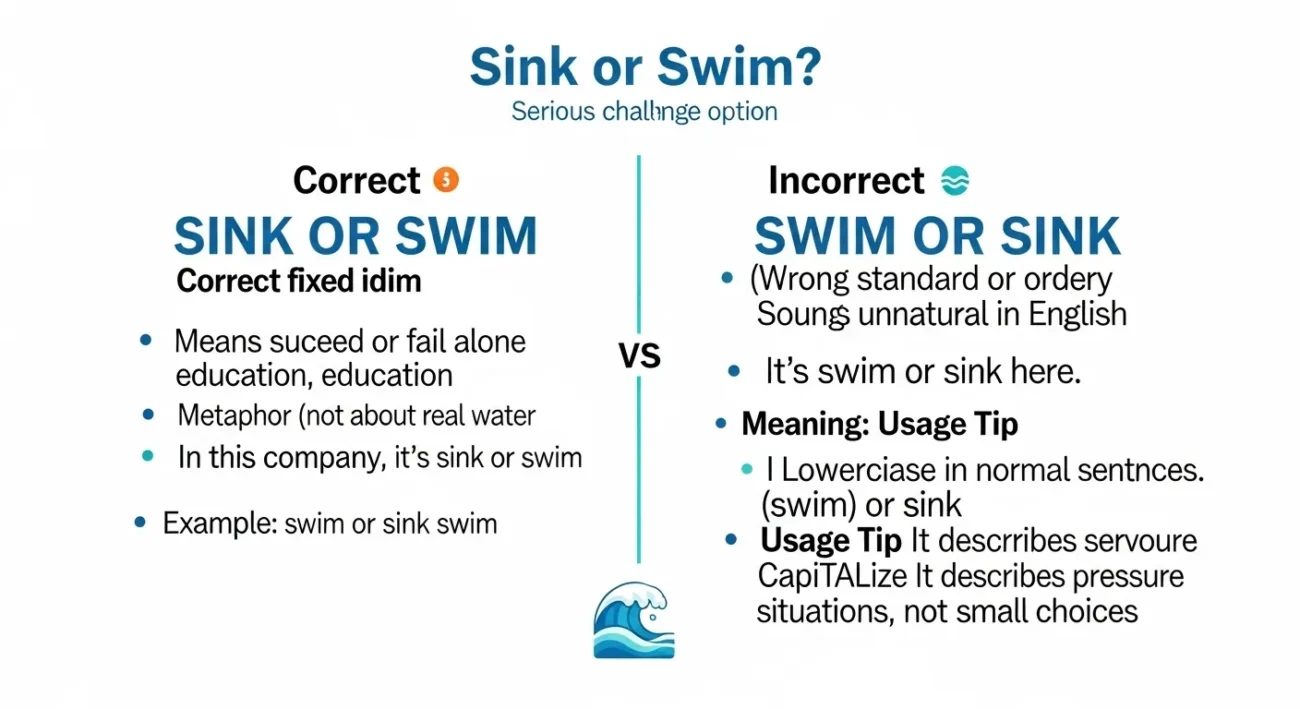
The Short answer is : Sink or swim means succeed by your own effort or fail completely.
I still remember my first job. No one guided me much. My manager smiled and said, “It’s sink or swim.” I felt nervous. Would I manage?
Many people search “sink or swim” because they hear it in movies, offices, and sports. They want to know what it really means. Is it negative? Is it about water?
In this guide, I will explain the meaning, origin, correct usage, common mistakes, and real-life examples in simple and clear language.
Sink or Swim: Quick Answer
Sink or swim means:
👉 You must succeed on your own, or you will fail.
It describes a situation with no help.
Examples:
- In this company, it’s sink or swim.
- The new student had to sink or swim in a tough class.
It is not about real swimming. It is a metaphor.
The Origin of Sink or Swim
The phrase comes from the natural idea of water. If someone falls into deep water, they either sink (fail) or swim (survive).
The expression has been used in English for hundreds of years. It became common in business, education, and military settings. It describes a test of ability.
In older times, people believed in “trial by water.” If someone floated, they were innocent. If they sank, they were guilty. This harsh idea helped shape the phrase.
Over time, the meaning changed. Today, it simply means proving yourself without support.
British English vs American English Spelling
There is no spelling difference between British and American English.
| Phrase | United States | United Kingdom |
| Sink or swim | Same | Same |
The phrase stays the same everywhere.
Which Spelling Should You Use?
Always write sink or swim in lowercase unless it starts a sentence.
Examples:
- It’s sink or swim in this field.
- Sink or swim situations build strong people.
There are no alternative spellings. The phrase never changes by region.
Common Mistakes with Sink or Swim
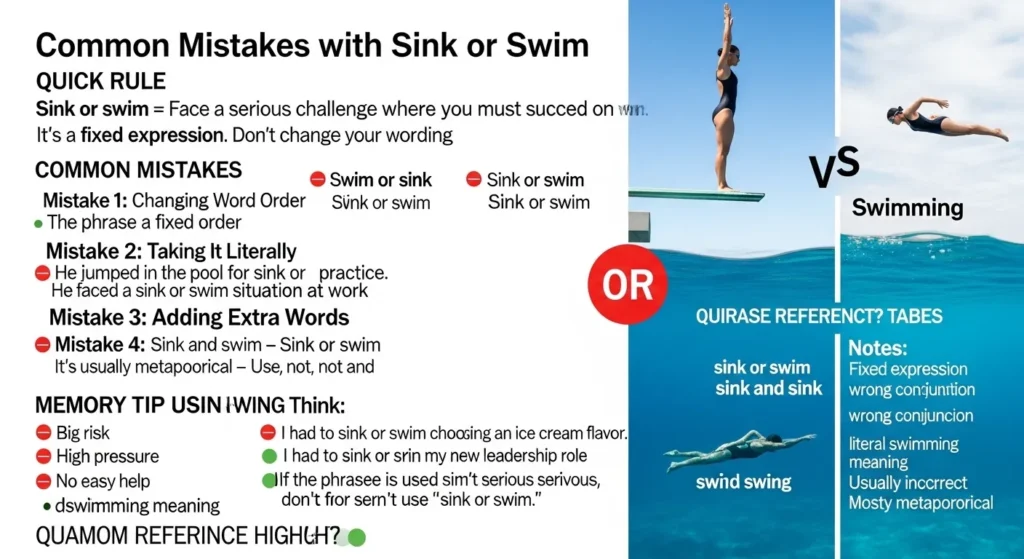
Mistake 1: Changing word order
❌ Swim or sink
✅ Sink or swim
Taking it literally
❌ He jumped in the pool for sink or swim practice.
✅ He faced a sink or swim situation at work.
Adding extra words
❌ Sink and swim
✅ Sink or swim
Mistake 4: Using it in soft situations
❌ I had to sink or swim choosing ice cream flavor.
✅ I had to sink or swim in my new leadership role.
The phrase is used for serious challenges.
Swin or Sink in Everyday Examples
In Business:
- New employees often face a sink or swim environment.
Education:
- The teacher believed in sink or swim learning.
In Sports:
- The rookie athlete had to sink or swim in the finals.
On Social Media:
- Life update: sink or swim mode activated.
In News:
- Small startups survive in a sink or swim market.
It shows pressure and independence.
Sink or Swim: Usage & Popularity
The phrase is popular worldwide. It is often searched with:
- sink or swim meaning
- sink or swim idiom
- sink or swim example sentence
Search interest increases during:
- Exam seasons
- Job interviews
- Career changes
It is common in English-speaking countries like:
- United States
- United Kingdom
- Canada
- Australia
- India
People use it to describe competitive environments.
Comparison Table: Sink vs Swim Meaning
| Word | Literal Meaning | Figurative Meaning |
| Sink | Go underwater | Fail |
| Swim | Move in water | Succeed |
| Sink or swim | Water survival | Succeed or fail alone |
The combined phrase shows a choice between failure and success.
FAQs
1. What does sink or swim mean?
It means succeed without help or fail.
2. Is sink or swim negative?
It can sound harsh, but it also shows strength.
3. Is it about real swimming?
No. It is a metaphor.
4. Where is it commonly used?
In business, education, and sports.
5. Can I say swim or sink?
No. The correct phrase is sink or swim.
6. Is it formal or informal?
It can be used in both casual and formal writing.
7. Does spelling change by country?
No. It stays the same everywhere.
Conclusion
Sink or swim is a powerful phrase. I remember feeling afraid when I first heard it. But later, I understood it meant growth. It means you must depend on yourself. No one will rescue you.
There is no spelling difference between countries. The phrase is fixed and simple. It describes serious challenges where success depends on effort and skill.
Life often puts us in sink or swim moments. At first, they feel scary. But they can build confidence and strength. Now, whenever I hear the phrase, I don’t feel fear. I feel motivation.
Discover More Articles:

I am Mark Twain, a writer who loved the English language for its humor, irony, and everyday comparisons. I used simple words to show deep differences between truth and lies, wisdom and foolishness. My writing proves that clear English is always more powerful than complicated English.