


Many people search for “somebody or someone” because both words seem to mean the same thing. They sound similar, look interchangeable, and appear in everyday speech, emails, books, and social media.
This creates confusion, especially for students, writers, and non-native English speakers who want to sound natural and correct. Is one more formal? Is one American and the other British? Or is there a hidden rule most people miss?
This article solves that confusion clearly and simply. I’ll give you a quick answer, explain the origin, compare usage, show real examples, highlight common mistakes, and help you choose the right word with confidence.
Somebody or Someone : Quick Answer
Both “somebody” and “someone” are correct and mean the same thing: an unknown or unspecified person.
Examples:
- Somebody left their bag here.
- Someone called you earlier.
In modern English, they are interchangeable in meaning. The difference is style and tone, not correctness.
- Someone sounds slightly more neutral and formal.
- Somebody sounds a bit more conversational and emotional.
The Origin of Somebody or Someone
Both words come from Old and Middle English. They were formed by combining:
- some (an unspecified amount)
- body / one (a person)
“Somebody” appeared earlier in spoken English and felt more physical or personal. “Someone” developed later and sounded more abstract and neutral. Over time, English speakers kept both forms, not because they mean different things, but because English often keeps multiple words with the same meaning for style choice.
There is no spelling evolution conflict here, unlike color/colour. The difference exists because English borrowed and blended words naturally across centuries.
British English vs American English Spelling
There is no spelling difference between British and American English for these words.
Both regions use:
- somebody
- someone
The difference is usage preference, not spelling rules.
| Aspect | British English | American English |
| Somebody | Common in speech | Common in speech |
| Someone | Common in writing | Very common in writing |
| Formal tone | Prefers “someone” | Prefers “someone” |
| Informal tone | Uses “somebody” | Uses “somebody” |
Which Spelling Should You Use?
Choose based on audience and tone, not location.
- For formal writing (emails, reports, exams):
Use someone
Someone has reviewed your application. - For casual speech or storytelling:
Use somebody
Somebody forgot their keys again. - For global audiences and SEO content:
Prefer someone, as it sounds neutral and professional worldwide.
If you are unsure, someone is always the safer choice.
Common Mistakes with Somebody or Someone
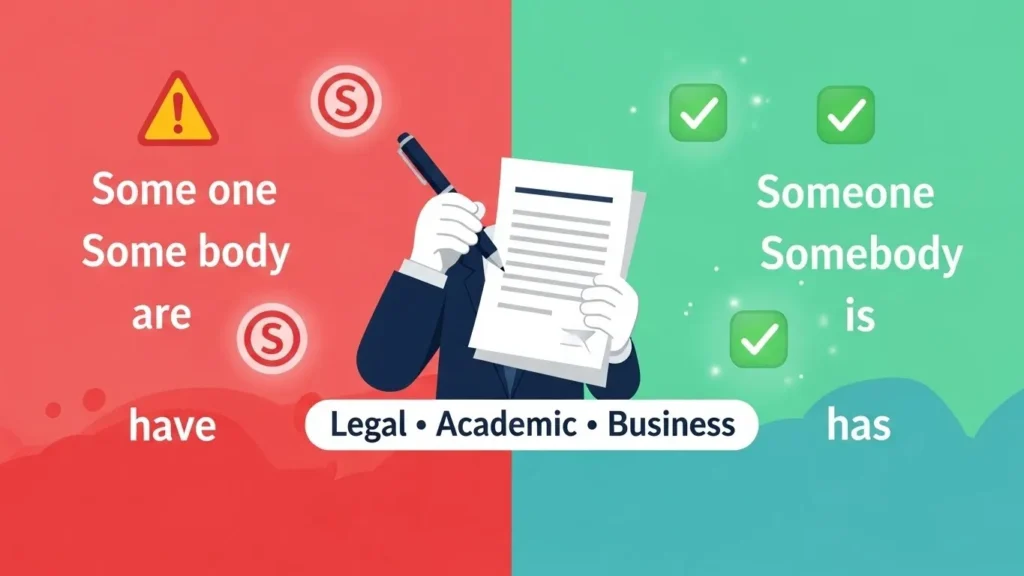
Here are frequent errors and how to fix them:
- ❌ Some one is waiting outside.
✅ Someone is waiting outside. - ❌ Some body called me yesterday.
✅ Somebody called me yesterday. - ❌ Somebody are knocking.
✅ Somebody is knocking. - ❌ Someone have finished the task.
✅ Someone has finished the task.
Remember: Both words are singular, even if they refer to an unknown person.
Learn MOre : Optimist or Pessimist: Meaning,Difference and Correct Usage?
Somebody or Someone in Everyday Examples
Emails:
- Someone from HR will contact you soon.
- Somebody attached the wrong file.
News:
- Someone was arrested during the protest.
- Police say somebody reported the incident.
Social Media:
- Somebody please explain this trend!
- Someone just spoiled the movie ending.
Formal Writing:
- Someone must take responsibility for the error.
- If somebody wishes to apply, they must submit the form.
Somebody or Someone : Google Trends & Usage Data
Search data shows that “someone” is slightly more popular globally, especially in professional and academic contexts.
- United States: “someone” dominates formal searches
- UK & Commonwealth: both are equally searched
- ESL learners: often search “somebody or someone” to understand correctness
In fiction, dialogue, and emotional writing, “somebody” appears more often. In legal, academic, and business writing, “someone” is preferred.
Comparison Table: Somebody vs Someone
| Feature | Somebody | Someone |
| Meaning | Unknown person | Unknown person |
| Formality | More casual | More neutral/formal |
| Grammar | Singular | Singular |
| British English | Correct | Correct |
| American English | Correct | Correct |
| Writing safety | Medium | High |
| Emotional tone | Slightly stronger | Neutral |
FAQs
1. Are somebody and someone interchangeable?
Yes. They have the same meaning and grammar.
2. Is somebody more informal than someone?
Slightly, yes. Somebody sounds more conversational.
3. Is one British and the other American?
No. Both are used in both varieties of English.
4. Which is better for exams or formal writing?
Someone is usually preferred.
5. Can somebody or someone be plural?
No. Both are singular and take singular verbs.
6. Do they affect SEO differently?
Someone performs slightly better in informational content.
7. Can I mix both in the same article?
Yes, but be consistent in tone.
Conclusion
The confusion between somebody or someone exists because English allows style-based choices without changing meaning. Both words refer to an unknown person, both are grammatically correct, and both are widely accepted in British and American English. The real difference lies in tone, not rules. From my experience, when I want to sound clear, professional, and safe especially in emails, articles, or exams I choose someone. When I want warmth, emotion, or a natural spoken feel, somebody fits better. Understanding this small distinction improves writing confidence and clarity. Once you know the context and audience, choosing between somebody and someone becomes easy, natural, and stress-free.

I am Sidney Greenbaum, a linguist who studied how English is actually used, not just how it is taught. I analyzed sentence structure and word differences to make English clearer and more practical. My research helped learners understand real-world English comparisons.