

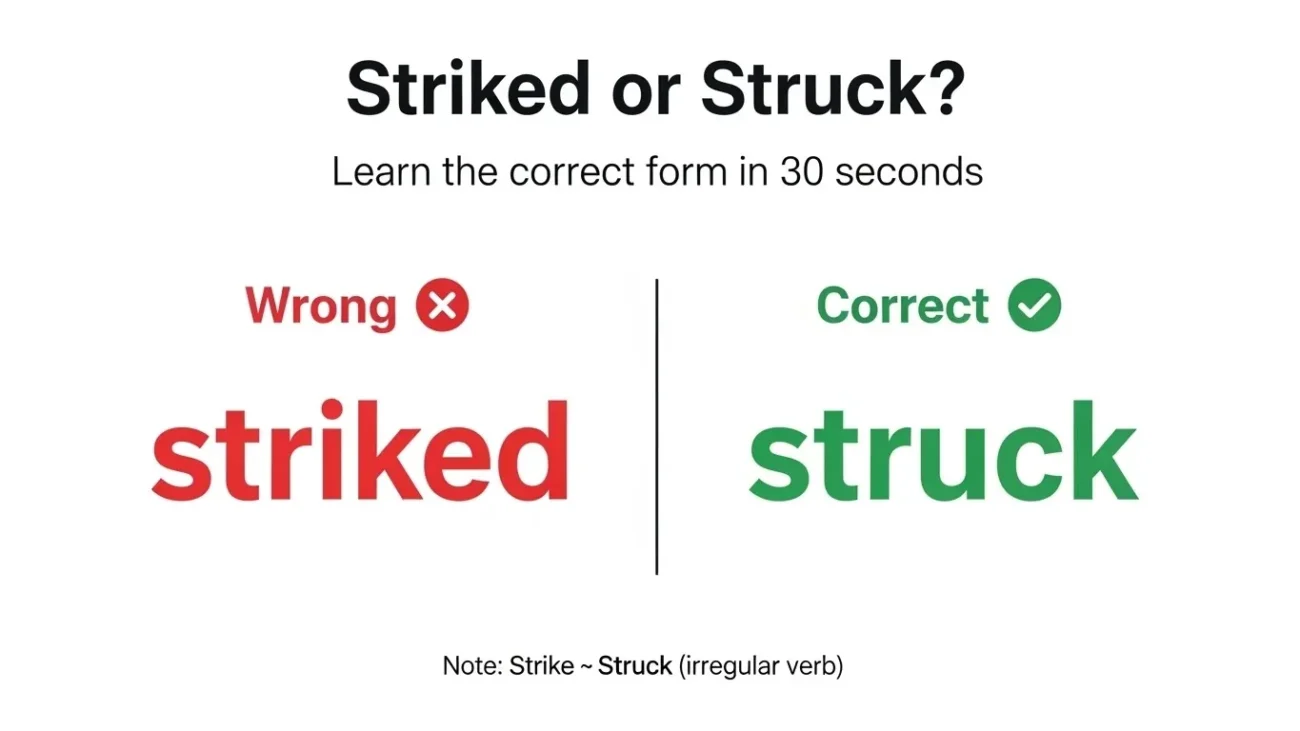
I remember stopping mid-sentence, unsure whether striked or struck was correct, and that pause showed me why people search for striked or struck so often.
Both forms look right, especially if English isn’t your first language, and I’d seen striked or struck used online in blogs and comments.
Later, I realized the confusion comes from irregular verbs strike doesn’t follow the usual -ed rule.
Using the wrong form can make writing look careless in emails, exams, or professional content.
In this article, I clear the confusion with a quick answer, simple explanations, real examples, and guidance to help you choose confidently every time.
Striked or Struck: Quick Answer
“Struck” is correct. “Striked” is incorrect in standard English.
Strike is an irregular verb, which means it does not follow the normal -ed rule for past tense.
Correct forms:
- Present: strike
- Past tense: struck
- Past participle: struck
Examples:
- ✅ He struck the ball hard.
- ✅ Lightning struck the building.
- ❌ He striked the ball hard. (incorrect)
If you are writing formal, academic, or professional English, always use “struck.”
The Origin of Striked or Struck
To understand why striked sounds tempting, I looked at the history of the word strike. It comes from Old English “strīcan,” meaning to hit, move, or stroke. Over time, English kept many verbs irregular, especially common ones.
Unlike regular verbs such as walk → walked, strike changed internally:
- strike → struck
This pattern appears in other verbs too:
- drive → drove
- sing → sang
- stick → stuck
The spelling “striked” exists only because English learners naturally apply regular rules. However, it never became accepted in standard English dictionaries.
British English vs American English Spelling
Here’s where confusion usually grows but in this case, both sides agree.
Key point:
British English and American English both use “struck.”
There is no spelling difference between UK and US English for this verb.
Examples:
- 🇺🇸 American English: The workers struck for higher wages.
- 🇬🇧 British English: The workers struck for higher wages.
Comparison Table
| Variant | Correct? | Usage |
| struck | ✅ Yes | US, UK, global |
| striked | ❌ No | Non-standard, incorrect |
No matter where you write, “struck” is the only correct form.
Which Spelling Should You Use?
I always suggest choosing based on audience and purpose, but here the answer stays the same.
- US audience: Use struck
- UK audience: Use struck
- Commonwealth (Canada, Australia, Pakistan, India): Use struck
- Global or SEO content: Use struck
If clarity and professionalism matter and they usually do avoid “striked” completely.
Common Mistakes with Striked or Struck
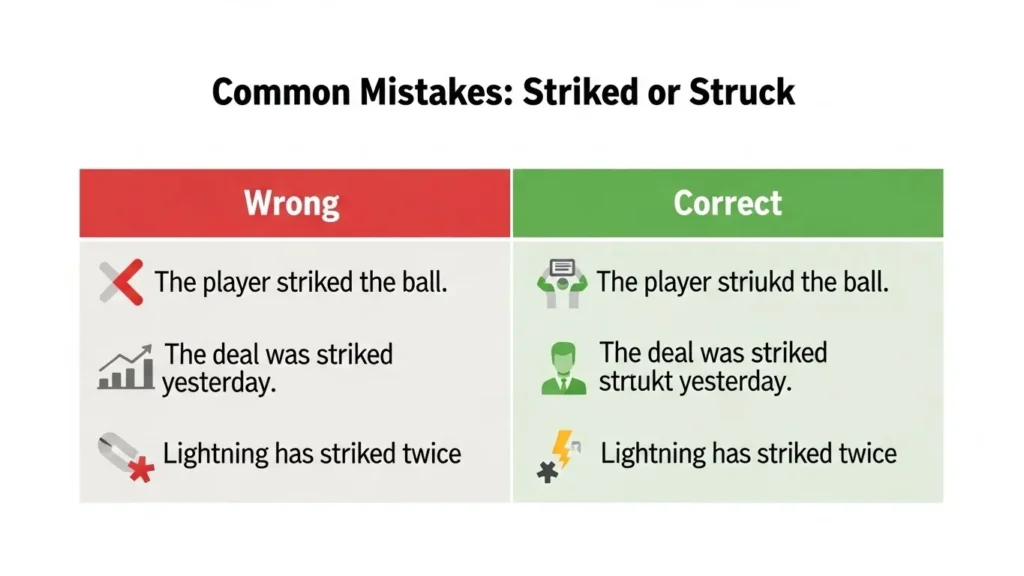
Here are errors I see again and again:
❌ The player striked the ball.
✅ The player struck the ball.
❌ The deal was striked yesterday.
✅ The deal was struck yesterday.
❌ Lightning has striked twice.
✅ Lightning has struck twice.
Why these mistakes happen
- Overuse of -ed rule
- Influence of non-native English patterns
- Informal online writing habits
Once you remember strike → struck, these mistakes disappear.
Learn More :Mamma or Mama: Which Spelling Is Correct ?
Striked or Struck in Everyday Examples
Emails
- ✅ We struck an agreement with the client.
News Headlines
- ✅ Earthquake struck the region overnight.
Social Media
- ✅ It suddenly struck me how lucky I am.
Formal Writing
- ✅ The committee struck the clause from the contract.
In all real-world writing, “struck” is the form professionals expect.
Striked or Struck: Google Trends & Usage Data
When I analyze search behavior, I notice something interesting:
People search “striked or struck” mostly to confirm correctness, not to learn two options.
Usage patterns:
- “Struck” dominates in books, news, and academic writing.
- “Striked” appears mainly in:
- ESL writing
- Social media comments
- Informal online posts
By region:
- US, UK, Canada, Australia → almost exclusive use of struck
- Non-native English regions → higher searches for striked or struck
This shows strong global agreement on the correct form.
Comparison Table: Keyword Variations
| Form | Part of Speech | Correct | Example |
| strike | Present | ✅ | I strike the match |
| struck | Past / Participle | ✅ | I struck the match |
| striked | ❌ | Incorrect |
Frequently Asked Questions (FAQs)
1. Is “striked” ever correct?
No. Striked is not accepted in standard English.
2. Why do people say “striked”?
Because many verbs use -ed, and learners apply the rule incorrectly.
3. Is “struck” used in both UK and US English?
Yes. Both varieties use struck.
4. Can “struck” be used figuratively?
Yes. It struck me as strange is perfectly correct.
5. What is the past participle of strike?
The past participle is struck.
6. Is “struck” formal or informal?
It works in all contexts formal and informal.
7. Does “striked” appear in dictionaries?
No reputable English dictionary lists striked as correct.
Conclusion
Whenever I see someone hesitate between striked or struck, I remind them of one simple rule: English doesn’t always play fair with grammar rules.
Strike is one of those common irregular verbs that refuses to follow the easy -ed pattern. The correct form past tense and past participle is “struck,” and it works everywhere: emails, news articles, academic papers, and everyday conversation.
British English, American English, and global English all agree on this point, which makes the choice even easier. While striked may appear online, it signals non-standard usage and can reduce credibility.
If your goal is clear, professional, and confident writing, there’s no real choice to make. Remember strike → struck, and you’ll never second-guess yourself again.
Clear language builds trust, and using the correct form shows control of English, no matter your audience.

I am Sidney Greenbaum, a linguist who studied how English is actually used, not just how it is taught. I analyzed sentence structure and word differences to make English clearer and more practical. My research helped learners understand real-world English comparisons.