

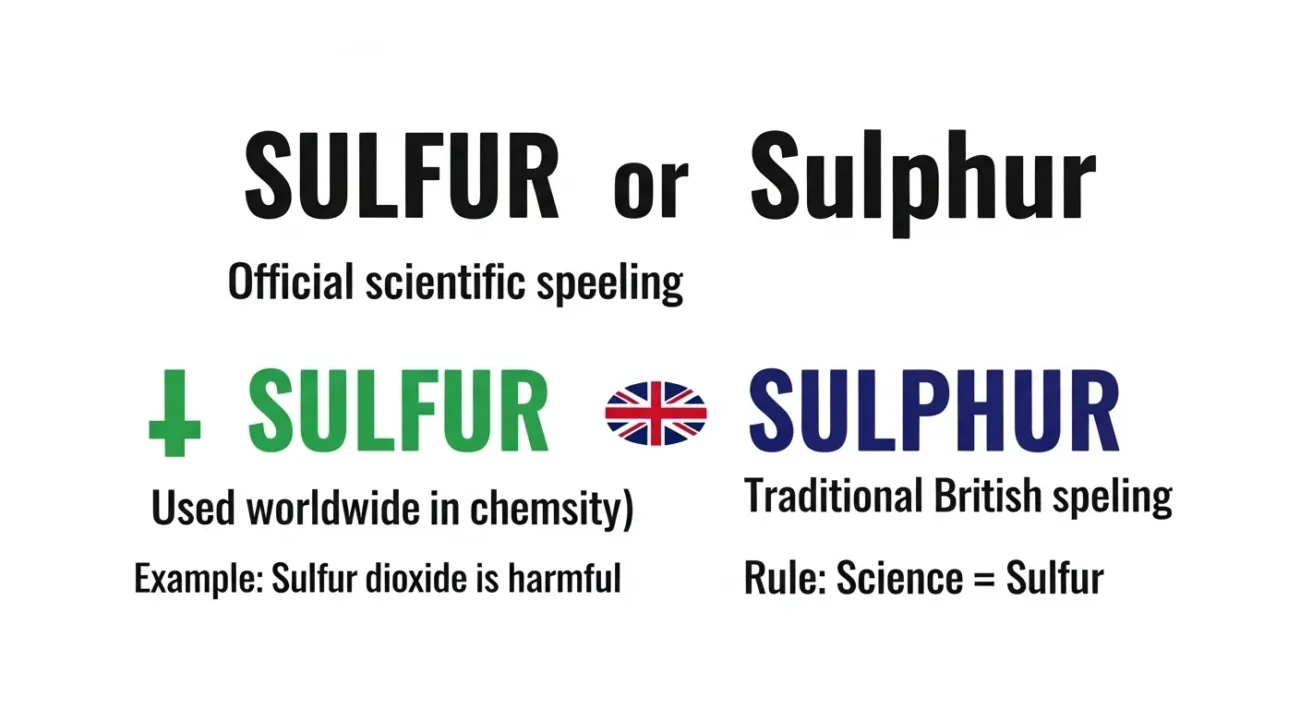
Sulfur or sulphur? The quick answer: “sulfur” is the official scientific spelling, but both are correct in general English.
I remember writing a science article and stopping at this exact word I had seen both spellings in books. I felt confused. Many students, writers, and researchers search this question for the same reason. Is one wrong? Is one American only? Why do chemistry books use “sulfur”?
In this guide, I will clearly explain the difference, history, spelling rules, common mistakes, usage examples, and which version you should choose.
Sulfur or Sulphur: Quick Answer
Both words refer to the same chemical element.
- Sulfur → American English and official scientific spelling
- Sulphur → Traditional British English spelling
In modern chemistry, “sulfur” is the standard worldwide spelling.
Example:
- The volcano released sulfur gas.
- The volcano released sulphur gas.
Both sentences are correct in general writing, but scientific publications prefer “sulfur.”
The Origin of Sulfur and Sulphur
The word comes from Latin sulfur (also spelled sulphur in old texts).
In the past, British English added “ph” in many Greek-based words. Over time, both spellings existed side by side.
In 1990, the International Union of Pure and Applied Chemistry (IUPAC) officially chose “sulfur” as the correct spelling for scientific use worldwide.
That decision made “sulfur” the global chemistry standard.
British English vs American English Spelling
English spelling differences explain this confusion.
Here are similar examples:
| American English | British English |
| Color | Colour |
| Theater | Theatre |
| Defense | Defence |
| Sulfur | Sulphur |
American English prefers simpler spellings. British English often keeps traditional forms.
However, in science, even the UK now uses “sulfur” in textbooks and research papers.
Which Spelling Should You Use?
It depends on context.
In Scientific Writing
Use sulfur. It is the official international standard.
In American English Writing
Use sulfur.
In British General Writing
You may use sulphur, especially in older or literary contexts.
For a Global Audience
Use sulfur. It is clear and accepted worldwide.
When I write about chemistry, I always use “sulfur.” It avoids confusion.
Common Mistakes with Sulfur or Sulphur
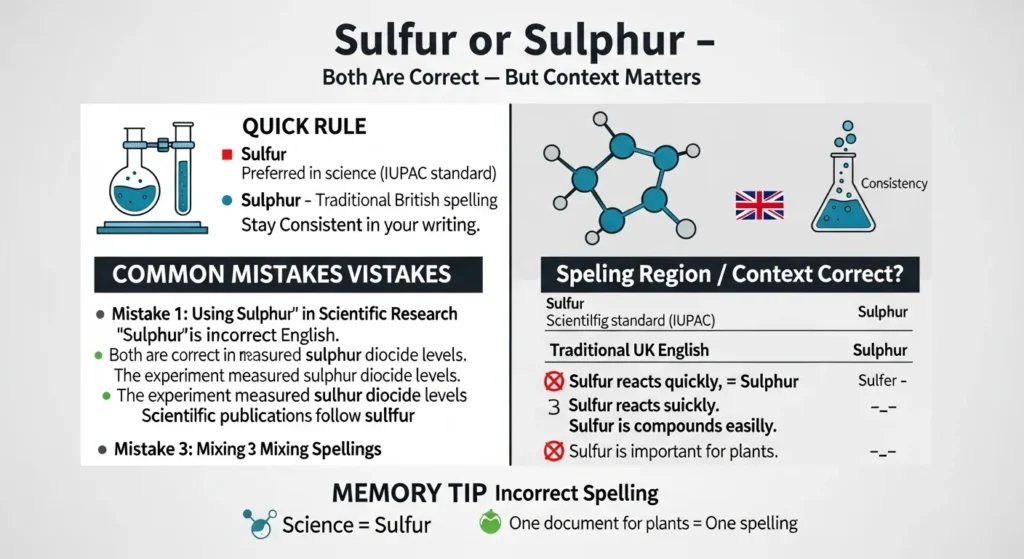
Mistake 1: Thinking One Is Completely Wrong
❌ “Sulphur” is incorrect English.
✅ Both are correct in general English, but science prefers “sulfur.”
Mistake 2: Using Sulphur in Scientific Research
❌ The experiment measured sulphur dioxide levels.
✅ The experiment measured sulfur dioxide levels.
Mistake 3: Mixing Both Spellings in One Document
❌ Sulfur reacts quickly. Sulphur forms compounds easily.
✅ Sulfur reacts quickly. Sulfur forms compounds easily.
Stay consistent.
Mistake 4: Incorrect Spelling
❌ Sulfer is important for plants.
✅ Sulfur is important for plants.
Sulphur or Sulfur in Everyday Examples
Here is how the word appears in daily life.
In School Textbooks
“Sulfur is a nonmetal element.”
In News Reports
“Volcano releases sulfur dioxide into the air.”
In Product Labels
“Contains sulfur for acne treatment.”
In Literature (British Style)
“The smell of sulphur filled the air.”
Context often decides the spelling.
Sulfur or Sulphur: Google Trends & Usage Data
Search patterns show clear trends:
- In the United States, sulfur dominates.
- In the United Kingdom, “sulphur” was common in the past.
- Modern science websites worldwide use sulfur.
Since IUPAC standardized the spelling, academic and chemical publications now almost always use “sulfur.”
Globally, “sulfur” has stronger search volume today.
Comparison Table: Sulfur vs Sulphur
| Feature | Sulfur | Sulphur |
| English Style | American | Traditional British |
| Scientific Standard | Yes | No |
| Used in Research | Yes | Rare |
| Used in Old UK Texts | Sometimes | Common |
| Meaning | Same element | Same element |
Frequently Asked Questions
1. Is sulfur or sulphur correct?
Both are correct in general English, but science officially uses “sulfur.”
2. Why did spelling change?
IUPAC standardized “sulfur” in 1990 for global consistency.
3. Do they mean different chemicals?
No. Both refer to the same element on the periodic table.
4. Which spelling is used in chemistry exams?
“Sulfur” is preferred in modern exams and textbooks.
5. Is sulphur outdated?
Not completely, but it is less common in modern scientific writing.
6. Which spelling is more common worldwide?
“Sulfur” is more common today.
7. Should I change based on country?
For science, always use “sulfur.” For general UK writing, either may appear.
Conclusion
Sulfur or sulphur may look different, but they refer to the same chemical element. The difference comes from spelling traditions in English. American English uses “sulfur.” British English traditionally used “sulphur.” However, modern science follows one global rule. The official spelling is “sulfur.”
When I write about chemistry, I always choose “sulfur.” It matches textbooks, research papers, and international standards. If I were writing historical or literary British content, I might use “sulphur.” The key is understanding your context.
Language changes over time. Standardization helps science stay clear and consistent. Now you can confidently choose the right spelling based on your audience and purpose.
Discover More Articles:

I am Sidney Greenbaum, a linguist who studied how English is actually used, not just how it is taught. I analyzed sentence structure and word differences to make English clearer and more practical. My research helped learners understand real-world English comparisons.