
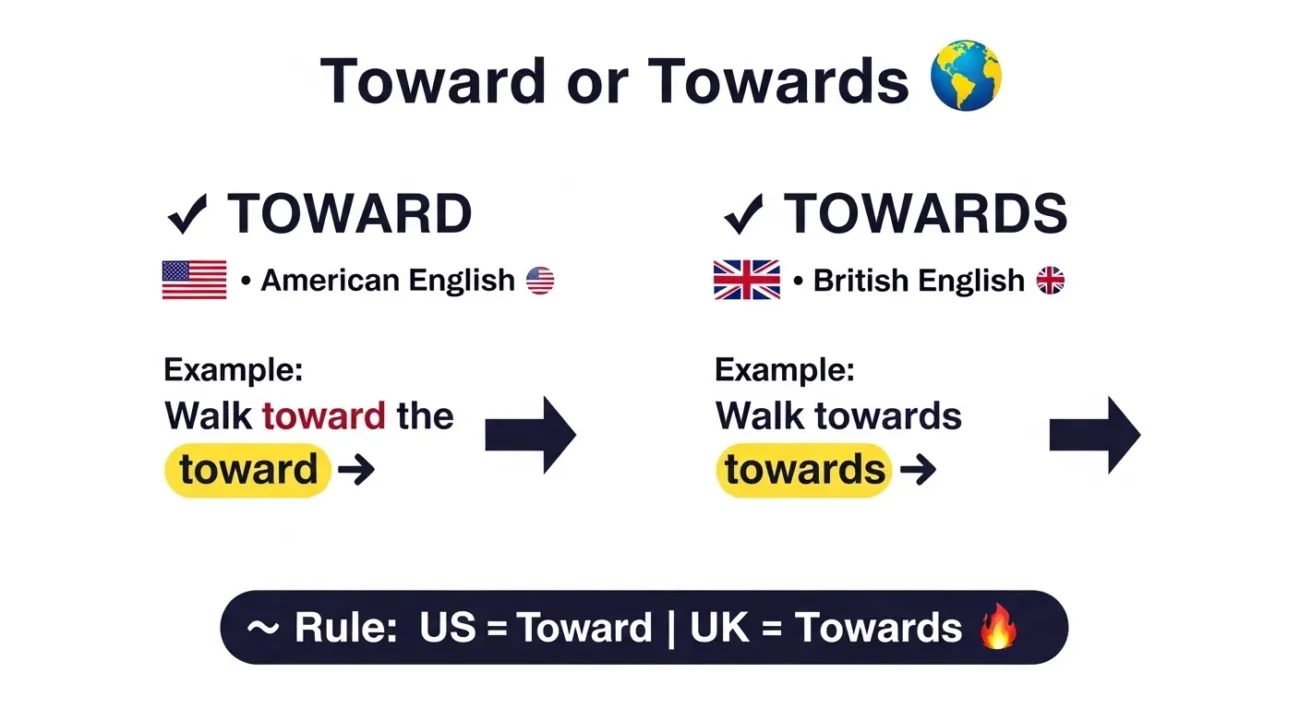
Toward or towards? Here’s the clear answer : both are correct, but toward is more common in American English, while towards is preferred in British English.
I remember editing a sentence “She walked towards the door” and then changing it to “toward the door” because the audience felt different. That tiny edit made me pause and think, Why do both exist? That pause is exactly why people search toward or towards.
These two words mean the same thing, sound equally natural, and yet feel “wrong” if you pick the one your reader isn’t used to. This article clears that confusion completely. I’ll explain meaning, origin, regional usage, common mistakes, everyday examples, and clear advice so you never hesitate again.
Toward or Towards: Quick Answer
Toward and towards both mean in the direction of or in relation to something.
- Toward → more common in American English
- Towards → more common in British English
Correct examples:
- She moved toward the exit.
- He leaned towards the window.
There is no difference in meaning only usage preference.
The Origin of Toward and Towards
When I look at word history, confusion usually disappears.
Both toward and towards come from Old English toweard, meaning in the direction of. Originally, English freely added or dropped the -s ending in adverbs. Over time, both forms survived.
English didn’t choose one and discard the other. Instead:
- Some regions favored the shorter form (toward)
- Others kept the longer form (towards)
That’s why both are still correct today.
British English vs American English Usage
This is where the difference becomes noticeable.
American English
- Strong preference for toward
- Seen in books, newspapers, and everyday writing
Example:
- The company is moving toward digital solutions.
British English
- Strong preference for towards
- Sounds more natural to UK readers
Example:
- He walked towards the station.
Comparison Table of Towards vs Toward
| Aspect | American English | British English |
| Preferred form | Toward | Towards |
| Meaning | Same | Same |
| Formal use | Yes | Yes |
| Spoken usage | Common | Common |
Neither version is wrong anywhere but preference matters.
Which Spelling Should You Use?
I always choose based on who will read the sentence.
- US audience → use toward
- UK or Commonwealth audience → use towards
- Mixed or global audience → either is fine, but be consistent
If you mix both forms in one article, readers may not complain but the writing feels careless. Consistency creates trust.
Common Mistakes with Toward or Towards
Even simple word pairs cause problems.
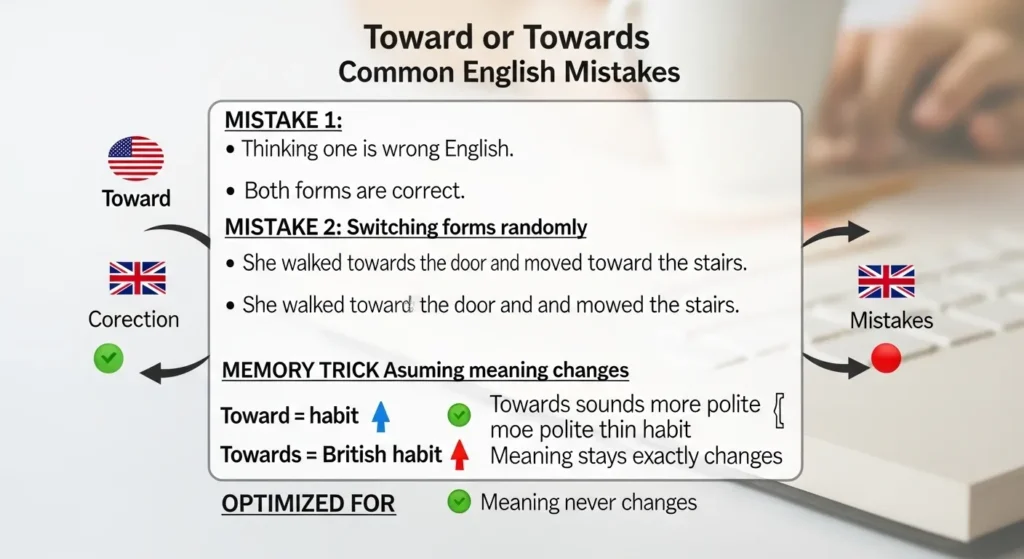
Mistake 1: Thinking one is incorrect
❌ Towards is wrong English.
✅ Both forms are correct.
Mistake 2: Switching forms randomly
❌ She walked toward the door and moved towards the stairs.
✅ She walked toward the door and moved to the stairs.
Mistake 3: Assuming meaning changes
❌ Towards sounds more polite than toward.
✅ Meaning stays exactly the same.
Memory trick I use:
- Toward = American habit
- Towards = British habit
Toward or Towards in Everyday Examples
Emails
- We are moving toward a final decision.
- Please move your chair towards the table.
News
- The country is shifting toward renewable energy.
- Attention turned towards public safety.
Social Media
- Working toward my goals.
- Feeling more positive towards life lately.
Formal Writing
- The research points toward a new conclusion.
- Policy changes were directed towards long-term growth.
Both forms work perfectly when matched to audience.
Towards or Toward: Google Trends & Usage Data
From general usage patterns:
- Toward appears more in American-based writing.
- Towards dominates in British and Commonwealth sources.
- Searches spike because learners worry one form is “wrong.”
The intent behind these searches is reassurance not meaning. Writers want confirmation that they won’t be judged for choosing the “wrong” version.
Toward vs Towards: Side-by-Side Comparison
| Feature | Toward | Towards |
| Meaning | In the direction of | In the direction of |
| Region | United States | UK / Commonwealth |
| Formal use | Yes | Yes |
| Spoken English | Common | Common |
| Common myth | More correct | More formal |
Neither myth is true.
FAQs: Toward or Towards
1. Are toward and towards interchangeable?
Yes. They mean the same thing.
2. Is towards more formal than toward?
No. Formality does not change.
3. Which one should students use?
Follow the version taught in your region.
4. Can I use both in one document?
It’s better not to. Choose one and stay consistent.
5. Do Americans ever use towards?
Yes, but toward is more common.
6. Do British writers use toward?
Sometimes, but towards feels more natural.
7. Which is safer for global writing?
Either is safe consistency matters more than choice.
Conclusion
I’ve learned that toward or towards isn’t about correctness it’s about comfort. Both words carry the same meaning, the same clarity, and the same grammatical strength. The difference lives in regional habit, not rules. Toward feels natural to American readers, while towards sounds right to British and Commonwealth audiences.
Once I stopped treating this as a “right vs wrong” problem and started treating it as an audience choice, the hesitation disappeared. Now I pick one, stay consistent, and write confidently. Do the same, and this pair will never slow you down again.

I am Sidney Greenbaum, a linguist who studied how English is actually used, not just how it is taught. I analyzed sentence structure and word differences to make English clearer and more practical. My research helped learners understand real-world English comparisons.