

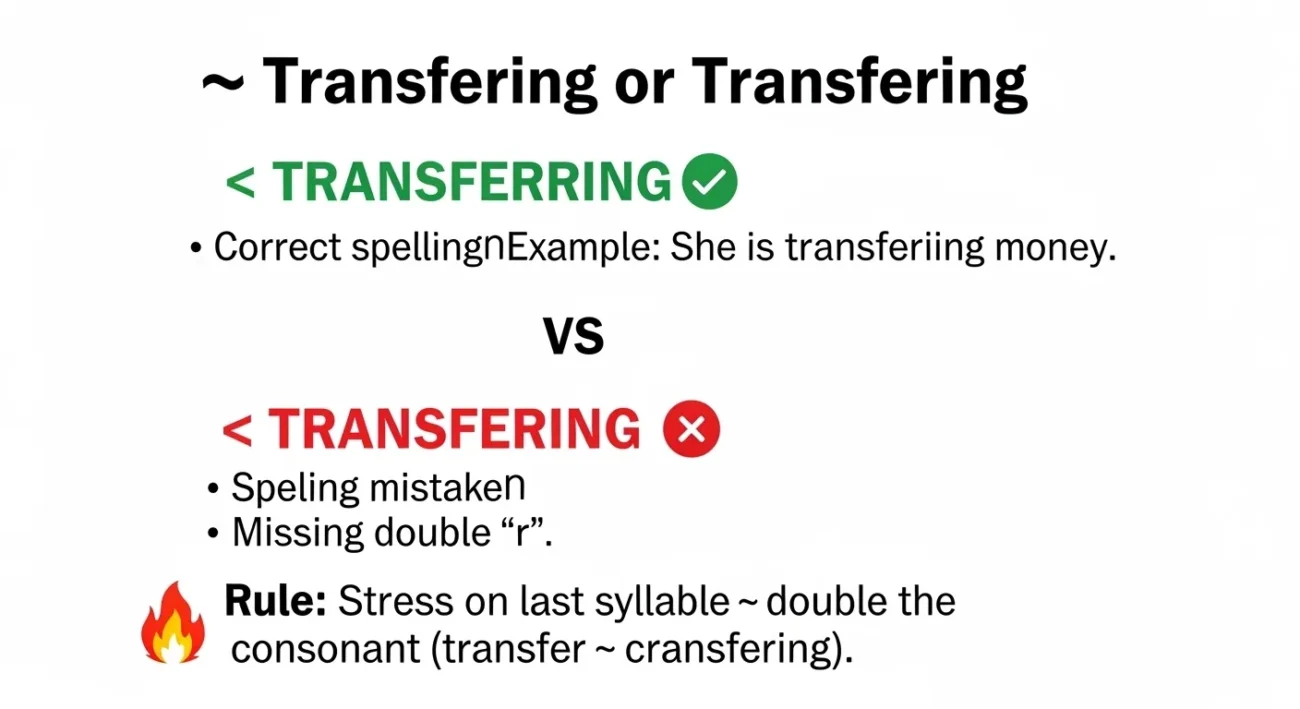
Transferring is correct in American and British English; transfering is wrong. I used to pause every time I typed this word. Should I use one “r” or two? Many people search “transfering or transferring” because English spelling rules about double letters feel confusing. When we add -ing, sometimes we double the last consonant. Sometimes we do not. That is where the mistake happens.
In this guide, I will explain the correct spelling, the rule behind it, common errors, usage differences, and clear examples. After reading this, you will never type transfering again.
Transfering or Transferring: Quick Answer
The correct spelling is transferring.
Transfering is incorrect.
✅ I am transferring the money.
❌ I am transfering the money.
Why? Because transfer ends in one vowel + one consonant, and the stress is on the last syllable (trans-FER). So we double the r before adding -ing.
Transfer → Transferring
The Origin of Transfering vs Transferring
The word transfer comes from Latin transferre, meaning “to carry across.” English kept the strong stress on the last syllable: trans-FER.
In English, we double the final consonant before adding -ing when:
- The word ends in one vowel + one consonant
- The stress is on the last syllable
Examples:
- Prefer → Preferring
- Refer → Referring
- Transfer → Transferring
Because transfer follows this rule, we must double the r.
That is why transfering is wrong.
British English vs American English Spelling
Here, both British and American English use transferring.
| Version | Correct Spelling | Incorrect |
| American English | transferring | transfering |
| British English | transferring | transfering |
| Canadian English | transferring | transfering |
However, you may notice small differences in related words:
| Word | American | British |
| Transferred | Transferred | Transferred |
| Transferring | Transferring | Transferring |
For this word, there is no regional spelling difference.
Which Spelling Should You Use Transferring or Transfering?
Always use transferring.
If you write for:
- 🇺🇸 US readers → Transferring
- 🇬🇧 UK readers → Transferring
- 🌍 Global audience → Transferring
There is no case where transfering is correct.
If your spelling checker shows a red line, trust it.
Common Mistakes with Transfering or Transferring
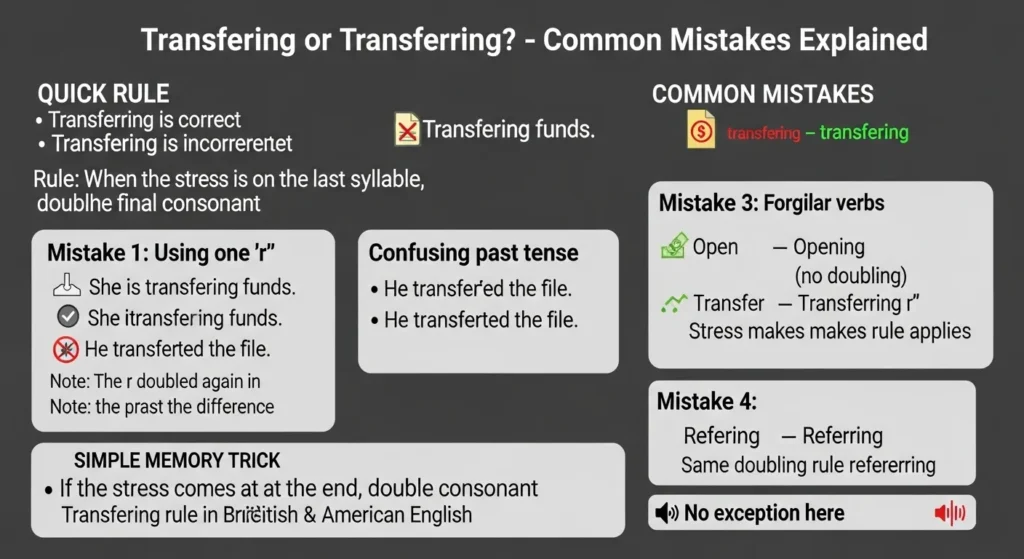
Here are errors I often see:
Mistake 1: Using one “r”
❌ She is transfering funds.
✅ She is transferring funds.
Mistake 2: Confusing past tense
❌ He transfered the file.
✅ He transferred the file.
Notice we double the r again in the past tense.
Mistake 3: Forgetting the stress rule
Some writers forget that stress matters in spelling.
Compare:
- Open → Opening (no doubling)
- Transfer → Transferring (double r)
Stress makes the difference.
Mistake 4: Mixing up similar verbs
❌ Refering
✅ Referring
Same rule applies.
Transfering and Transferring in Everyday Examples
In Banking
“I am transferring money to your account.”
In Business Email
“We are transferring the project to another team.”
In School
“She is transferring to a new college.”
In News
“The company is transferring ownership.”
On Social Media
“Transferring all my photos to my new phone.”
This word appears often in finance, business, school, and technology.
Transfering or Transferring: Google Trends & Usage Data
Many learners search “transfering or transferring” every month. The mistake is common in:
- India
- Pakistan
- Philippines
- United States
Search data shows that transferring appears millions of times in books and official writing.
Transfering mostly appears as a typing error.
Most confusion happens when people are unsure about doubling letters.
Comparison Table Transferring vs Transfering
Here is a simple side-by-side view:
| Word | Status | Meaning | Correct? |
| Transferring | Correct | Moving from one place to another | ✅ Yes |
| Transfering | Incorrect | No correct meaning | ❌ No |
Rule Pattern Table:
| Base Verb | -ing Form |
| Refer | Referring |
| Prefer | Preferring |
| Transfer | Transferring |
| Open | Opening |
Notice how stress changes the spelling.
FAQs
1. Is transfering ever correct?
No. It is always wrong.
2. Why do we double the “r” in transferring?
Because the stress is on the last syllable and the word ends in vowel + consonant.
3. What is the past tense of transfer?
Transferred.
4. Do British and American English spell it differently?
No. Both use transferring.
5. Why don’t we double in “opening”?
Because the stress is not on the last syllable.
6. Is transferring used in formal writing?
Yes. It is common in business and legal writing.
7. How can I remember the correct spelling?
Think of “referring” and “preferring.” Same pattern.
Conclusion
Transferring is correct. Transfering is wrong. That is the clear answer. I remember struggling with this spelling because I was not sure when to double letters. But once I learned the stress rule, everything made sense. When a word ends in one vowel and one consonant, and the stress is on the last syllable, we double the consonant before adding -ing.
Transfer follows that rule. There is no regional difference to worry about. If you use transferring in emails, reports, school work, or online posts, your writing will look correct and professional. Small spelling details matter. One missing letter can reduce clarity. So next time you type this word, pause for a second and make sure you use transferring.

I am Mark Twain, a writer who loved the English language for its humor, irony, and everyday comparisons. I used simple words to show deep differences between truth and lies, wisdom and foolishness. My writing proves that clear English is always more powerful than complicated English.