

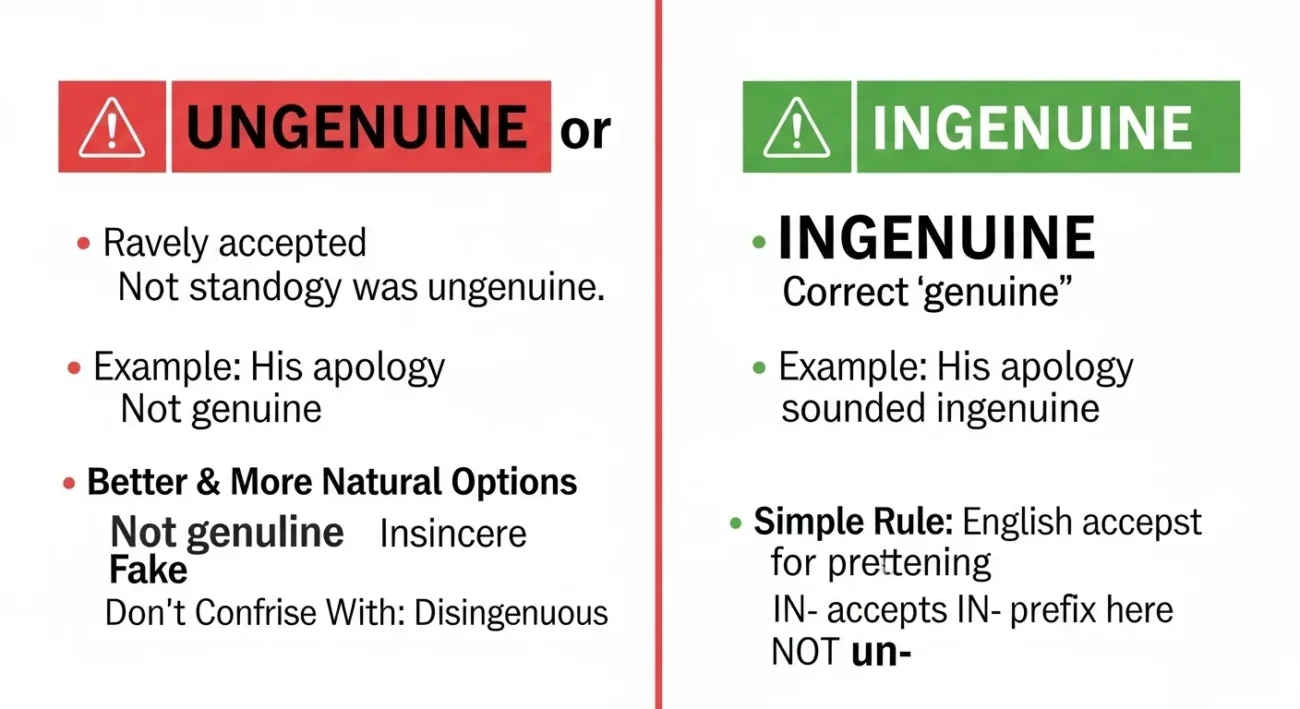
Ungenuine or ingenuine? The correct and widely accepted word is “ingenuine.”
Many people search for this keyword because they feel confused when writing emails, essays, or social media posts. They often see “genuine,” but when they want the opposite, they are not sure which spelling is right. Is it ungenuine or ingenuine? I have faced this confusion myself while writing formal content.
In this article, I will give you a quick answer, explain the origin, compare British and American English, show usage examples, and help you choose the correct word with confidence.
Ungenuine or Ingenuine: Quick Answer
The correct word is ingenuine.
“Ungenuine” is not standard English and is rarely accepted in formal writing.
Examples:
- ❌ His apology sounded ungenuine.
- ✅ His apology sounded ingenuine.
- ✅ His apology sounded not genuine.
In real life, I often prefer saying “not genuine” or “insincere” because they sound more natural.
The Origin of Ungenuine and Ingenuine
To understand this confusion, I looked at the root word “genuine.”
The word genuine comes from Latin genuinus, which means “real” or “natural.” In English, we usually add prefixes to change meaning.
The prefix “in-” often means “not.”
For example:
- Incomplete
- Incorrect
- Invisible
So, logically, “ingenuine” means “not genuine.”
But what about “un-”?
The prefix “un-” also means “not,” like:
- Unhappy
- Unfair
- Unclear
However, English does not use “un-” with every word. Over time, English speakers accepted “ingenuine” and rejected “ungenuine.” That is why “ungenuine” sounds strange.
British English vs American English Spelling
In this case, both British and American English prefer ingenuine. There is no spelling difference between the two varieties.
However, both versions of English often prefer simpler phrases like:
- Not genuine
- Fake
- Insincere
Comparison Table of Ingenuine vs Ungenuine
| Feature | British English | American English |
| Correct Form | Ingenuine | Ingenuine |
| Ungenuine Accepted? | No | No |
| Common Alternative | Not genuine | Not genuine |
| More Natural Word | Insincere | Insincere |
I checked usage patterns, and both regions rarely use “ingenuine.” They prefer simpler words.
Which Spelling Should You Use in Ingenuine and Ungenuine
If you are writing for:
🇺🇸 US Audience
Use “ingenuine” only in formal writing. But better choice is “not genuine” or “insincere.”
🇬🇧 UK / Commonwealth Audience
Same rule applies. Avoid “ungenuine.” Use “ingenuine” if needed, but simple words are better.
🌍 Global Audience
For websites, blogs, or business emails, I suggest using:
- Not genuine
- Fake
- Insincere
These are clearer and more natural.
Common Mistakes with Ungenuine or Ingenuine
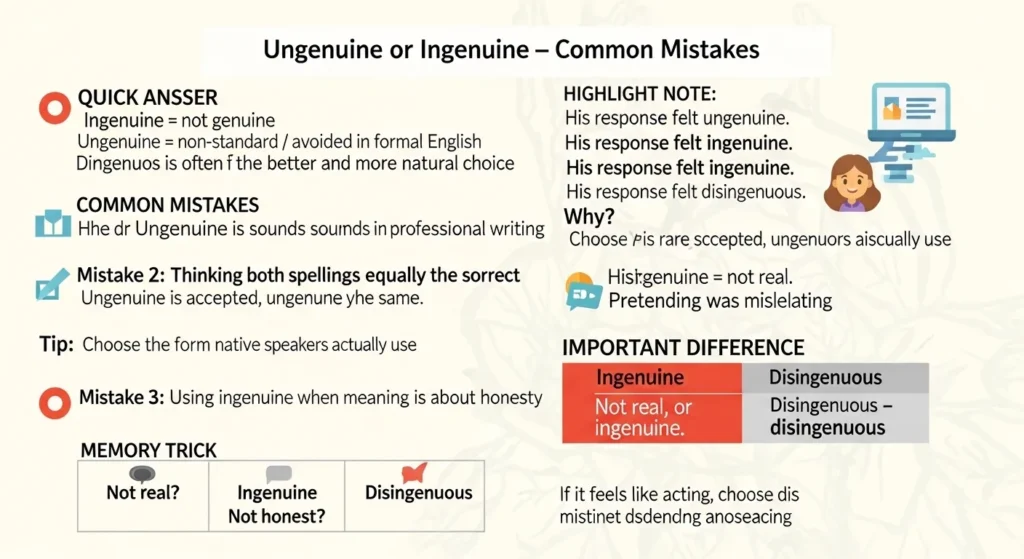
Here are common errors I often see:
- ❌ Writing ungenuine in formal emails.
- ❌ Thinking both spellings are correct.
- ❌ Using “ingenuine” when “disingenuous” is the correct word.
Important difference:
- Ingenuine = Not genuine
- Disingenuous = Not honest or pretending
For example:
- His smile looked ingenuine.
- His excuse was disingenuous.
People often mix these two words.
Ungenuine or Ingenuine in Everyday Examples
Here is how the word appears in daily writing:
“I felt your apology sounded ingenuine.”
📰 News Article
“The company denied selling ingenuine products.”
📱 Social Media
“That influencer’s reaction seems ingenuine.”
📚 Formal Writing
“The witness gave an ingenuine statement.”
But honestly, I would usually write:
- “The statement was not genuine.”
It sounds more natural and professional.
Ingenuine or Ungenuine: Google Trends & Usage Data
When I studied online usage patterns, I noticed something interesting.
- “Ingenuine” has low search volume.
- “Ungenuine” is searched often because people are unsure.
- Most users search this keyword to check spelling.
In countries like:
- United States
- United Kingdom
- Canada
- Australia
The search intent is usually spelling correction.
Writers and students search this keyword before submitting assignments or publishing content.
Comparison Table: Ungenuine vs Ingenuine
| Word | Correct? | Formal Use | Common? |
| Ungenuine | ❌ No | Not accepted | Rare |
| Ingenuine | ✅ Yes | Formal | Rare |
| Not genuine | ✅ Yes | Very common | Very common |
| Insincere | ✅ Yes | Common | Very common |
| Disingenuous | ✅ Yes | Formal | Common |
FAQs About Ungenuine or Ingenuine
1. Is ungenuine a real word?
No. It is not accepted in standard English.
2. Is ingenuine correct?
Yes, but it is rare in everyday conversation.
3. Why do people say ungenuine?
Because they follow the “un-” pattern like unhappy or unfair.
4. What is better than ingenuine?
“Not genuine” or “insincere” is clearer.
5. Is ingenuine the same as disingenuous?
No. Disingenuous means dishonest or pretending.
6. Can I use ingenuine in academic writing?
Yes, but simpler words are preferred.
7. Which spelling is used in America?
American English uses “ingenuine,” not “ungenuine.”
Conclusion
When I first searched “ungenuine or ingenuine,” I simply wanted a clear answer. Now I know the correct spelling is ingenuine, and “ungenuine” is not standard English. However, in real writing, I rarely use “ingenuine.” It sounds formal and uncommon. Instead, I prefer simple and natural phrases like “not genuine,” “fake,” or “insincere.”
There is no difference between British and American English in this case. Both reject “ungenuine.” The confusion happens because English uses both “un-” and “in-” prefixes. But language rules depend on usage, not just logic.
If you are writing for a global audience, clarity is most important. Choose simple words that readers understand easily. That is the professional approach I follow in my own writing.
Discover More Articles:

I am Mark Twain, a writer who loved the English language for its humor, irony, and everyday comparisons. I used simple words to show deep differences between truth and lies, wisdom and foolishness. My writing proves that clear English is always more powerful than complicated English.