
I have often seen people pause while writing and wonder whether whimp or wimp is the correct word.
This confusion is common because both spellings look believable, especially to non native English speakers.
Many people search for this keyword after seeing whimp used online, in comments, or even in casual messages.
The problem is simple but important: using the wrong spelling can make writing look unprofessional or unclear.
This article solves that confusion by giving a quick answer, explaining the word’s origin, comparing British and American English, and showing correct usage in real life examples. By the end, you will know exactly which spelling to use and why.
Whimp or Wimp: Quick Answer
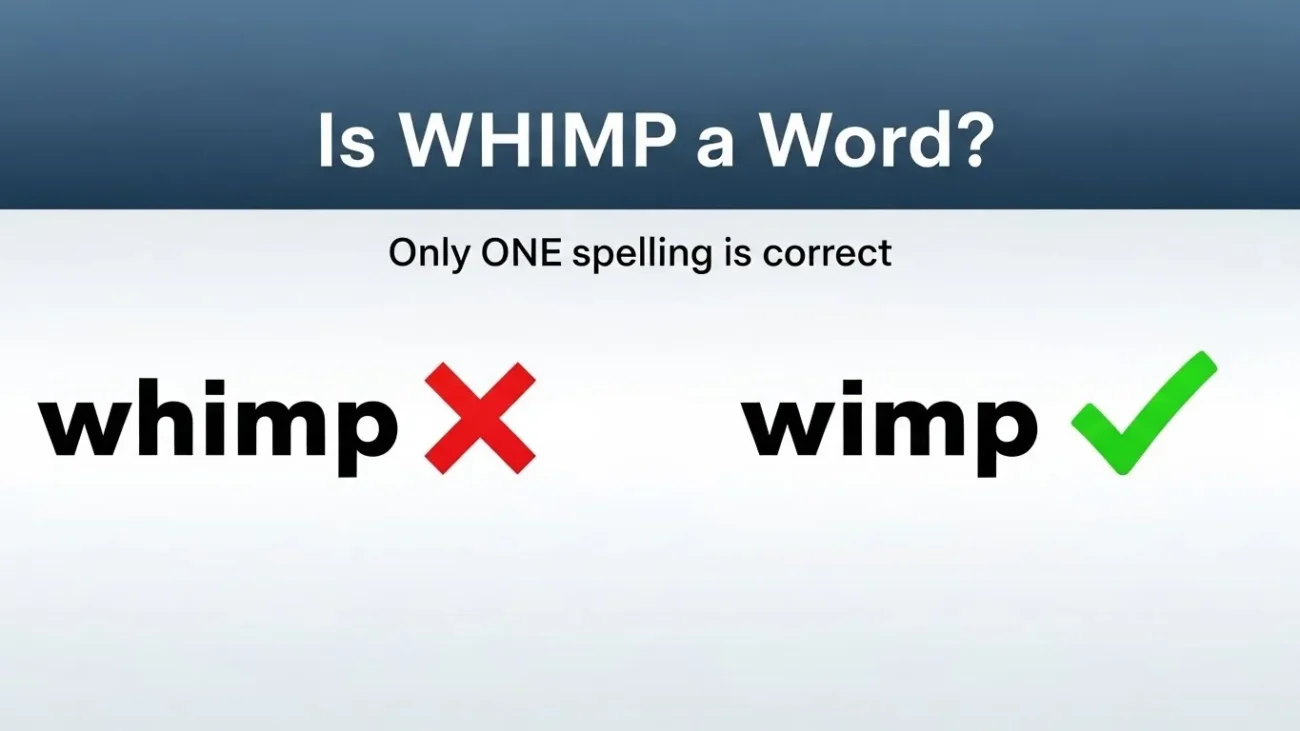
The correct spelling is wimp.
Whimp is not a standard English word.
Wimp is a noun used to describe a weak, timid, or cowardly person.
Examples:
- He quit the race early and felt like a wimp.
- Don’t be a wimp just try it once.
If you see whimp, it is almost always a spelling mistake.
The Origin of Whimp or Wimp
The word wimp first appeared in American English in the early 20th century. Linguists believe it may have come from children’s slang or informal speech. Some sources link it to the name “Wimpy,” a weak character from early comic strips, which helped popularize the meaning.
The spelling whimp does not have a historical root in English. It likely exists because English has many words starting with “wh,” such as what, why, and whisper. This pattern causes writers to assume whimp might be correct.
Over time, wimp became widely accepted in dictionaries, literature, and media, while whimp remained a common misspelling rather than a true variant.
British English vs American English Spelling
Unlike many spelling debates, whimp or wimp is not a UK vs US issue. Both British and American English use wimp only.
There is no regional spelling difference here.
Comparison Table
| Aspect | American English | British English |
| Correct spelling | wimp | wimp |
| Meaning | Weak or timid person | Weak or timid person |
| “Whimp” usage | Incorrect | Incorrect |
No major dictionary in either variety accepts whimp as correct.
Which Spelling Should You Use?
Your choice is simple: always use wimp.
- US audience: Use wimp
- UK audience: Use wimp
- Global or ESL audience: Use wimp
If you are writing professionally emails, articles, schoolwork, or marketing content using whimp can reduce credibility. Even in casual writing, wimp is the only form readers expect to see.
Common Mistakes with Whimp or Wimp
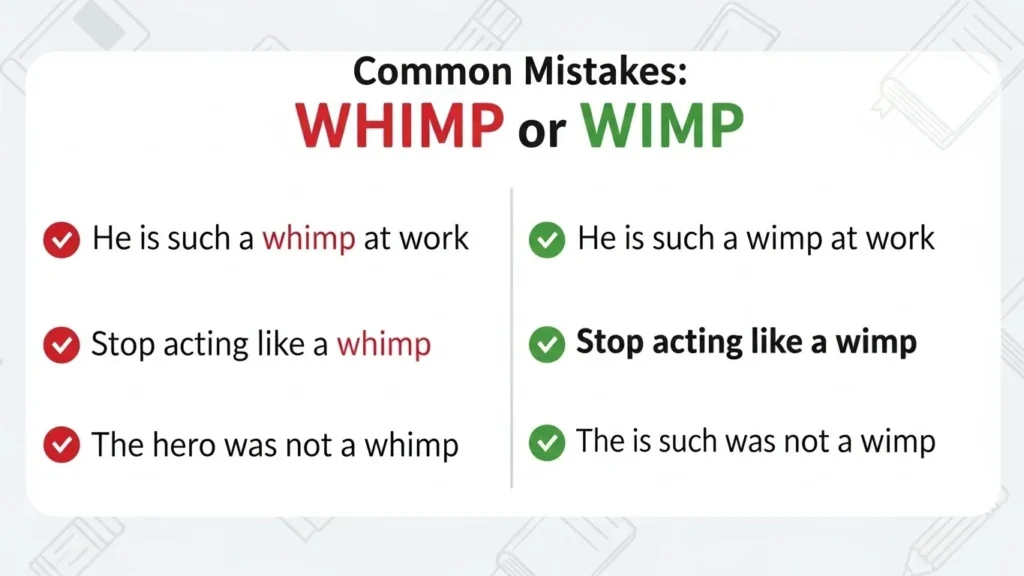
Here are frequent errors people make and how to fix them:
❌ He is such a whimp at work
✅ He is such a wimp at work
❌ Stop acting like a whimp
✅ Stop acting like a wimp
❌ hero was not a whimp
✅ The hero was not a wimp
The most common mistake is adding h after w, following the pattern of other English words.
Read More :Complements or Compliments: Meaning Difference Explained
Whimp or Wimp in Everyday Examples
Seeing correct usage in context makes it easier to remember.
Emails
- “I almost skipped the meeting, but I didn’t want to look like a wimp.”
News
- “Critics accused the leader of being a wimp during negotiations.”
Social Media
- “Cold showers are tough, but only a wimp gives up!”
Formal Writing
- “The term wimp is often used to describe a lack of courage in informal contexts.”
In all cases, wimp fits naturally and correctly.
Whimp or Wimp: Google Trends & Usage Data
Search data shows that wimp is widely used across English speaking countries, especially in the United States, United Kingdom, Canada, and Australia. The spelling whimp appears mostly in search queries, not in published content.
This tells us something important: people search whimp or wimp because they are unsure, not because whimp is correct. Online dictionaries, books, and major news sites consistently use wimp.
In casual contexts like comments or social posts, whimp may appear, but it is treated as an error, not a variant.
Comparison Table: Keyword Variations
| Spelling | Correct? | Meaning | Usage |
| wimp | ✅ Yes | Weak or timid person | Standard English |
| whimp | ❌ No | None | Misspelling |
FAQs About Whimp or Wimp
1. Is whimp ever correct?
No. Whimp is not accepted in standard English.
2. Why do people spell wimp as whimp?
Because many English words start with “wh,” causing confusion.
3. Is wimp offensive?
It can be informal or mildly insulting, depending on context.
4. Is wimp used in British English?
Yes. British and American English both use wimp.
5. Can wimp be used in formal writing?
It is informal but acceptable in descriptive or quoted contexts.
6. Is there a verb form of wimp?
Yes. “To wimp out” means to avoid something out of fear.
7. Are there synonyms for wimp?
Yes. Examples include coward, weakling, or pushover.
Conclusion
The confusion between whimp or wimp is understandable, but the rule is clear. Wimp is the only correct spelling, used in both British and American English. The spelling whimp has no dictionary support and exists mainly as a common mistake influenced by other “wh” words in English. If your goal is clear, professional communication, choosing wimp is essential.
Understanding the origin of the word, seeing how it is used in real life situations, and knowing that there is no regional spelling difference helps remove doubt. Whether you are writing an email, a blog post, or a social media comment, using wimp ensures your message sounds natural and correct. In short, when faced with the choice between whimp or wimp, always choose wimp your writing will be clearer, more confident, and more credible.

I am Sidney Greenbaum, a linguist who studied how English is actually used, not just how it is taught. I analyzed sentence structure and word differences to make English clearer and more practical. My research helped learners understand real-world English comparisons.