

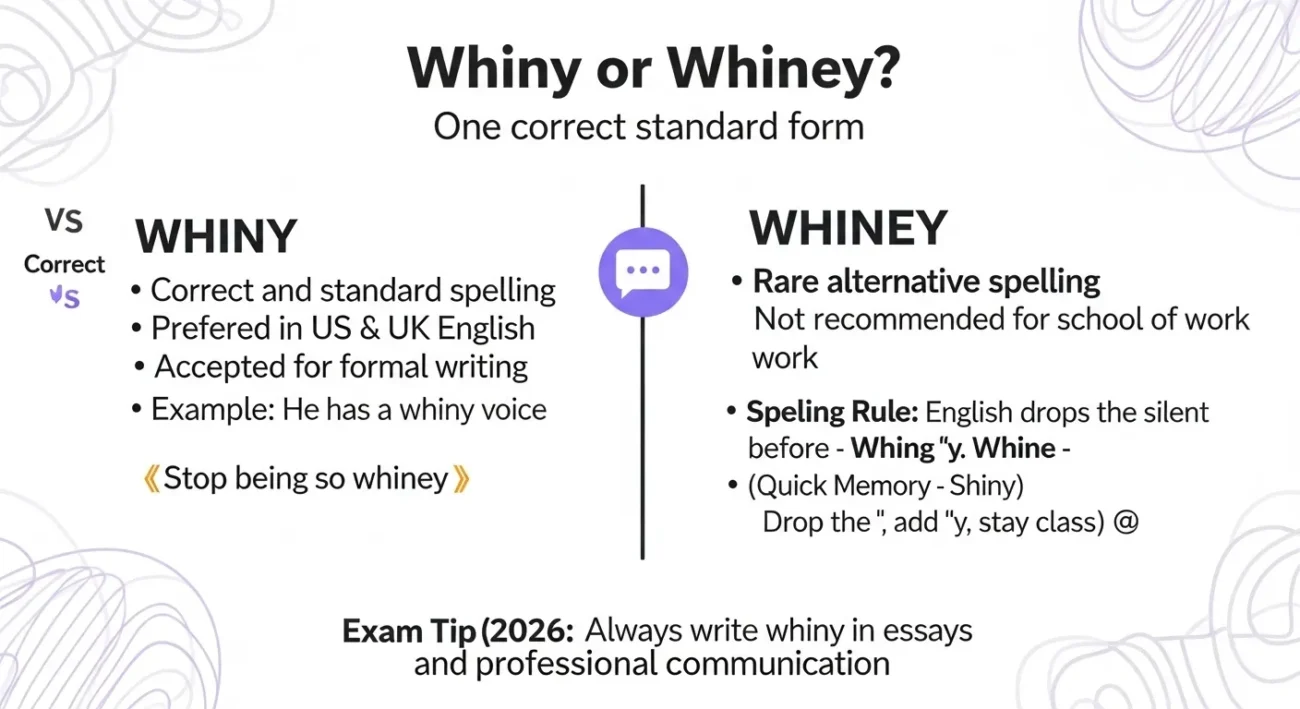
Whiny or whiney? The quick answer is simple: “whiny” is the standard and correct spelling, while “whiney” is a less common variant.
I once wrote “whiney” in a message and my friend corrected me. That small spelling change made me curious. Many people search this keyword because both words look right. Both come from the word “whine.” But only one is widely accepted in dictionaries and formal writing. This guide clears the confusion.
I will explain the origin, spelling rules, common mistakes, real life examples, and usage trends so you can use the correct form with confidence.
Whiny or Whiney : Quick Answer
Whiny is the correct and standard spelling.
Whiney is a rare alternative spelling.
Example:
- ✅ He has a whiny voice.
- ❌ He has a whiney voice. (less accepted)
If you want to be safe in school, work, or professional writing, use whiny.
The Origin of Whiny and Whiney
The word comes from the verb whine, which means to complain in a weak or annoying way. It can also describe a high pitched sound.
Over time, English added the “ y” ending to describe someone who complains often. That created whiny.
Some people added an extra “e” and wrote whiney, but dictionaries list whiny as the main spelling.
English sometimes drops the silent “e” before adding “y.” That is why “whine” becomes “whiny,” not “whiney.”
British English vs American English Spelling
There is no major difference between British and American English here. Both prefer whiny.
However, informal writing online sometimes shows “whiney.”
Comparison Table
| Word | British English | American English | Status |
| Whiny | Whiny | Whiny | Standard spelling |
| Whiney | Rare | Rare | Informal / less accepted |
In formal writing, always choose whiny.
Which Spelling Should You Use?
Use whiny in:
- School essays
- Work emails
- Articles
- Formal communication
Avoid whiney unless you are quoting someone’s informal writing.
If your audience is global, stick to whiny. It is clear and widely accepted everywhere.
Common Mistakes with Whiny or Whiney
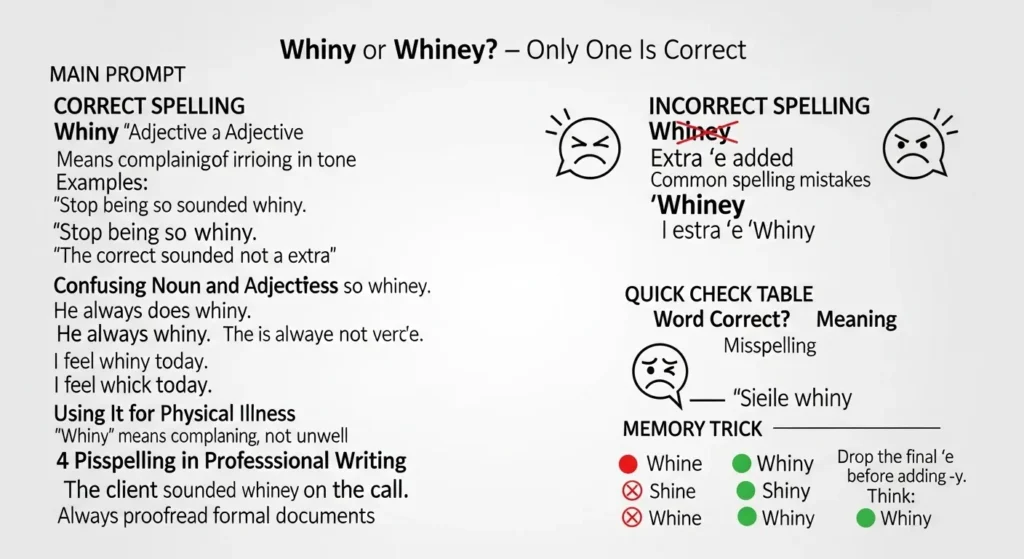
Mistake 1: Adding extra “e”
❌ Stop being so whiney.
✅ Stop being so whiny.
Mistake 2: Confusing noun and adjective
❌ He always does whiny.
✅ He is always whiny.
Mistake 3: Using it for physical illness
❌ I feel whiny today.
✅ I feel sick today.
(Whiny means complaining, not unwell.)
Mistake 4: Misspelling in professional writing
❌ The client sounded whiney on the call.
✅ The client sounded whiny on the call.
Whiney or Whiny in Everyday Examples
Email:
“The customer’s tone sounded whiny.”
Text Message:
“Don’t be whiny 😂”
News Article:
“Critics called the speech whiny and emotional.”
Social Media:
“Why is he acting so whiny today?”
Clear spelling makes your writing stronger.
Whiny or Whiney : Google Trends & Usage Data
Search data shows:
- Whiny is searched more often worldwide.
- Whiney appears mainly in spelling questions.
- Countries like the United States and United Kingdom show strong preference for “whiny.”
- Grammar websites list “whiny” as the correct spelling.
Most dictionaries only highlight whiny as standard.
Quick Comparison Table
| Feature | Whiny | Whiney |
| Correct Spelling | Yes | Rare variant |
| Formal Writing | Recommended | Not recommended |
| Origin | From “whine” + y | Extra “e” added |
| Dictionary Status | Standard | Alternative / uncommon |
| Usage Frequency | High | Low |
FAQs
1. Is whiney wrong?
It is not fully wrong, but it is uncommon and not preferred.
2. Which spelling is correct in school essays?
Whiny.
3. Why is the “e” removed?
English often drops silent “e” before adding “y.”
4. Do British people spell it differently?
No. They also use whiny.
5. Is whiny an insult?
It can be negative. It describes someone who complains too much.
6. Can whiny describe a sound?
Yes. It can describe a high pitched complaining sound.
7. Is whiny formal?
It is informal in tone but correct in spelling.
Conclusion
Whiny or whiney now the confusion is gone. The correct and standard spelling is whiny. It comes from the word “whine,” and English grammar drops the silent “e” before adding “y.” While you may see “whiney” online, it is not the preferred form in dictionaries or formal writing. If you want to write clearly and professionally, always choose whiny.
Small spelling details matter. They show care and confidence in communication. I once made the mistake myself, but now I remember the simple rule: drop the “e,” add “y,” and write whiny every time.
Discover More Articles:

I am Michael Swan, an English grammarian known for explaining confusing grammar and word comparisons in a clear way. I focused on real usage, not just rules, helping learners understand why English works the way it does. My work simplifies complex language problems for everyday users.