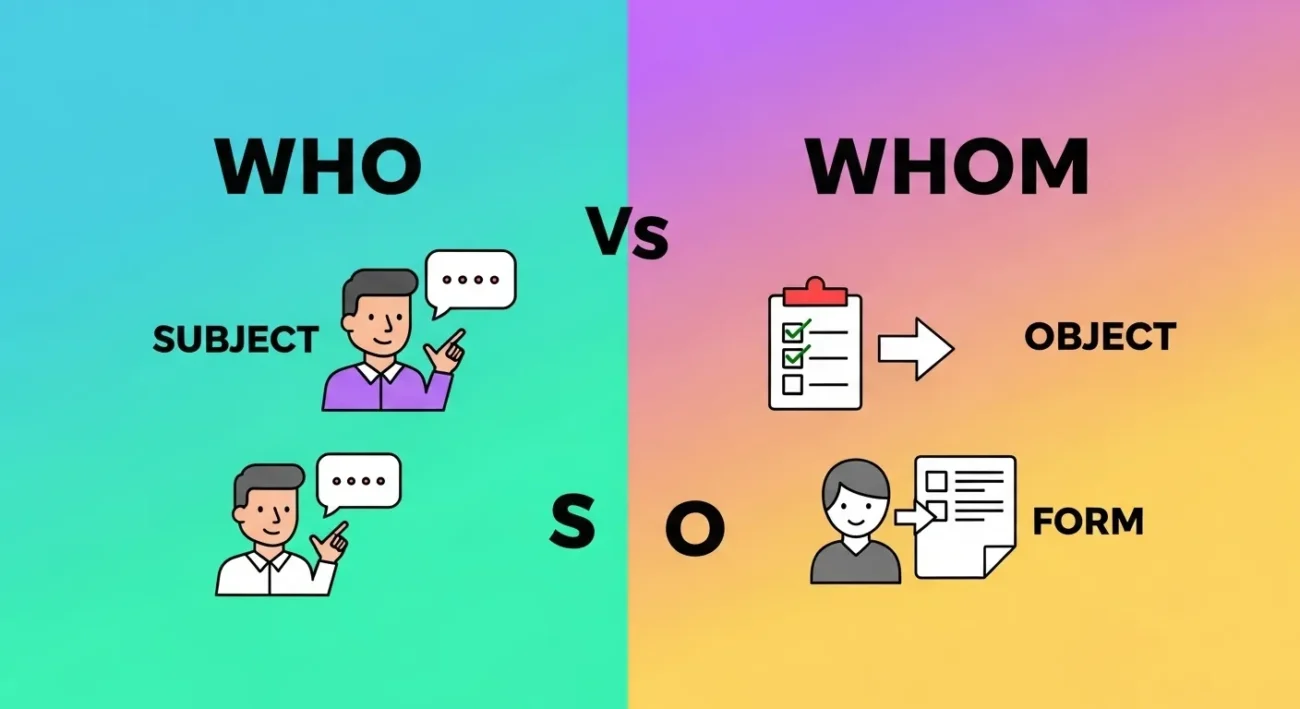
The answer is simple: who is used for the subject, and whom is used for the object.
I still remember pausing while typing a formal email, staring at the sentence, and wondering: who or whom? If that’s happened to you, you’re not alone. This keyword is searched so often because spoken English rarely uses whom, yet it still appears in exams, professional writing, news articles, and formal emails. The confusion comes from English grammar rules that feel invisible in everyday speech.
In this guide, I’ll break everything down in plain, simple language. I’ll show you the quick rule, real-life examples, common mistakes, and an easy trick that has never failed me so you’ll always know which word to choose.
Who or Whom: Quick Answer
- Who = subject (does the action)
Example: Who called you? - Whom = object (receives the action)
Example: Whom did you call?
My favorite trick:
👉 Replace the word with they → use who
👉 Replace the word with him/her → use whom
If him/her sounds right, whom is correct.
The Origin of Who or Whom
Both words come from Old English.
- Who comes from hwā, used for subjects.
- Whom comes from hwām, used for objects.
Old English had strong case rules, like Latin or German. Over time, spoken English simplified these rules, and whom slowly disappeared from daily conversation. However, formal writing kept it alive, which is why the confusion still exists today.
British English vs American English Spelling
There is no spelling difference between British and American English.
| Aspect | British English | American English |
| Who | Who | Who |
| Whom | Whom | Whom |
| Spoken usage | Mostly “who” | Mostly “who” |
| Formal writing | Uses “whom” | Uses “whom” |
The difference is not regional it’s stylistic and grammatical.
Which Spelling Should You Use?
Choose based on context and tone:
- US audience:
Use whom in formal writing; who is fine in casual speech. - UK/Commonwealth audience:
Same rule applies. - Global or SEO writing:
Use who unless the sentence is clearly formal.
If using whom feels too stiff, rewriting the sentence is often the best solution.
Common Mistakes with Who or Whom
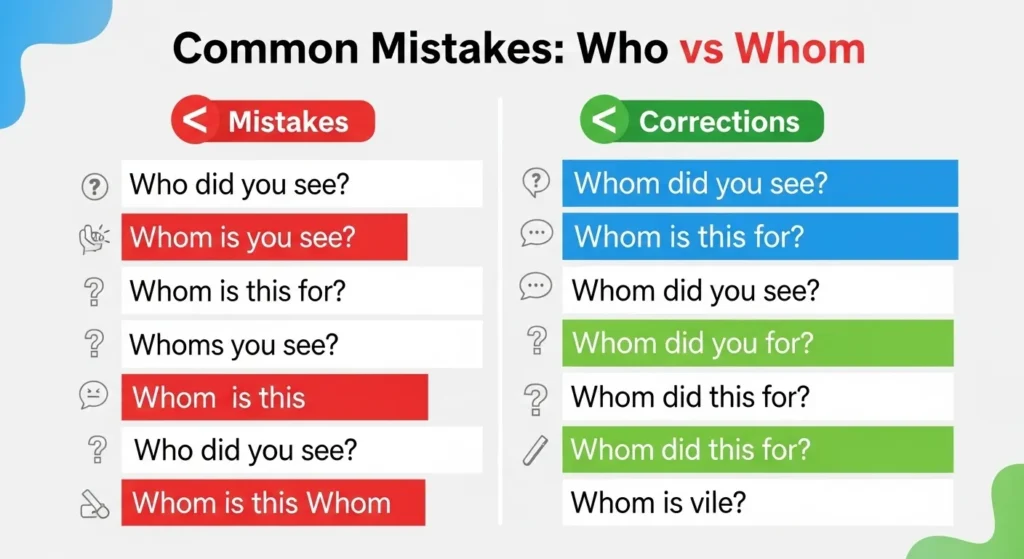
❌ Whom is calling me?
✅ Who is calling me?
❌ Who did you invite? (formal writing)
✅ Whom did you invite?
❌ The person whom won the prize
✅ The person who won the prize
Quick check:
If the word follows a preposition (to, with, for), whom is often correct.
To whom it may concern ✔️
Who or Whom in Everyday Examples
Emails
- Who is responsible for this report?
- Whom should I contact for support?
News
- The senator who proposed the bill spoke today.
- The candidate whom voters trusted won the election.
Social Media
- Who else agrees with this?
- (Rare but correct) Whom did you meet today?
Formal Writing
- The client whom we advised accepted the proposal.
- The manager who approved the budget resigned.
Whom or Who: Google Trends & Usage Data
Search interest for “who or whom” stays consistently high, especially during:
- Exam seasons
- Job application periods
- Academic writing deadlines
Countries like the US, UK, India, Pakistan, and Canada show strong search volume. This proves that even fluent English users still struggle with this rule, mainly because spoken English avoids whom.
Comparison Table: Who vs Whom
| Feature | Who | Whom |
| Role | Subject | Object |
| Pronoun match | He / She | Him / Her |
| Formal level | Neutral | Formal |
| Spoken English | Very common | Rare |
| Example | Who called you? | Whom did you call? |
FAQs: Who or Whom
1. Is “whom” still correct in modern English?
Yes, especially in formal writing.
2. Can I always use “who” instead of “whom”?
In casual speech, yes. In formal writing, not always.
3. Why does “whom” sound awkward?
Because spoken English has mostly dropped it.
4. Is “to whom it may concern” still correct?
Yes, and it’s grammatically perfect.
5. Do native speakers use “whom”?
Mostly in writing, rarely in speech.
6. What’s the easiest test?
Replace with him/her. If it fits, use whom.
7. Will using “whom” make my writing better?
Only if it fits the tone clarity matters more than formality.
Conclusion
I’ve realized that who or whom isn’t as scary as it looks. Once you understand that who does the action and whom receives it, everything clicks. The he/him test is the fastest and most reliable trick I know, and it works every time.
While modern English often avoids whom in speech, it still plays an important role in formal and professional writing. My advice is simple: don’t force whom just to sound smart. Use it when it fits, rewrite when it doesn’t, and always prioritize clarity. Mastering this small rule instantly makes your writing sound confident, polished, and natural.
Over time, I’ve noticed that writers who understand who or whom communicate with more precision and confidence. This small grammar skill shows attention to detail and respect for the reader. With regular practice, the rule becomes instinctive, helping you write clearly in both professional and everyday situations.

I am Michael Swan, an English grammarian known for explaining confusing grammar and word comparisons in a clear way. I focused on real usage, not just rules, helping learners understand why English works the way it does. My work simplifies complex language problems for everyday users.