

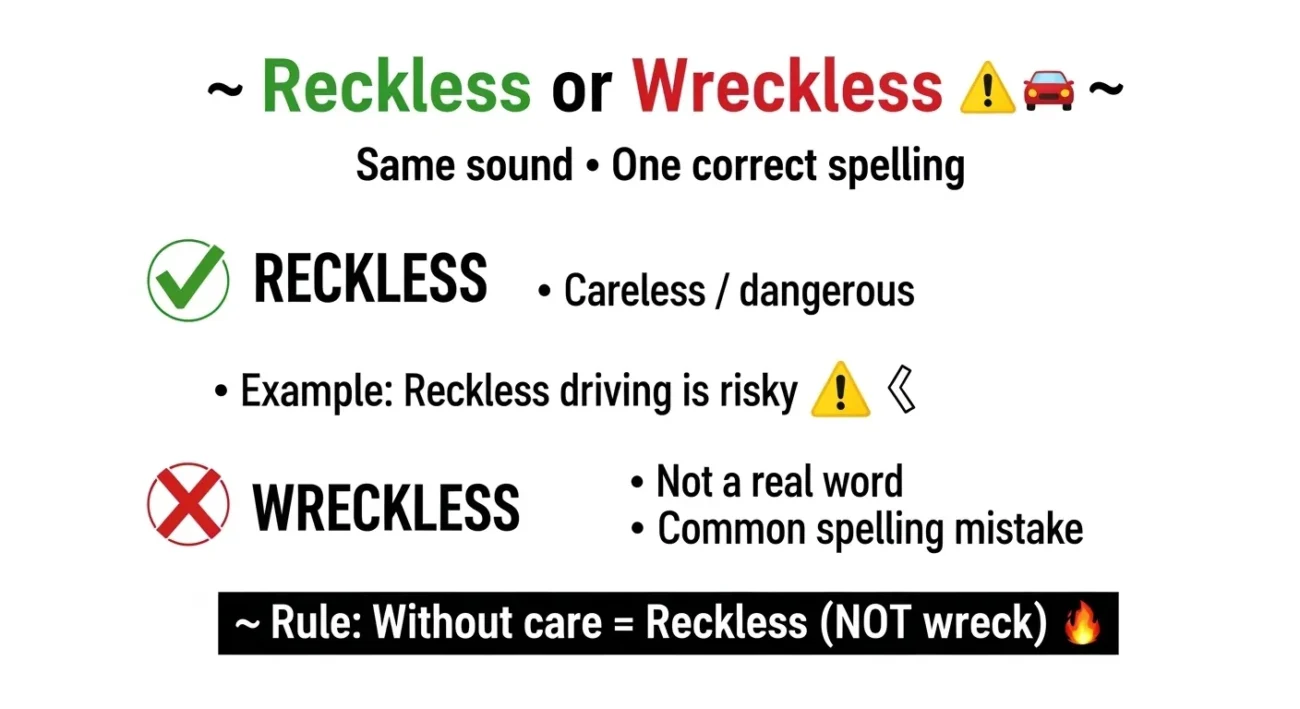
Wreckless or reckless? Here’s the Short Answer: reckless is correct, and wreckless is almost always a misspelling.
I remember typing “wreckless driving” once and thinking it looked logical. After all, reckless driving often causes a wreck right? But logic doesn’t always win in English. That small doubt is exactly why people search wreckless or reckless. The words sound identical, and “wreckless” looks meaningful at first glance. But only one form is accepted in standard English.
In this article, I’ll clear the confusion completely. I’ll explain meaning, origin, usage, common mistakes, examples, and practical advice so you never second-guess this word again.
Wreckless or Reckless: Quick Answer
Reckless = careless, without caution, or ignoring danger.
Wreckless = not a standard English word (usually incorrect spelling).
Correct examples:
- He made a reckless decision.
- Reckless driving is dangerous.
Wrong example:
- ❌ She was acting wreckless.
If you mean careless or dangerous behavior, always use reckless.
The Origin of Reckless
Understanding the history made it easier for me to remember the spelling.
The word reckless comes from Middle English. It combines:
- Reck (an old verb meaning to care or pay attention)
- -less (meaning without)
So reckless literally means without care.
That’s why the spelling has nothing to do with “wreck.” The similarity in sound is pure coincidence.
Why “Wreckless” Feels Logical
I used to think “wreckless” made sense. Many people do.
Here’s why:
- Reckless behavior often leads to a wreck.
- The word wreck is common in accidents.
- The sound is identical.
But English spelling doesn’t always follow logic. The meaning comes from reck, not wreck.
British English vs American English Usage
Here’s something simple and important:
Both British and American English use reckless the same way.
There is:
- No spelling difference
- No regional variation
- No accepted alternative
Comparison Table Wreckless vs Reckless
| Aspect | Reckless | Wreckless |
| Correct spelling | Yes | No |
| Meaning | Careless, dangerous | Not standard |
| Used in UK | Yes | No |
| Used in US | Yes | No |
The rule is universal.
Which Spelling Should You Use?
I follow one rule:
👉 If you mean careless behavior, write reckless.
There are rare creative uses of “wreckless” in brand names or song titles, but in standard writing, it is incorrect.
If you’re writing formally, academically, or professionally, always use reckless.
Common Mistakes with Wreckless or Reckless
These errors happen often.
Mistake 1
❌ Wreckless driving is dangerous.
✅ Reckless driving is dangerous.
Mistake 2
❌ He acted wreckless with money.
✅ He acted reckless with money.
Mistake 3
❌ She made a wreckless mistake.
✅ She made a reckless mistake.
Memory trick I use:
- Reckless = without care
- Ignore the word “wreck”
Reckless or Wreckless in Everyday Examples
Emails
- That was a reckless decision.
- Please avoid reckless spending.
News
- The driver was arrested for reckless driving.
- Reckless behavior caused the accident.
Social Media
- Don’t be reckless with your time.
- Reckless choices lead to regret.
Formal Writing
- The company faced penalties for reckless conduct.
- Reckless actions can harm public trust.
You will not see “wreckless” in professional editing.
Wreckless or Reckless: Google Trends & Usage Data
From general search behavior:
- Reckless dominates in books, news, and formal writing.
- Wreckless appears mainly in search queries due to spelling confusion.
- Many searches happen after autocorrect highlights “wreckless.”
The confusion usually starts with sound, not meaning.
Reckless vs Wreckless: Side-by-Side Comparison
| Feature | Reckless | Wreckless |
| Dictionary entry | Yes | No |
| Meaning | Careless | None (misspelling) |
| Professional writing | Correct | Incorrect |
| Common mistake | Misspelled | Used by error |
| Origin | From “reck” | From confusion with “wreck” |
This comparison makes the answer clear.
FAQs: Wreckless or Reckless
1. Is wreckless ever correct?
Not in standard English.
2. Why do people spell it wreckless?
Because it sounds connected to “wreck.”
3. What does reckless mean exactly?
It means acting without care or caution.
4. Is reckless negative?
Yes. It describes risky or careless behavior.
5. Can reckless describe positive risk-taking?
Sometimes in casual speech, but usually it has a negative tone.
6. Is reckless used worldwide?
Yes. Both British and American English use it.
7. How can I remember the correct spelling?
Think: Reckless = without care.
Conclusion
I’ve learned that wreckless or reckless isn’t a grammar puzzle it’s a spelling trap. The word has nothing to do with car wrecks or accidents. It comes from an old verb meaning “to care,” and when you add “-less,” it becomes “without care.” That simple meaning makes the correct spelling obvious. Reckless is the only accepted form in standard English.
Once I understood its origin, I stopped second-guessing it completely. If you remember that it means “careless,” not “without a wreck,” you’ll never misspell it again and your writing will look sharper and more confident every time.

I am Michael Swan, an English grammarian known for explaining confusing grammar and word comparisons in a clear way. I focused on real usage, not just rules, helping learners understand why English works the way it does. My work simplifies complex language problems for everyday users.