


It can appear as if the credit score is a kind of mystery that cannot be explained easily. There are times when things are not so clear. A lot of people pay their credit card every month, thinking it will help their score. Some feel anxious when they read their credit report, worried that they will get punished right away. Many just listen to old advice and end up paying more interest than they should. Some actions hurt their credit, even if that was not what they wanted.
MoneyFAQ.com makes it easier to get the facts. The site gives plain advice about money, so you can learn how credit scores really work. This guide goes over five common myths about credit. It tells you what scoring models like FICO and VantageScore really look for. You will also read about the habits that help build good credit for the long term.
5 Common Credit Myths That Cost You Money
Myth 1: Carrying a Balance Boosts Your Credit Score
If you keep a balance on your card each month, it will not help your credit score. It just means you will pay more in interest to your card company.
Many people think that paying a card in full shows scoring models that it is not being used. The truth is, card companies let the big credit bureaus (Equifax, Experian, and TransUnion) know your balance on your statement once each month. You get a good payment history by using the card a little and paying what you owe in full by the due date.
Myth 2: Checking Your Own Credit Lowers Your Score
Checking your own credit report or credit score is called a “soft inquiry.” It does not lower your credit score in any way.
Credit inquiries come in two main types:
- Soft Inquiries: Such inquiries occur if you check your score, if you get background checks from potential employers, or if you are being considered for any special deals. Only you will be able to see them, and they will not affect your score.
- Hard Inquiries: Such inquiries will occur if you apply for loans or credit cards. A hard inquiry will usually decrease your score by fewer than five points and will stay on your credit report for up to two years.
Myth 3: Closing Old Accounts: Cleaning Up Your Credit Report
Closing old credit cards cuts your total credit limit. It also makes the average age of your credit go down. Both of these can hurt your credit score.
When you close a credit card, it will not add to your total credit limit anymore. If you have money you still owe on other cards, your credit utilization ratio goes up right away. A closed card that has a good record stays on your report for 10 years. Closing the card early stops it from getting older along with your active accounts.
What Actually Drives Your Credit Score?
FICO credit scores are made up of five main parts. These are payment history (35%), amount owed or how much you use your credit (30%), length of your credit history (15%), new credit (10%), and the type of credit you have (10%).
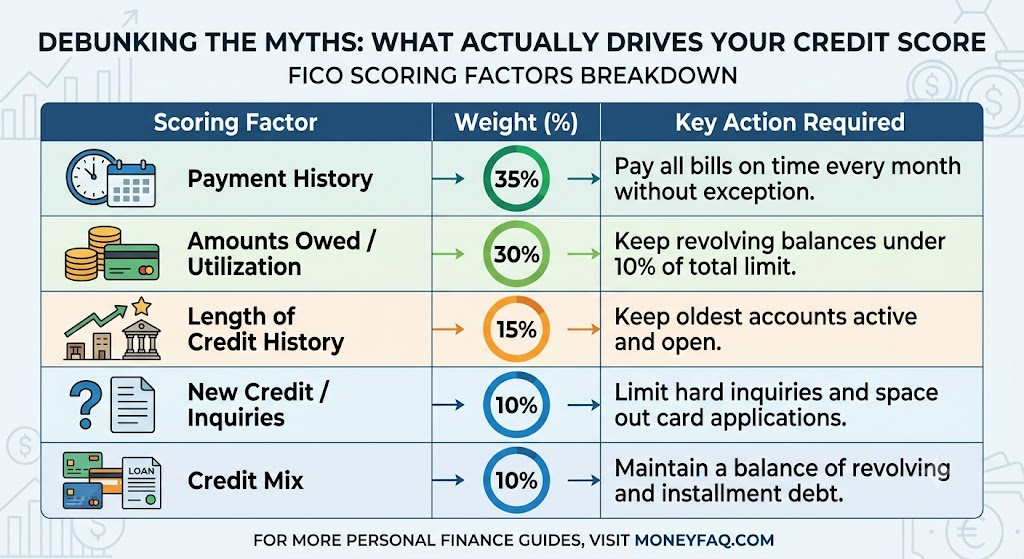
The Heavy Hitters: Payment History and Utilization
Payment history and credit use together make up 65% of your total score.
- Payment History (35%): Even if you’ve never missed a payment before, a single 30-day delay will result in a sharp drop in your score. Set up an automatic payment of at least the minimum payment due on all of your accounts.
- Credit Utilization Rate (30%): It is calculated by dividing the total balances on all of your revolving accounts by the total credit limits. Maintaining utilization at below 10% will maximize your credit score, while any amount above 30% might indicate financial troubles to lenders.
You do not need any special tricks to keep your credit in good shape. You also do not need to pay interest on balances you carry. Put your energy into the things that really matter. These are paying your bills on time with automated payments, using a small percentage of your card limits, and keeping your accounts open for a long time. If you let go of myths about money and use real tips for credit scores, you have more power over your good credit name.
MoneyFAQ.com gives you more tips and easy guides. You can use these to help with your debt, credit, and money matters so you feel good about your choices.
Frequently Asked Questions
Does income affect your credit score directly?
No, your salary or net worth is not shown in your credit reports. It also does not directly affect your credit score. But when you apply for a loan, lenders will look at your income on its own. They use this to see your debt-to-income (DTI) ratio.
How long do negative marks stay on a credit report?
Most bad marks on your credit report, like late payments, collections, and Chapter 13 bankruptcies, stay there for seven years. A Chapter 7 bankruptcy will stay on your report for up to ten years.
Is VantageScore different from a FICO score?
Yes. Both use the same score range of 300 to 850. VantageScore is easier on paid collections. It also needs less time of credit history to give you your first score than FICO does.

