

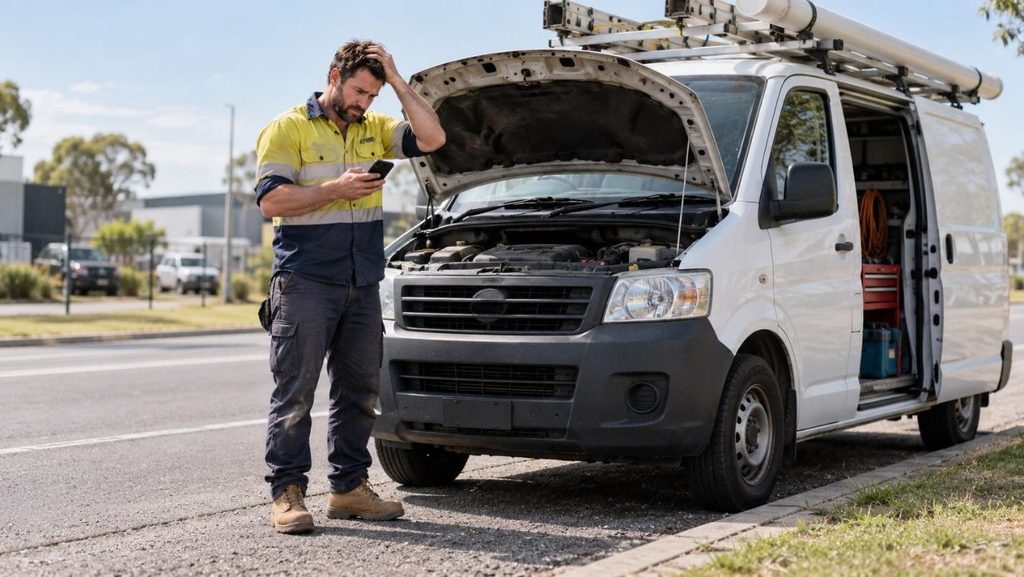
For a small business that relies on vehicles, an unexpected breakdown can turn an ordinary working day into an expensive disruption.
Imagine a plumber travelling to a scheduled job when their work van suddenly stops running. The vehicle needs towing, repairs must be arranged, and the customer is left waiting. Meanwhile, the business is losing valuable working hours.
The repair bill might be manageable. But what about the lost income, replacement transport and disrupted appointments?
The true cost of a vehicle breakdown extends well beyond getting the vehicle back on the road. Understanding those hidden expenses can help Australian small businesses make better decisions about maintenance, emergency planning and financial risk.
The Real Cost of an Unexpected Vehicle Breakdown
A breakdown creates two types of financial consequences: direct expenses, such as towing and repairs, and indirect costs, including lost productivity and cancelled work.
Both can affect a business’s profitability.
1. Towing and Emergency Recovery Costs
When a business vehicle becomes undriveable, arranging safe recovery is often the first expense.
Towing costs depend on several factors, including the vehicle’s size, breakdown location, recovery requirements and distance to the workshop. A vehicle stranded in a difficult-to-access location may require more complicated recovery arrangements.
For businesses operating on tight schedules, delays can also affect the rest of the working day.
When professional recovery is needed, operators such as Underground Towing & Salvage provide vehicle towing services across Canberra and Launceston, helping drivers arrange recovery when their vehicles can no longer be driven safely.
Although towing is an immediate expense, recovering the vehicle promptly also allows the business to move forward with repairs and alternative arrangements.
2. Unexpected Mechanical Repairs
A breakdown can result from anything from a failed battery to a more serious engine or transmission problem.
The cost depends on the fault, required parts and labour involved.
However, the final repair invoice is not necessarily the biggest financial problem.
If a replacement component is unavailable, the vehicle might remain in a workshop for several days. A business that depends on that vehicle could experience continued disruption even after the repair cost is known.
This is why vehicle downtime deserves as much attention as the mechanical failure itself.
3. Lost Revenue and Billable Working Hours
For a service-based business, time spent off the road can mean fewer completed jobs.
Consider an electrician who has three customer appointments scheduled. If their vehicle breaks down before the first appointment, they may need to postpone the entire day’s work.
Some customers might reschedule. Others could choose another provider.
The resulting financial loss depends on the profitability of the jobs that cannot be recovered.
Importantly, lost revenue is not the same as lost profit. A cancelled $1,000 job does not automatically create a $1,000 financial loss because the business may avoid certain materials, fuel or subcontractor expenses.
A more useful calculation considers the contribution the job would have made towards fixed costs and profit after its avoidable expenses.
4. Employee Downtime and Replacement Transport
A breakdown can also affect employees who are ready to work but cannot reach their next destination.
If the business continues paying staff during the interruption, that time may become an unproductive labour expense.
Other possible costs include hiring a temporary vehicle, arranging equipment transfers, paying overtime or sending another employee to complete urgent work.
For tradespeople carrying specialised tools, finding a replacement vehicle may be particularly challenging.
An ordinary passenger car might provide transport, but it cannot necessarily carry the equipment needed to finish the job.
5. Customer Relationships and Reputation
Not every breakdown-related cost appears on an invoice.
A missed delivery or cancelled appointment can damage customer confidence, particularly when the customer has made arrangements around the scheduled service.
One isolated delay may have little lasting effect. Repeated disruptions, however, can make customers less willing to rely on the business.
For small operators that depend heavily on referrals and repeat customers, protecting service reliability is an important commercial consideration.
How Much Could One Vehicle Breakdown Actually Cost?
Consider a hypothetical Australian plumbing business operating a single service van.
The van breaks down on the way to a customer appointment. It requires towing and mechanical repairs, and the business hires a temporary vehicle to resume work.
One customer cancels rather than rescheduling.
The financial impact might look like this:
| Expense | Illustrative cost |
| Vehicle towing | $300 |
| Mechanical repairs | $700 |
| Temporary replacement vehicle | $200 |
| Lost contribution from a cancelled job | $500 |
| Additional rescheduling and administrative labour | $100 |
| Total estimated impact | $1,800 |
These are hypothetical Australian-dollar figures for illustration, not industry averages or actual towing and repair quotes. They exclude insurance reimbursements and tax effects.
In this scenario, towing and mechanical repairs account for $1,000. Another $800 comes from replacement transport, lost job contribution and additional labour.
The $500 lost contribution assumes the cancelled job cannot be recovered and accounts for expenses the business avoids by not completing it. The additional administrative labour represents a separate incremental cost, rather than wages already included elsewhere.
The total impact is therefore 80% higher than the towing and repair expenses alone.
And this example assumes the interruption is relatively short.
If the vehicle remains unavailable for several days, the business could face additional costs depending on its workload, staffing and ability to arrange alternative transport.
The lesson is simple: the cost of a breakdown depends not only on what fails, but on how much business activity is interrupted.
Why Breakdowns Can Be Particularly Expensive for Small Businesses
Larger businesses may have spare vehicles, additional employees or established replacement arrangements.
Smaller businesses often have fewer alternatives.
A sole trader operating one work van could lose their main means of earning income until the vehicle becomes available again.
For a delivery business with two vehicles, losing one temporarily removes half its fleet capacity. For a mobile technician, the loss of a specialised service vehicle could prevent work even if alternative transport is available.
The financial exposure varies, but the underlying issue is the same: the more essential a vehicle is to daily operations, the greater the potential consequences of unexpected downtime.
According to Joshua Harrison, Founder of Underground Towing & Salvage, businesses should consider vehicle recovery as part of a wider plan for managing downtime, rather than treating towing as an isolated expense. The priority is to get everyone to safety, arrange appropriate recovery and make decisions that allow operations to resume. Communicating with customers and organising alternative transport early can help prevent a mechanical problem from becoming a much larger business disruption.
What Should a Small Business Do When a Vehicle Breaks Down?
The first priority is safety. Protecting staff, passengers and other road users must come before concerns about schedules or revenue.
Once everyone is safe, business owners can take several practical steps to limit disruption.
Prioritise Safety and Arrange Recovery
If possible and safe, move the vehicle out of traffic, activate hazard lights and follow applicable road safety guidance.
Do not continue driving a vehicle showing signs of a potentially serious mechanical failure.
If the vehicle cannot be driven safely, arrange suitable towing or recovery assistance.
For businesses operating around Canberra and Launceston, having a local recovery contact is useful when unexpected breakdowns occur. Underground Towing & Salvage’s presence in these regions provides an option for motorists who need professional towing.
Communicate With Affected Customers
Once the immediate situation is under control, identify which jobs or deliveries will be affected.
Contact customers promptly, provide realistic updates and offer alternative appointment times where possible.
Early communication may help preserve bookings that would otherwise be cancelled.
Find Alternative Ways to Complete Urgent Work
Assess whether another employee, temporary vehicle or subcontractor can handle the most time-sensitive commitments.
Not every job will justify the expense of alternative arrangements. Compare the additional cost with the contribution the work is expected to generate.
Document the Financial Impact
Record the breakdown date, recovery charges, repair expenses, downtime and any additional costs directly associated with the incident.
Keeping these records makes it easier to understand the real financial consequences and assess whether changes to maintenance or fleet arrangements are worthwhile.
How Can Small Businesses Reduce the Financial Impact of Breakdowns?
Not every mechanical failure can be prevented. However, preparation can reduce the likelihood of avoidable problems and improve the response when something goes wrong.
Keep Up With Preventive Vehicle Maintenance
Routine servicing is an operating expense, but neglecting it can create greater financial exposure.
Business owners should follow manufacturer-recommended servicing intervals, monitor warning signs and address mechanical concerns promptly.
Particular attention should be given to tyres, brakes, batteries, fluid levels and cooling systems.
Simple checks before longer journeys can also help identify potential problems. Grammaryx’s guide on what to check before taking your car on a road trip outlines several vehicle components worth inspecting before travelling.
Preventive maintenance cannot guarantee breakdown-free operation. Its value lies in identifying avoidable problems and improving vehicle reliability.
Develop a Vehicle Breakdown Contingency Plan
A contingency plan does not need to be complicated.
At a minimum, business owners should know who to contact for towing, where their vehicle can be repaired, how urgent work can be reassigned and whether replacement transport is available.
The Australian Government’s business.gov.au guidance on emergency management planning recommends identifying operational risks, protecting critical business activities and preparing arrangements for unexpected disruptions.
For vehicle-dependent businesses, applying those principles to transport and service delivery is a practical starting point.
A short plan established in advance can prevent unnecessary delays when employees are stranded and customers are waiting.
Review Insurance and Emergency Funds
Insurance arrangements vary significantly between policies.
Some vehicle insurance or roadside assistance products may offer towing or replacement transport benefits, while others exclude mechanical breakdowns or limit particular types of cover.
Business owners should review their policy documents rather than assume every breakdown-related expense will be reimbursed.
Maintaining accessible emergency funds can also help cover unexpected towing, repairs or temporary vehicle arrangements without immediately disrupting normal business expenses.
Track Vehicle Downtime and Operating Costs
Many businesses monitor fuel, registration and servicing costs but overlook the financial consequences of vehicles being unavailable.
A simple downtime record can help identify recurring problems.
Track when breakdowns occur, their causes, how long vehicles are unavailable, and any associated direct expenses or unrecoverable job contribution.
Over time, these records can inform decisions about preventive maintenance, repair expenditure and whether an ageing vehicle remains financially sensible to operate.
For tax purposes, the Australian Taxation Office also provides guidance on motor vehicle expense records and business-use deductions. Businesses should retain the relevant documentation and check which requirements apply to their circumstances.
Final Thoughts: Vehicle Reliability Is a Business Investment
An unexpected vehicle breakdown can cost a small business considerably more than the repair invoice suggests.
Towing, mechanical repairs, lost working hours, replacement transport and disrupted customer commitments can combine to create a substantial financial impact.
The exact cost depends on the vehicle, the nature of the failure and how effectively the business can continue operating.
For small businesses that rely on vehicles to generate income, regular maintenance and breakdown planning are not simply additional expenses. They are part of protecting productivity, customer relationships and profitability.
The objective is not to eliminate every breakdown. It is to ensure that one unexpected mechanical failure does not cause avoidable financial damage to the entire business.

