

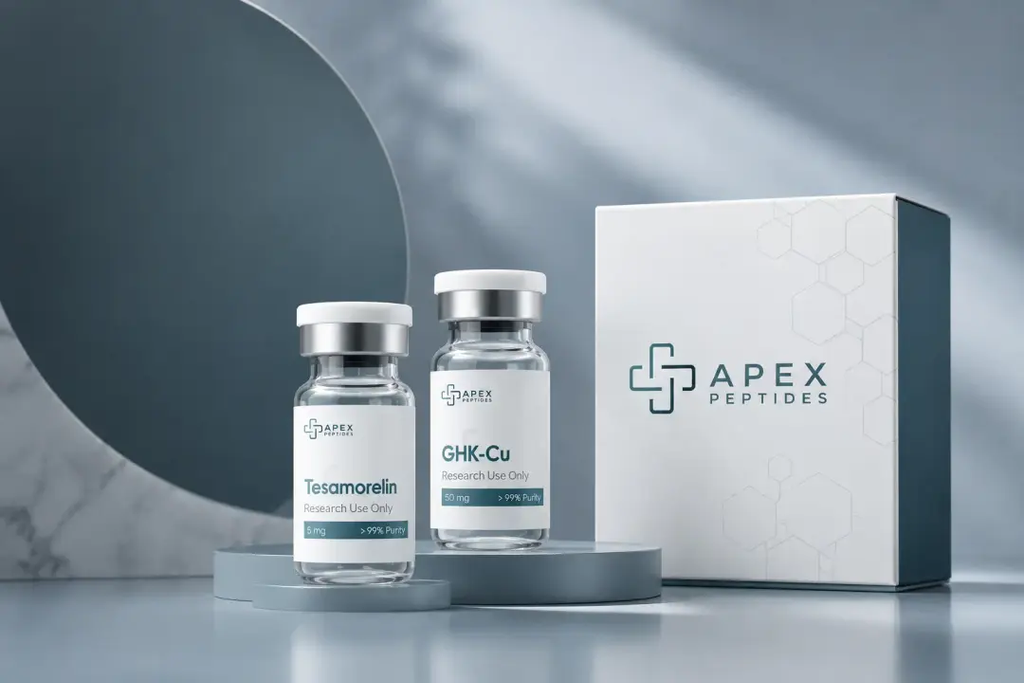
The assay ran clean in March. In April, a new vial of the same peptide went through the same protocol, and the binding curve shifted to the right. The controls were fine, and the cells came from the same passage range. The only thing that had changed was the lot number.
Most people who have worked at a peptide bench have lived through some version of this. The usual first move is to suspect technique, so they check the pipettes, remake the buffers, and a week disappears. Eventually someone looks at the label, which said 99% pure on both vials.
That number answers a narrower question than most people assume, and two lots can share it while behaving quite differently in an experiment. Knowing what the figure covers, and what else to ask a supplier for, is one of the more useful habits a lab can build when sourcing research peptides.
HPLC Purity and Net Peptide Content Are Not the Same Thing
HPLC purity is the share of the peptide material in a sample that is the target sequence. It says nothing about how much of the vial’s weight is peptide.
Lyophilized powder also contains water and counterions left from purification, most often TFA (trifluoroacetic acid) or acetate. They add weight without adding peptide. A lot can test at 99% purity and still have a noticeably lower net peptide content, and that gap can vary between lots. Weigh out the same mass from two such lots, and you have made two different concentrations without realizing it. For this reason, some suppliers report net peptide content alongside purity, and it’s worth asking for it when they don’t.
Lot-to-Lot Differences Start at Synthesis and Continue After It
Most research peptides are produced by solid-phase peptide synthesis, in which amino acids are coupled one at a time onto a chain attached to a resin. Incomplete couplings leave truncated and deletion sequences behind. Reversed-phase HPLC removes most of these, but the impurity profile still depends on how each run went, so it is rarely identical between batches.
After synthesis, methionine and cysteine can oxidize, and asparagine can deamidate during storage. A lot that tested well on the day of analysis can drift if it sat warm in transit or went through several freeze-thaw cycles.
The Details Worth Finding on a COA
A certificate of analysis is only as useful as its details, which is why suppliers like Apex Research Peptides publish batch-specific COAs. Better ones include the HPLC chromatogram rather than a percentage alone, mass spectrometry results showing observed versus expected molecular weight, the lot number, the analysis date, and the testing lab’s name. A generic document on a product page gives you nothing to check against.
The difference is easy to see side by side:
| Factors | Detailed COA | Minimal COA |
| Purity | Chromatogram included | Percentage only |
| Identity | Observed vs expected mass | Often absent |
| Traceability | Matches your lot number | Generic to the product |
| Testing lab | Named, with date | Not stated |
When the data matters to a study, some labs also send a sample to an independent analytical lab before using a new lot in critical experiments.
Storage and Record Keeping
Lyophilized peptides are best kept at -20 °C or below, dry, and out of the light. Splitting the material into aliquots on arrival means you thaw each tube only once. Filing the lot number, date received, and COA together gives you a record to go back to if results change months later.
Apex Research Peptides and the Documentation Standard
Labs looking at research peptides for sale tend to compare prices first, but a cheaper lot that behaves differently from the previous one often costs more once you factor in repeat experiments. Suppliers that build their listings around documentation make these checks easier. Apex Peptides Lab, for example, publishes batch-specific COAs with HPLC chromatograms and mass spectrometry data from MZ BioLabs, a named independent US lab, and encourages buyers to run their own third-party tests. Its catalog is sold for laboratory research only.
Even with a well-documented supplier like Apex Research Peptides, the same routine applies: match the COA to your lot and check the reported mass against the expected molecular weight. Labs that buy research peptides with this habit spend less time explaining results that don’t line up.
Questions Worth Asking
Can TFA affect an assay?
In some cases, yes. Residual TFA has been reported to interfere with certain cell-based assays, so labs running sensitive work sometimes request acetate or hydrochloride salts instead.
Is a higher purity grade always necessary?
Not always. Screening work can often use lower grades, while quantitative in vitro and receptor binding studies generally call for 95% or higher.
Should you reconstitute the whole vial at once?
Usually not. Peptides in solution tend to be less stable than lyophilized powder, so many labs reconstitute only what they need.
Before the Next Order
Net peptide content, the impurity profile, and storage history all affect what ends up in the well plate, and a detailed COA is the only practical way to see most of that before an experiment starts. Whether a lab is ordering Apex Research Peptides or working with another supplier, reading that document carefully is a small step that protects a lot of data.

