
Professional writing is often judged by small details. A report can contain excellent ideas, an email can have the right information, and a business proposal can present a strong argument, but an incorrectly used word can still make the message confusing or less polished.
English contains many words that look or sound similar but have completely different meanings. Some have related definitions, while others differ by only a single letter or syllable. These similarities make them easy to confuse, especially when writing quickly.
Knowing the difference between commonly misused words can make professional communication clearer and more precise. Whether you are writing an email, preparing a presentation, creating website content, or submitting a business document, choosing the correct word helps readers understand your intended meaning.
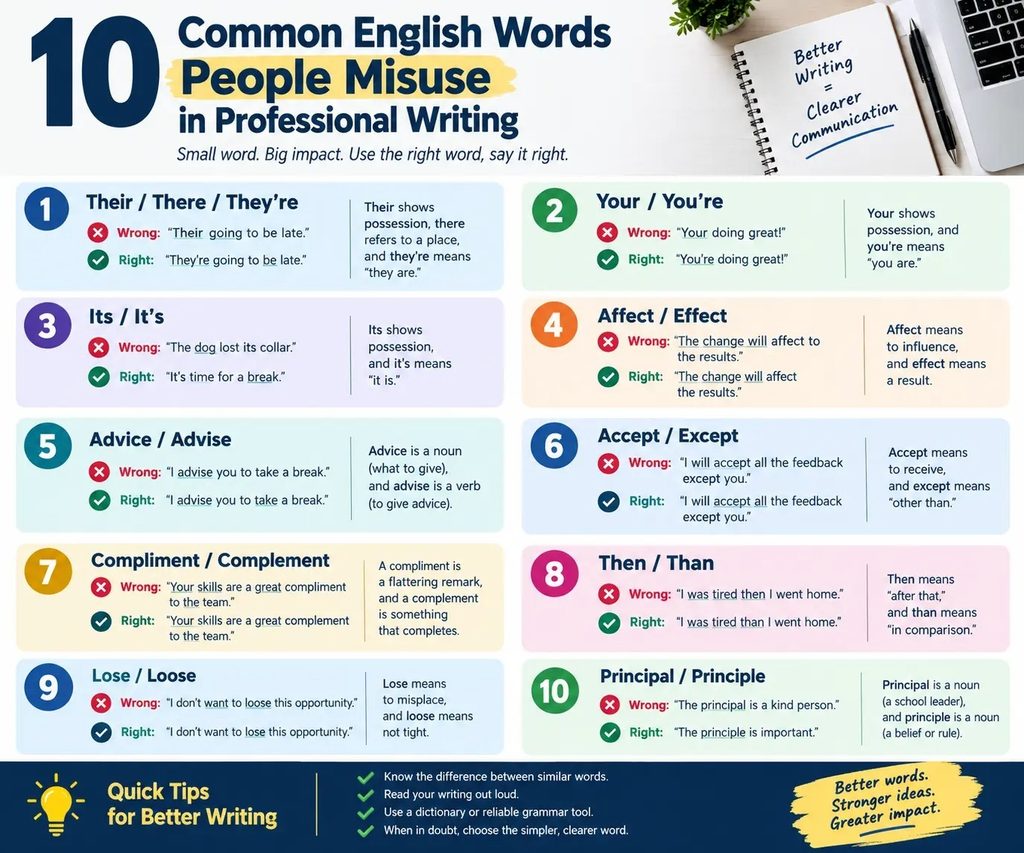
Here are ten common English word pairs that professionals should know.
1. Affect vs. Effect
Affect and effect are among the most frequently confused words in English.
In most everyday professional writing:
- Affect is usually a verb meaning to influence something.
- Effect is usually a noun referring to a result or consequence.
For example:
“The new policy may affect employee productivity.”
Here, affect means influence.
On the other hand:
“The new policy had a significant effect on employee productivity.”
Here, effect refers to the result.
A simple way to remember the distinction is to associate affect with action and effect with an end result.
There are exceptions. Effect can sometimes be used as a verb meaning to bring about something, while affect can be used as a noun in psychology. However, these specialized uses are less common in everyday business communication.
2. Advice vs. Advise
The difference between advice and advise is primarily grammatical.
Advice is a noun. It refers to a recommendation or suggestion.
“Thank you for your advice regarding the project.”
Advise is a verb. It means to give a recommendation or provide information.
“Please advise us when the project is ready.”
A useful pronunciation trick can help. Advice ends with a sound similar to “ice,” while advise ends with a sound similar to “eyes.”
Because these words are pronounced differently, saying the sentence aloud can sometimes help identify which form you need.
3. Accept vs. Except
Accept means to receive, agree to, or approve something.
“The company accepted the proposal.”
Except means excluding someone or something.
“Everyone attended the meeting except Daniel.”
The two words can sound similar in fast speech, but their meanings are very different.
A quick test is to ask whether you mean receive or agree. If you do, accept is usually the correct choice. If you mean exclude, use except.
This distinction is particularly important in contracts, instructions, policies, and business emails, where a single word can change the meaning of a sentence.
4. Complement vs. Compliment
These words differ by only one letter but have distinct meanings.
A compliment is a positive remark or expression of praise.
“The manager complimented the team on its performance.”
A complement is something that completes, improves, or works well with something else.
“The new software is a useful complement to our existing system.”
You can remember the difference by thinking of a compliment as praise and a complement as something that completes or enhances another thing.
This distinction is useful in marketing, product descriptions, business writing, and customer communication.
For example, saying that one service “compliments” another could technically suggest that someone is praising it. If you mean that the services work well together, complements is the appropriate word.
5. Principal vs. Principle
Principal and principle are another commonly confused pair.
Principal can mean the most important person or thing. In education, it can also refer to the head of a school.
“The principal reason for the delay was a supply shortage.”
Principle refers to a fundamental rule, belief, or standard.
“The organization operates according to several important principles.”
A memory trick is:
The principal is your pal.
This phrase is especially useful when remembering the school-related meaning of principal.
In professional writing, principle is commonly used when discussing ethics, company values, scientific rules, or fundamental ideas.
6. Its vs. It’s
This is one of the easiest mistakes to make, even for experienced writers.
It’s is a contraction of it is or it has.
“It’s important to review the document.”
You can test this by replacing it’s with it is:
“It is important to review the document.”
The sentence still works, so it’s is correct.
Its is a possessive form.
“The company updated its website.”
Here, its shows possession.
A common mistake is assuming that an apostrophe always indicates possession. In this case, the opposite is true: it’s indicates a contraction, while its indicates possession.
7. Then vs. Than
Then generally relates to time, sequence, or consequence.
“We completed the research and then prepared the report.”
It can also be used in conditional constructions:
“If the proposal is approved, then the team will begin implementation.”
Than is normally used when making comparisons.
“The revised process is more efficient than the previous one.”
A quick rule is:
- Then = time or sequence
- Than = comparison
Confusing the two is especially common in informal digital communication, but professional documents should use the appropriate form.
8. Fewer vs. Less
The distinction between fewer and less is related to whether you are talking about individual countable items or an amount.
Use fewer with thing
s that can generally be counted individually:
“The company received fewer applications this month.”
Use less with an amount or something considered uncountable:
“The new process requires less time.”
You can think of it this way:
Fewer = number
Less = amount
There are exceptions and special cases, but this basic distinction works well in most professional writing.
For example:
“We need fewer meetings.”
refers to the number of meetings.
Meanwhile:
“We need less meeting time.”
refers to the amount of time spent in meetings.
9. Ensure vs. Insure
Ensure and insure are sometimes used interchangeably in casual communication, but they have different standard meanings.
Ensure means to make certain that something happens.
“Please ensure that all documents are submitted before Friday.”
Insure generally refers to protecting against financial loss through insurance.
“The company decided to insure the equipment against damage.”
There is also assure, which means to give someone confidence or remove doubt.
For example:
“The manager assured the client that the issue would be resolved.”
This creates a useful three-word distinction:
- Ensure = make certain
- Insure = provide or obtain insurance
- Assure = give someone confidence
Keeping these meanings separate can make business communication much more precise.
10. Imply vs. Infer
Imply and infer describe two different sides of communication.
When a speaker or writer implies something, they communicate an idea indirectly rather than stating it explicitly.
“The report implies that additional training may be necessary.”
When a reader or listener infers something, they reach a conclusion based on the information provided.
“From the report, we can infer that additional training may be necessary.”
A useful way to remember this is:
The speaker implies; the listener infers.
This distinction is especially important in professional reports, research papers, journalism, and analytical writing.
Why Word Choice Matters in Professional Writing
Using the correct words is not simply about avoiding grammar mistakes. Precise word choice can improve the effectiveness of professional communication.
It Reduces Confusion
When words are used correctly, readers can understand the intended message without having to interpret ambiguous language.
It Improves Credibility
Consistent and accurate writing can create a more professional impression. This can be particularly important when communicating with clients, managers, employers, or business partners.
It Makes Information Easier to Understand
Clear writing reduces the amount of effort readers need to spend figuring out what a sentence means.
It Prevents Unintended Meanings
Some word mistakes are harmless, but others can change the meaning of a sentence. This matters even more in contracts, instructions, technical documents, and formal correspondence.
How to Avoid Common Word-Usage Mistakes
Memorizing every English rule isn’t necessary. Instead, develop a few practical habits.
Read Your Writing Before Sending It
A quick review can reveal obvious word-choice mistakes that are easy to miss while drafting.
Read Difficult Sentences Aloud
Hearing a sentence can make awkward or incorrect word choices more noticeable.
Use a Dictionary When You’re Unsure
Online dictionaries can provide definitions, pronunciation, grammatical information, and examples of usage.
Consider the Meaning Before the Spelling
Instead of asking, “Which spelling looks right?” ask, “What exactly am I trying to say?”
This is particularly useful with homophones and near-homophones.
Don’t Rely Completely on Automated Grammar Checkers
Writing software can identify many errors, but automated tools don’t always understand context perfectly. A word can be grammatically possible while still being inappropriate for the intended meaning.
Human review remains valuable for important documents.
Professional Writing Requires Context
Correct English isn’t only about following isolated rules. Context matters.
For example, the word principal could refer to a school administrator, a main factor, or a financial amount depending on the context. Similarly, effect can have different grammatical roles in specialized writing.
This is why writers should learn words in sentences rather than memorizing definitions alone.
When you understand how a word functions in context, you are more likely to choose the correct form naturally.
The Importance of Clear Writing in the Digital Age
Professional communication now happens across many formats. People write emails, instant messages, reports, social media posts, presentations, product descriptions, online guides, and customer-support responses.
The speed of digital communication can encourage people to write quickly without checking their wording.
This doesn’t mean every message needs to sound formal. Instead, the goal should be clear communication appropriate to the situation.
The same principle applies when people research information online. Whether someone is reading an educational article, comparing digital services, or researching a platform such as TMT Cash, understanding the language used can help them distinguish factual information from promotional claims.
Likewise, when encountering terms such as TMT Cash Casino, readers should pay attention to the exact wording of descriptions, policies, and terms rather than relying only on assumptions about what a phrase means.
Frequently Asked Questions
What are the most commonly misused English words?
Some frequently confused pairs include affect/effect, advice/advise, accept/except, complement/compliment, principal/principle, its/it’s, then/than, fewer/less, ensure/insure, and imply/infer.
Why do people confuse English words?
Many English words sound similar, look similar, or have related meanings. Others are difficult because English contains many exceptions and words borrowed from different languages.
How can I improve my professional writing?
Read your work before sending it, check unfamiliar words in a reliable dictionary, focus on meaning and context, and learn the difference between commonly confused words.
Are grammar-checking tools always accurate?
No. Grammar tools are useful for identifying potential errors, but they can misunderstand context. Important professional documents should still be reviewed by a person.
Does correct word choice really matter in business writing?
Yes. Precise word choice can make communication clearer, reduce misunderstandings, and create a more professional impression.
Conclusion
Professional writing does not require complicated vocabulary. In many situations, the strongest writing is simple, direct, and precise.
Understanding commonly misused words is one practical way to improve that precision. Knowing the difference between affect and effect, advice and advise, accept and except, and the other pairs covered here can help prevent misunderstandings and make everyday communication more effective.
The next time you write an important email, report, article, or business document, don’t focus only on spelling. Consider whether every word communicates exactly what you intend.
Clear writing starts with clear word choice.

