

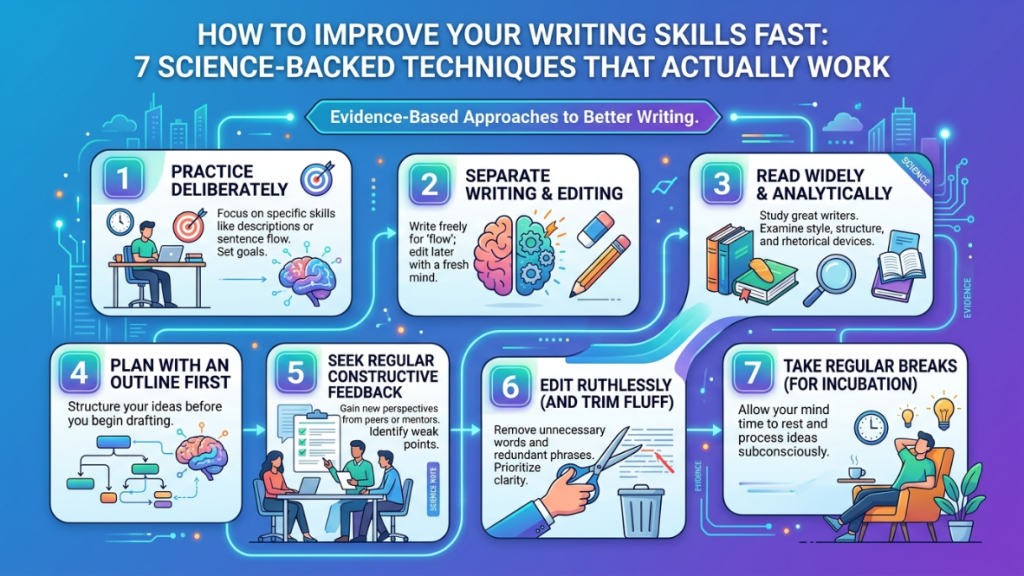
You can improve your writing skills fast by using deliberate practice, structured reading, feedback loops, and cognitive writing techniques like outlining, sentence simplification, and spaced repetition. Research shows that consistent application of these methods improves clarity, speed, and writing confidence within weeks.
Introduction
Writing is a skill that improves with the right system, not just time. Many people believe good writers are naturally talented, but research in cognitive science and education shows otherwise—writing is built through structured learning, repetition, and feedback.
Interestingly, writing skills are important even in industries beyond education. For example, platforms like TMTCash rely heavily on clear communication, structured content, and user-friendly messaging to engage users in digital environments.
In this article, we will explore 7 science-backed techniques that can help you improve your writing skills fast, whether you’re a student, blogger, or professional.
1. Deliberate Practice (Not Just Writing More)
One of the strongest findings in learning science is that improvement comes from deliberate practice, not random repetition.
What it means:
- Focus on one skill at a time
- Set specific goals
- Get feedback immediately
- Repeat and refine
How to apply it:
Instead of writing full articles every day, focus on micro-skills:
- Sentence clarity
- Paragraph structure
- Transitions
Exercise:
Rewrite the same paragraph 3 times:
- Simple version
- Clear version
- Engaging version
This builds writing fluency quickly and effectively.
2. Read Like a Writer, Not a Consumer
Reading improves writing only when done actively. Cognitive research shows that analyzing text patterns improves your ability to reproduce them.
What to focus on:
- Sentence structure
- Word choice
- Flow between ideas
- Tone and clarity
Method:
Ask yourself:
- Why is this sentence effective?
- How does the writer transition ideas?
- What makes the introduction engaging?
3. Use the “One Idea Per Sentence” Rule
Cognitive load theory proves that readers process information better when ideas are simplified.
Example (Bad):
“The company improved performance, reduced costs, and increased satisfaction while expanding globally.”
Example (Better):
“The company improved performance. It reduced costs and increased satisfaction. It also expanded globally.”
Why it works:
- Easier to read
- Faster comprehension
- Cleaner structure
4. Build Vocabulary Using Spaced Repetition
Strong vocabulary improves clarity and precision.
Science insight:
Spaced repetition strengthens long-term memory retention.
How to apply:
- Learn 5–10 words daily
- Review after 1, 3, 7, and 14 days
- Use each word in a sentence
5. Reverse Editing Technique
This technique helps remove unnecessary words and improve clarity.
Steps:
- Write a paragraph quickly
- Break it into core ideas
- Rebuild each sentence in a clearer form
Example:
Original: “There are many reasons why writing is important in communication today.”
Improved: “Writing is essential in modern communication.”
6. Structured Outlining Before Writing
Planning improves writing quality and reduces cognitive overload.
Simple outline:
- Main idea
- Supporting points
- Example
- Conclusion
Why it works:
Outlining activates structured thinking before writing begins, leading to faster and clearer output.
7. Get Feedback and Improve Iteratively
Feedback is one of the fastest ways to improve writing skills.
Sources of feedback:
- Grammar tools
- Writing communities
- Peer reviews
Improvement loop:
Write → Get feedback → Revise → Repeat
Bonus Tip: Write Daily, Even for 10 Minutes
Consistency builds fluency. Even short daily writing sessions improve:
- Sentence formation speed
- Confidence
- Writing flow
How Writing Connects to Real-World Digital Platforms
Strong writing skills are essential across industries, especially in digital platforms like TMTCash Casino, where communication clarity, structured messaging, and user experience content play a key role in engagement and trust-building.
Clear writing is not just academic—it is a real-world skill that affects marketing, UX writing, and digital communication.
Common Mistakes to Avoid
- Writing without planning
- Ignoring feedback
- Using overly complex sentences
- Not revising drafts
- Waiting for inspiration
FAQ: Improving Writing Skills Fast
How long does it take to improve writing skills?
Most people see improvement in 2–4 weeks with consistent practice.
What is the fastest way to improve writing?
Use deliberate practice, structured outlining, and daily writing exercises.
Does reading help writing skills?
Yes, especially when you actively analyze sentence structure and style.
Can anyone become a good writer?
Yes. Writing is a learnable skill, not a talent-only ability.
Conclusion
Improving your writing skills fast is completely achievable when you use structured, science-backed techniques instead of random practice.
By applying deliberate practice, structured reading, feedback loops, and consistent writing habits, you can significantly improve clarity, speed, and confidence in just a few weeks.
Start small, stay consistent, and focus on improvement—not perfection.

