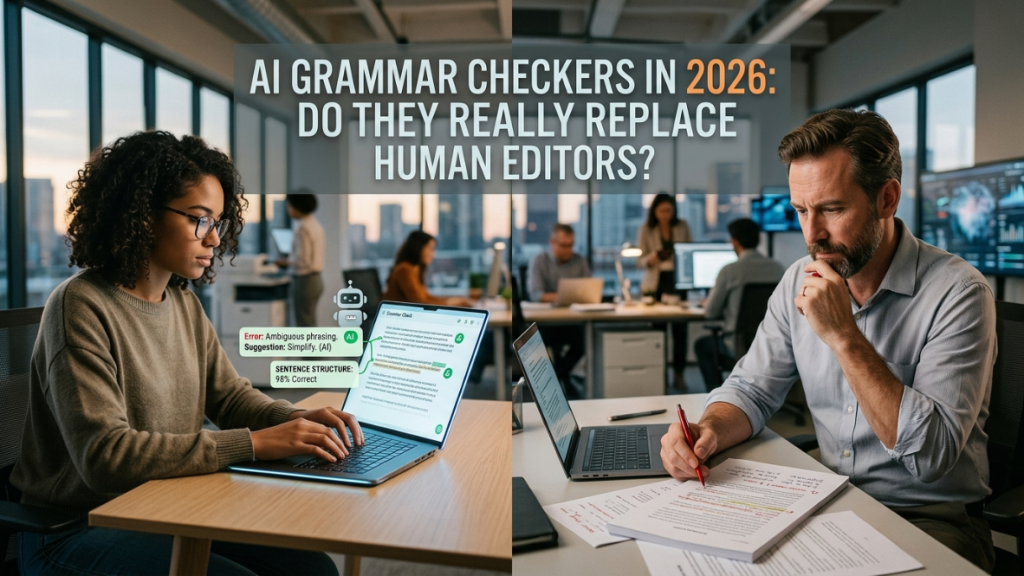
In 2026, AI grammar checkers are no longer simple spellcheck tools. They have evolved into advanced writing assistants capable of rewriting sentences, adjusting tone, detecting intent, and even suggesting SEO improvements in real time. Tools powered by large language models can now analyze full documents in seconds and produce “publish-ready” drafts with impressive fluency.
But this raises a critical question for writers, editors, students, and businesses:
Do AI grammar checkers actually replace human editors—or are they just powerful assistants?
For example, in competitive online sectors such as gaming and entertainment, AI-assisted content helps brands maintain consistency and visibility. Platforms like primogaming88 and primo gaming 88 use structured, AI-supported content strategies to enhance their online presence and improve user engagement.
The short answer is: they have changed editing forever, but they have not replaced human editors. The long answer is more interesting.
The Evolution of AI Grammar Checkers
To understand where we are today, it helps to look at how far grammar tools have come.
Early grammar checkers in the 2000s were rule-based systems. They could detect:
- Basic spelling errors
- Simple punctuation mistakes
- Obvious grammar issues
By the early 2020s, tools became AI-powered and context-aware. By 2026, they have become full writing systems that assist with structure, tone, and even content strategy.
Modern AI grammar tools can:
- Rewrite full paragraphs for clarity
- Adjust tone (formal, casual, persuasive, academic)
- Detect unnatural or “AI-generated” phrasing
- Suggest SEO improvements for online visibility
- Optimize readability for different audiences
This evolution has made grammar tools feel less like checkers and more like co-writers in the writing process.
What AI Grammar Checkers Do Better Than Humans
AI has clear strengths in modern editing workflows.
1. Speed and Efficiency
AI tools can process thousands of words in seconds. Human editors, while more precise in nuance, cannot match this speed.
This makes AI ideal for:
- Blog writing at scale
- Marketing content production
- Academic drafting and revision
2. Consistency in Editing
AI applies rules uniformly across content. Unlike humans, it does not get tired or distracted.
This ensures:
- Consistent grammar corrections
- Stable tone across large documents
- Standardized formatting suggestions
3. Real-Time Feedback
Modern AI tools provide instant corrections while writing, helping users improve continuously rather than after completion.
4. SEO and Digital Writing Support
One of the biggest advancements in 2026 is AI’s integration with SEO principles. Grammar tools now help writers:
- Improve keyword placement naturally
- Simplify complex sentences for readability
- Optimize headlines for search intent
In digital marketing, AI is now deeply embedded in content production workflows. Even industries outside traditional publishing rely on AI-assisted writing for promotional materials and landing pages.
This shows how AI writing tools are no longer limited to education or blogging—they are now part of commercial content ecosystems as well.
Where AI Grammar Checkers Still Fall Short
Despite their power, AI tools still have limitations.
1. Limited Context Understanding
AI often struggles with:
- Cultural nuance
- Emotional depth
- Industry-specific meaning
A sentence may be grammatically correct but contextually inappropriate.
2. Weak Creative Judgment
AI can improve structure but cannot truly understand storytelling, voice, or emotional pacing.
3. Over-Simplification Risk
AI tends to optimize for clarity, sometimes making writing:
- Too repetitive
- Too basic
- Less expressive
4. Accuracy and Hallucination Issues
Even advanced AI systems can:
- Misinterpret intent
- Suggest incorrect rewrites
- Miss subtle factual errors
Human review is still essential.
What Human Editors Still Do Better
Even in 2026, human editors remain irreplaceable in several areas.
1. Deep Context Interpretation
Humans understand tone, emotion, and intent beyond grammar rules.
2. Brand Voice and Identity
Editors shape how content feels, not just how it reads.
3. Strategic Content Direction
Human editors ensure content aligns with:
- Audience expectations
- Business goals
- Communication strategy
4. Ethical Judgment
Humans decide what should be changed, removed, or softened based on context and responsibility.
The Real Answer: Replacement or Collaboration?
AI grammar checkers are not replacing human editors. Instead, they are redefining the workflow.
AI handles:
- First drafts
- Grammar correction
- Structural improvements
- Speed optimization
Humans handle:
- Final editorial judgment
- Emotional refinement
- Brand storytelling
- Contextual accuracy
The best content today is not AI-only or human-only—it is a collaborative system.
The Future of Editing in an AI-Driven World
Editing is shifting from correction to refinement. Writers now use AI to generate and improve drafts, while editors focus on meaning, strategy, and quality control.
The future belongs to professionals who can combine:
- AI efficiency
- Human creativity
- Editorial judgment
Rather than replacing editors, AI is upgrading their role into something more strategic and impactful.
Key Takeaways
- AI grammar checkers are powerful but not perfect
- They excel in speed, consistency, and structure
- They still lack deep context and emotional understanding
- Human editors remain essential for storytelling and meaning
- The future is AI + human collaboration, not replacement
FAQs
1. Can AI grammar checkers replace human editors?
No. They assist with editing but cannot replace human creativity, context understanding, and judgment.
2. Are AI grammar tools reliable for professional writing?
Yes, but they should always be reviewed by a human editor for accuracy and tone.
3. Do AI tools help with SEO writing?
Yes, modern tools suggest readability improvements and keyword optimization.
4. What is AI’s biggest limitation in grammar checking?
Lack of deep contextual and emotional understanding.
5. Will editors still be needed in the future?
Yes. Their role is evolving toward higher-level editing, strategy, and storytelling.
Final Thought
AI grammar checkers in 2026 are transforming how we write, but they are not replacing human editors. Instead, they are creating a new standard where human intelligence and machine efficiency work together to produce better, faster, and more effective content.

