

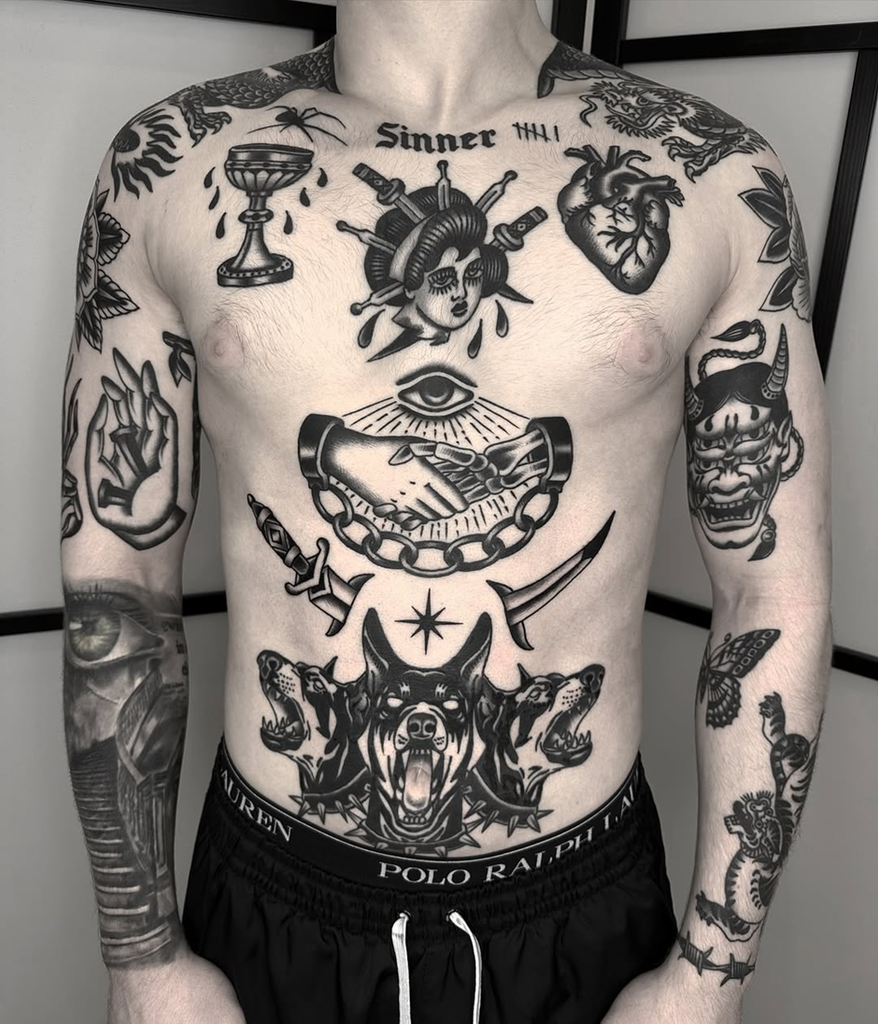
Fashion trends come and go every season, but some ideas stick because they match how people actually live. Patchwork tattoos are one of them. Instead of one large, carefully planned sleeve, a patchwork sleeve is built from many small, separate tattoos placed close together, often in different styles and collected over years. The result looks like a well-loved denim jacket covered in patches: personal, a little eclectic, and impossible to copy.
What makes a patchwork tattoo different
Traditional sleeves are designed as a single composition, with background shading, wind bars, or flowing elements that tie everything together. Patchwork sleeves skip the filler. Each piece stands on its own, with a bit of bare skin around it, so the arm reads as a collection rather than a mural.
That approach has real advantages:
- No huge upfront commitment. You can start with one small piece and add more as your budget and taste allow.
- Room for different artists. Many collectors pick up pieces from artists they admire while traveling.
- Every tattoo has a story. The sleeve becomes a scrapbook of places, people and phases of life.
Why it fits the way we dress now
Patchwork tattoos mirror what’s happening in fashion more broadly: thrifted pieces mixed with designer basics, upcycled garments, visible mending, and outfits built from personal finds instead of head-to-toe looks. The same mix-and-match spirit shows up on skin. A patchwork sleeve pairs naturally with rolled-up sleeves, vintage tees and minimalist jewelry, and it looks intentional even when the individual tattoos are tiny.
Styles that look great together
Patchwork doesn’t mean random. The best sleeves usually share one unifying element:
- Color palette: all black-and-grey, or a limited set of traditional colors such as red, yellow and green.
- Line weight: bold outlines throughout, or fine line throughout. Mixing both can look messy.
- Theme: travel souvenirs, flash classics, botanical pieces, or nostalgic objects.
American traditional flash is the classic choice because bold lines and solid color hold up for decades and read clearly at a small size. Fine lines and micro-realism create a softer, more delicate patchwork, but they need more space between pieces to avoid blurring as they age.
Placement and planning tips
- Start near the elbow or forearm and work outward. It’s easier to fill the gaps later.
- Leave consistent spacing. About a finger’s width between pieces keeps the sleeve looking deliberate.
- Vary the sizes. Mix a few larger anchor pieces with smaller fillers like stars, hearts, or dots.
- Think about orientation. Decide whether designs face you or face the world.
If you’re considering one, this guide to patchwork tattoos covers the history of the style, sleeve layouts, and dozens of design ideas, and it’s a useful thing to bring to your first consultation.
Styling a patchwork sleeve
Because a patchwork sleeve has so much visual variety, it pairs best with simple clothing: plain white or black tees, crisp button-downs with rolled cuffs, and neutral knits. Keep accessories minimal, with a slim watch, a single chain, or a classic ring, so the tattoos stay the focal point.
The verdict
Patchwork sleeves aren’t a passing aesthetic. They’re a smarter way to collect tattoos: flexible, affordable over time, and full of meaning. Like the best wardrobes, they’re built one great piece at a time.

